Journal of Jilin University(Medicine Edition) ›› 2025, Vol. 51 ›› Issue (6): 1717-1727.doi: 10.13481/j.1671-587X.20250629
• Methodology • Previous Articles
Prokaryotic expression, purification of coxsackievirus A16 Vp1 protein and preparation of rabbit polyclonal antibodies
Jianing WANG1,2,Yongjuan LIU3,Kaikai RAN4,Binlian SUN1,2,Yingying SHI1,2( )
)
- 1.Hubei Provincial Key Laboratory of Cognitive and Affective Disorders,Jianghan University,Wuhan 430056,China
2.Department of Immunology,School of Basic Medical Sciences,Jianghan University,Wuhan 430056,China
3.Central Laboratory,Affiliated First People’s Hospital,Lianyungang City,Xuzhou Medical University,Lianyungang 222002,China
4.Wuhan Mabnus Biotechnology Co. Ltd. ,Wuhan 430206,China
-
Received:2024-11-25Accepted:2025-01-16Online:2025-11-28Published:2025-12-15 -
Contact:Yingying SHI E-mail:shiyingyinga@126.com

CLC Number:
- R373.2
Cite this article
Jianing WANG,Yongjuan LIU,Kaikai RAN,Binlian SUN,Yingying SHI. Prokaryotic expression, purification of coxsackievirus A16 Vp1 protein and preparation of rabbit polyclonal antibodies[J].Journal of Jilin University(Medicine Edition), 2025, 51(6): 1717-1727.
share this article
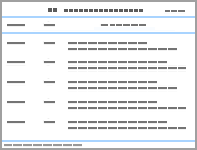
Tab.1
Analysis of amino acid composition of Vp1"
| Amino acid | Number[n (η/%)] | Amino acid | Number[n (η/%)] |
|---|---|---|---|
| Alanine (A) | 23(7.7) | Leucine (L) | 20(6.7) |
| Arginine (R) | 15(5.1) | Lysine (K) | 11(3.7) |
| Asparagine (N) | 19(6.4) | Methionine (M) | 10(3.4) |
| Aspartic acid (D) | 15(5.1) | Phenylalanine (F) | 13(4.4) |
| Cysteine (C) | 4(1.3) | Proline (P) | 22(7.4) |
| Glutamine (Q) | 15(5.1) | Serine (S) | 20(6.7) |
| Glutamic acid (E) | 9(3.0) | Threonine (T) | 30(10.1) |
| Glycine (G) | 17(5.7) | Tryptophan (W) | 4(1.3) |
| Histidine (H) | 6(2.0) | Tyrosine (Y) | 12(4.0) |
| Isoleucine (I) | 13(4.4) | Valine (V) | 19(6.4) |
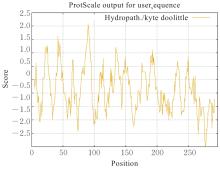
Fig. 1
Hydrophilic/hydrophobic analysis of Vp1 protein"
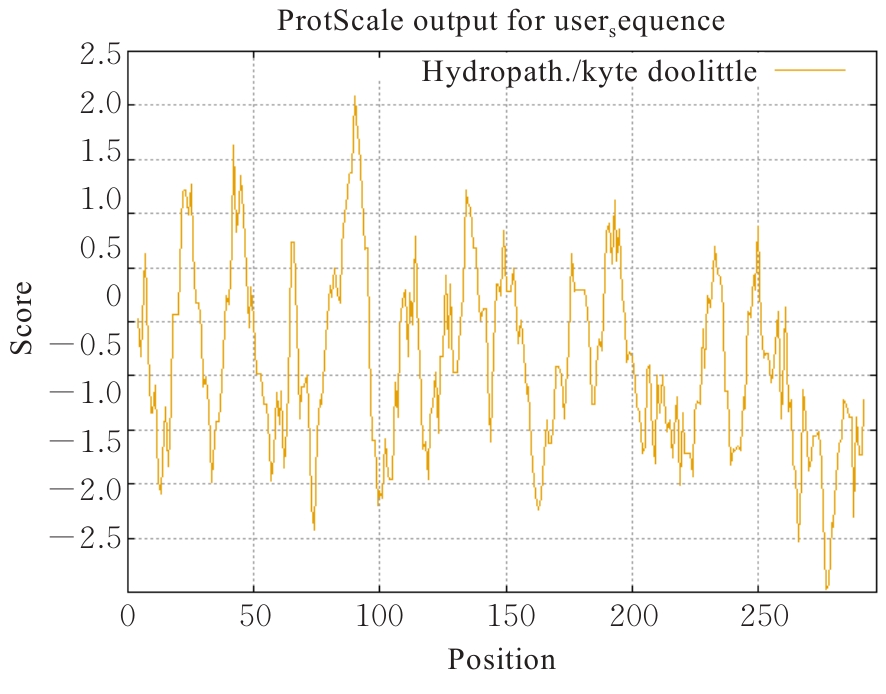
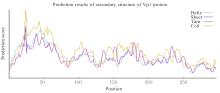
Fig. 2
Secondary structures of Vp1 protein"
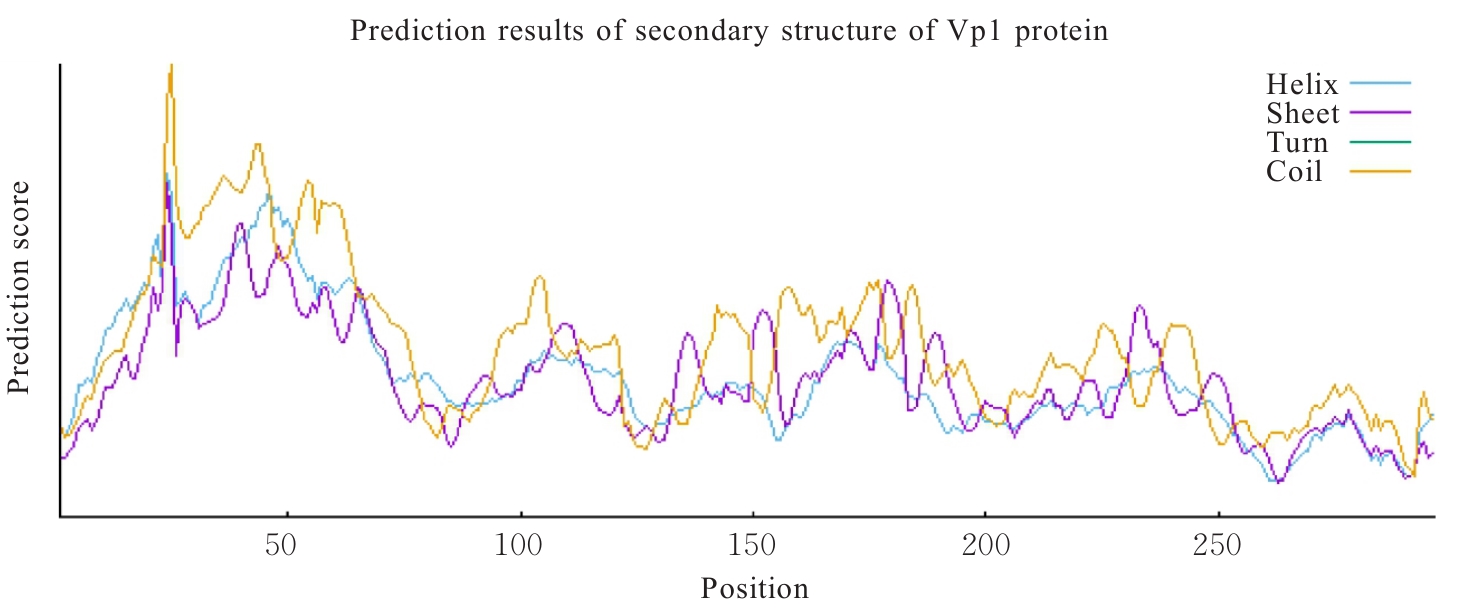
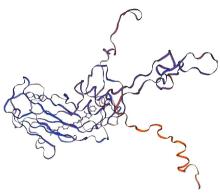
Fig. 3
Tertiary structures of Vp1 protein"
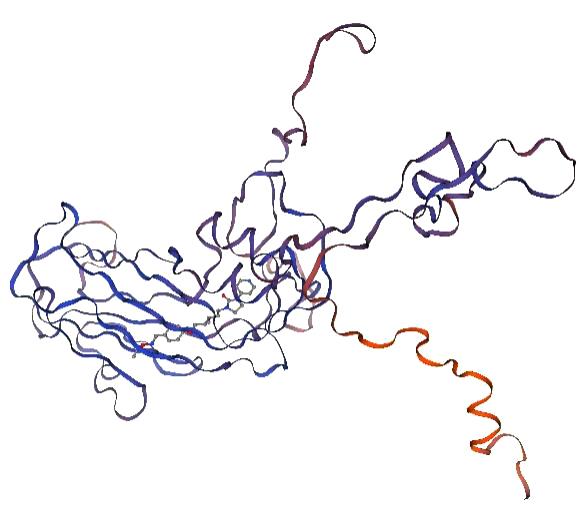
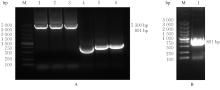
Fig. 4
Gel electrophoregram of PCR products of Vp1 gene and linearized plasmids"
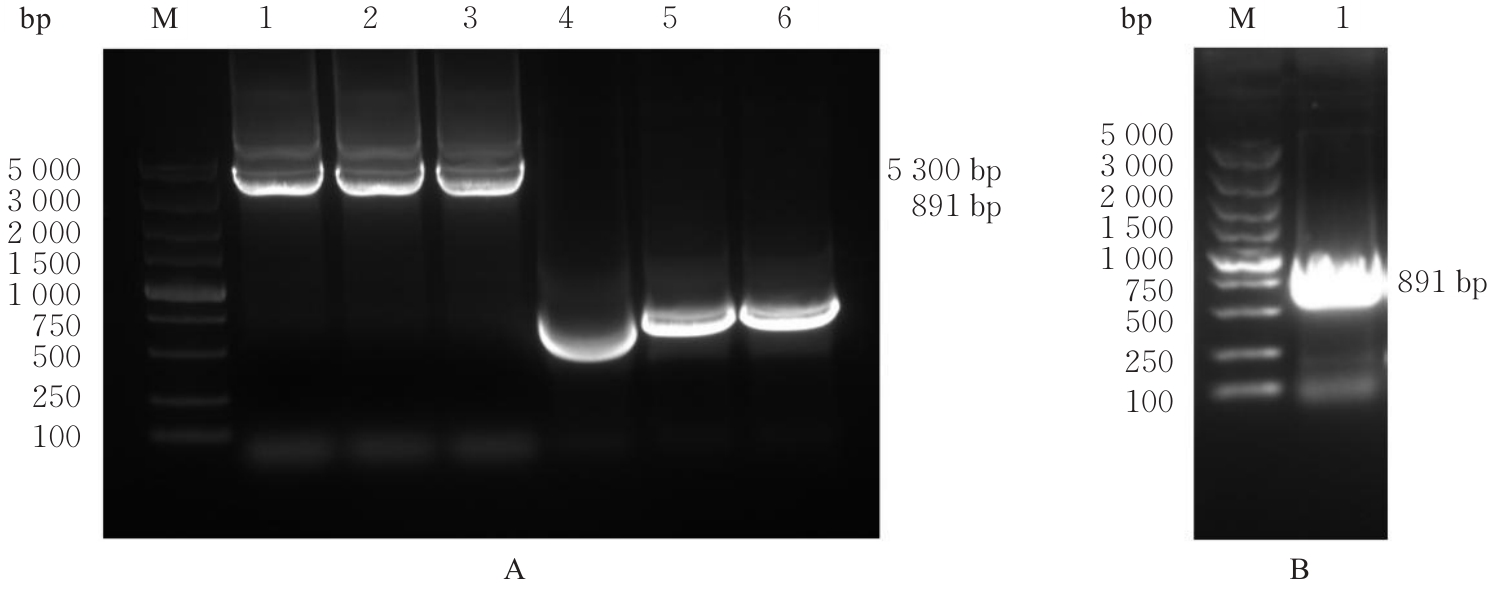
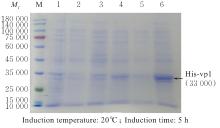
Fig. 5
Coomassie bright blue staining results of recombinant Vp1 protein induced expression"
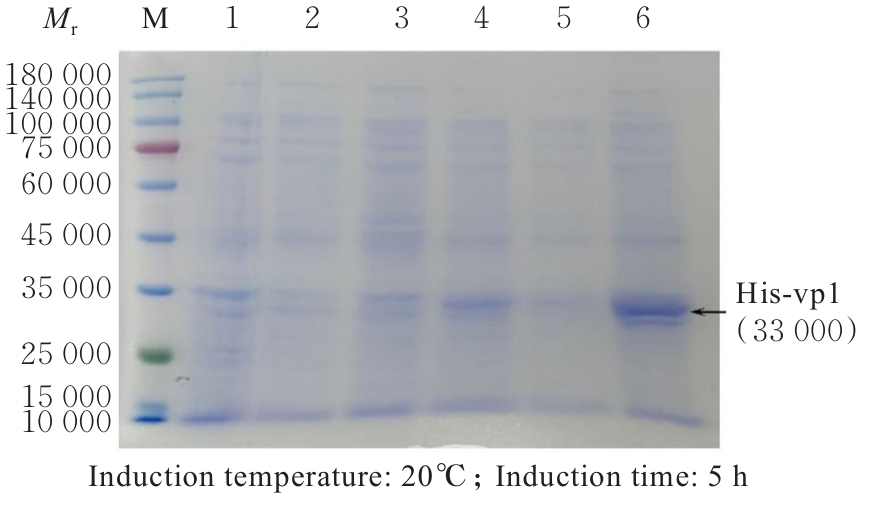
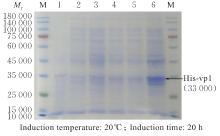
Fig. 6
Coomassie bright blue staining results of expression time optimization induced by recombinant Vp1 protein"
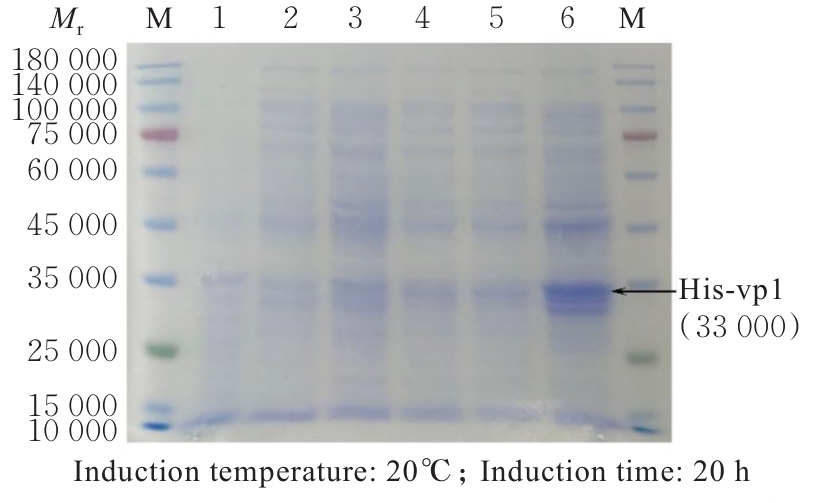
Fig. 7
Coomassie bright blue staining results of expression temperature optimization induced by recombinant Vp1 protein"
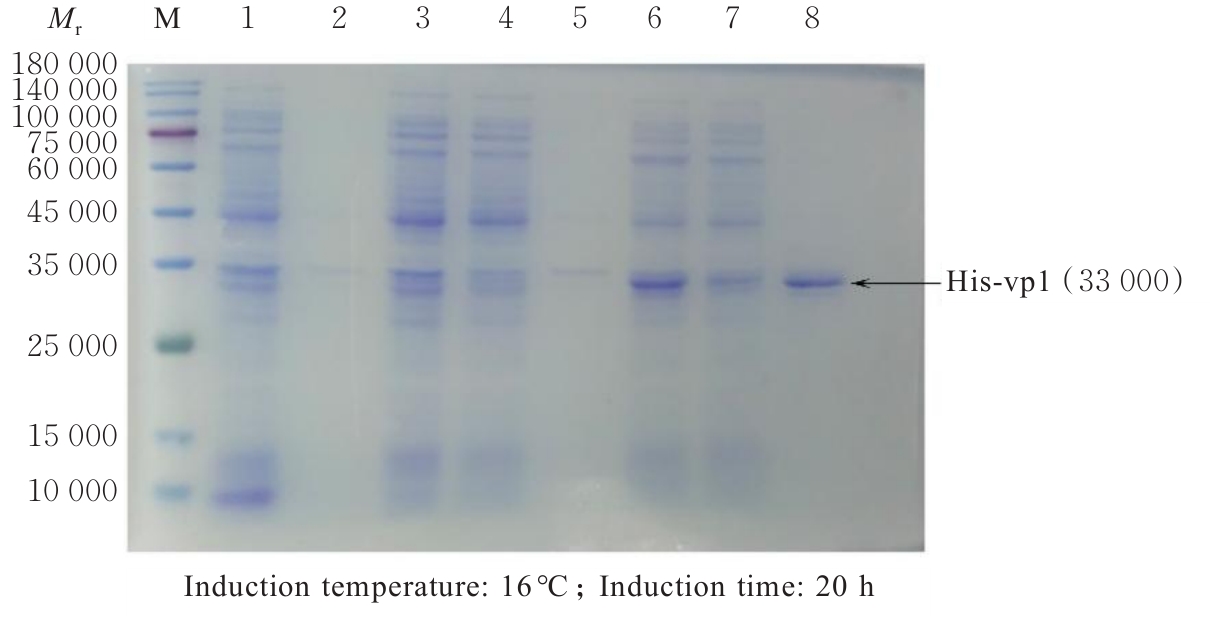
Fig. 8
Expression induced by recombinant Vp1 protein identified by Coomassie bright blue staining(A) and Western blotting method(B)"
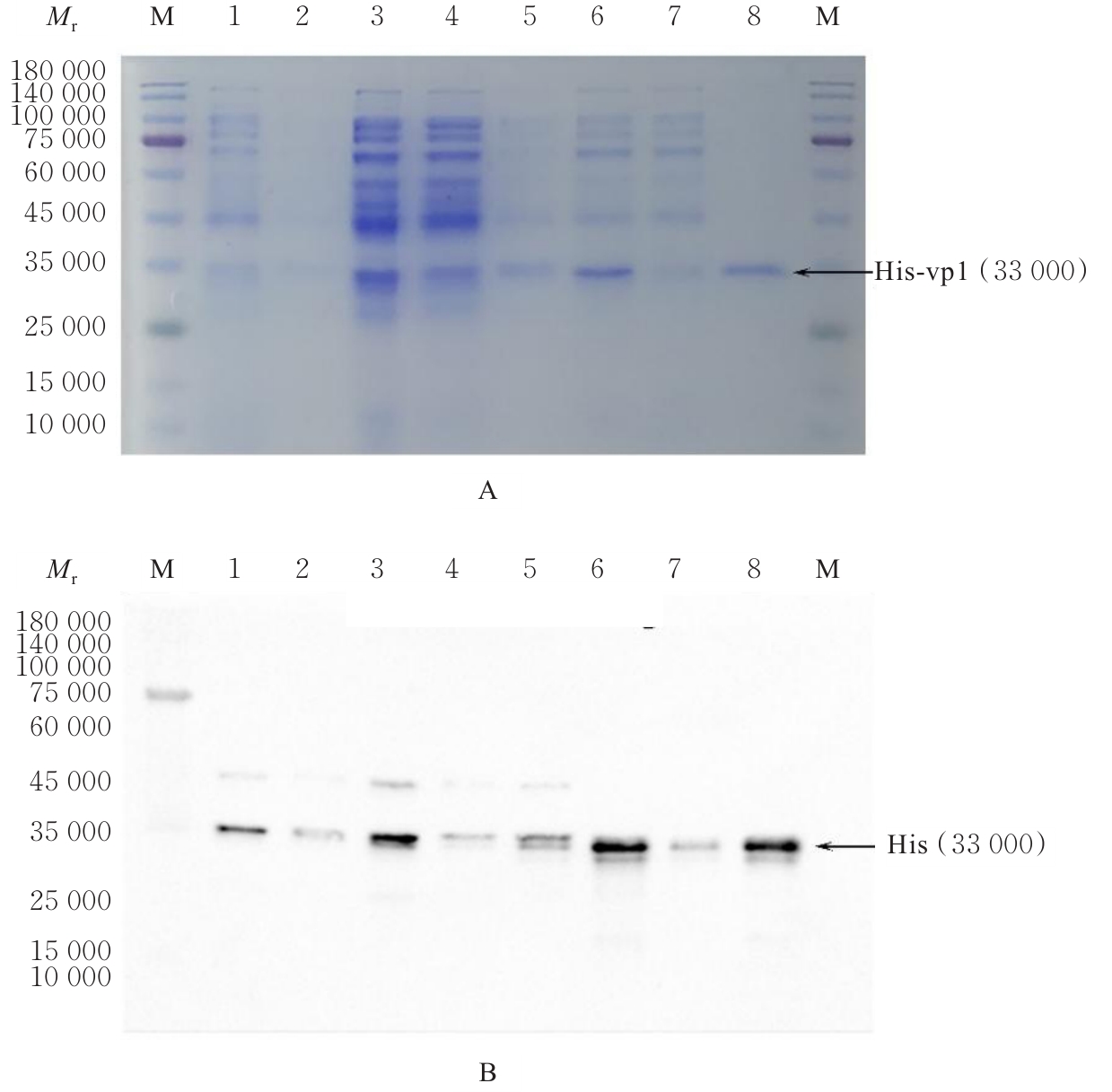
Fig. 9
Expression of recombinant Vp1 protein identified by Coomassie bright blue staining(A) and Western blotting method(B)"
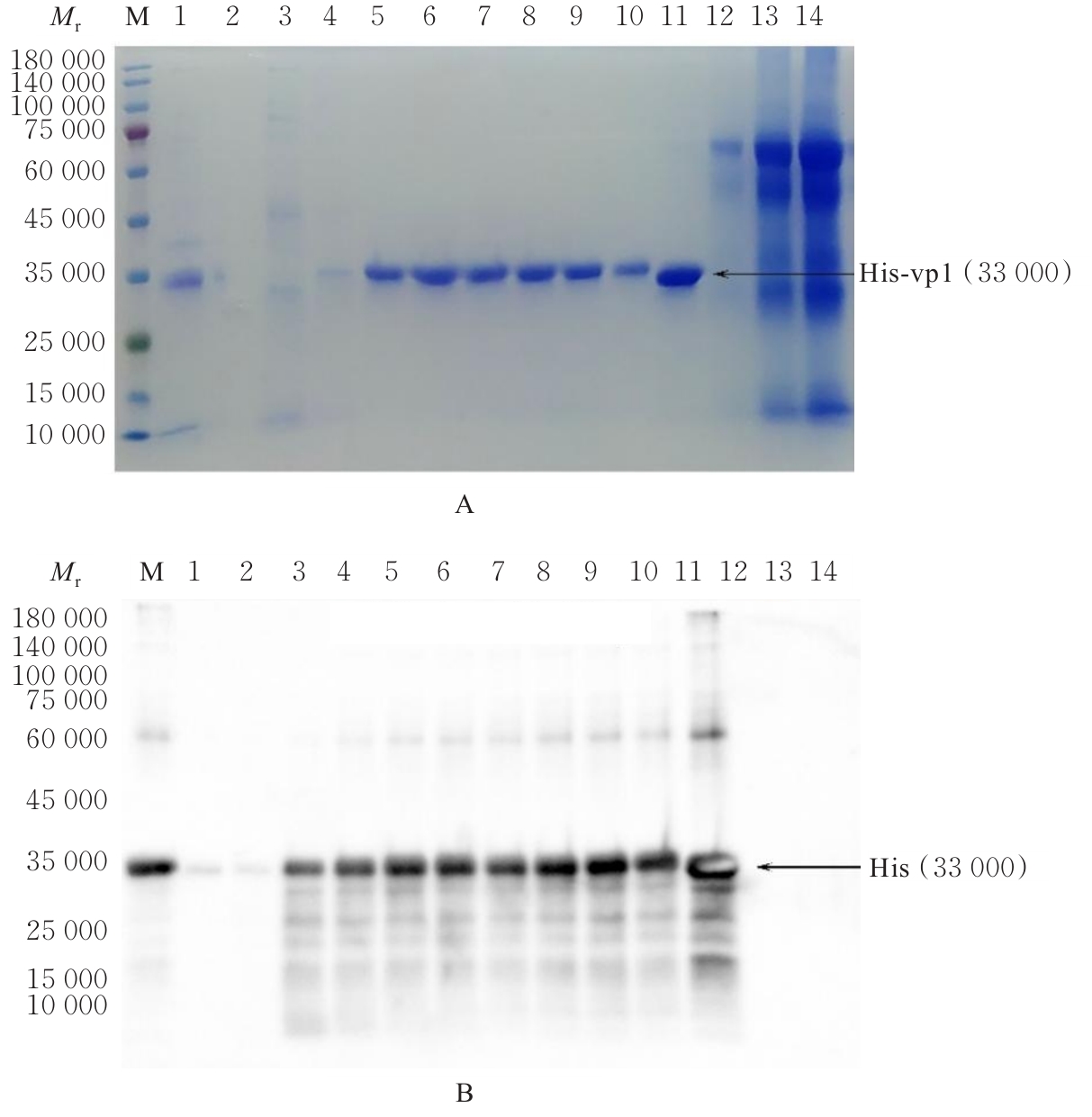
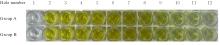
Fig. 10
Titer of rabbit polyclonal antibody detected ELISA method"
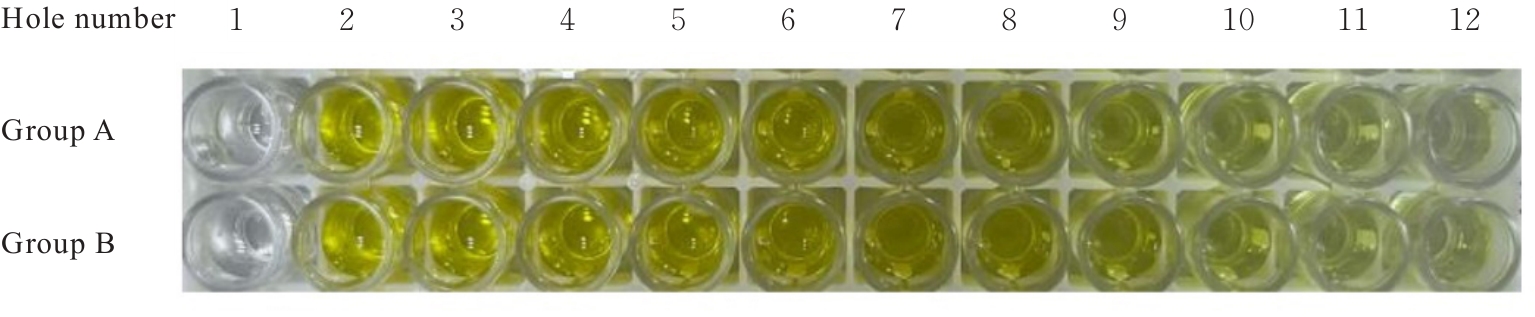
Tab.2
Titers of rabbit polyclonal antibodies"
| Group | Titer of rabbit polycolonal antibody | |||||||||||
|---|---|---|---|---|---|---|---|---|---|---|---|---|
| Control | 1 000 | 2 000 | 4 000 | 8 000 | 16 000 | 32 000 | 64 000 | 128 000 | 256 000 | 512 000 | 1 024 000 | |
| Group A | 0.091 | 2.025 | 2.002 | 1.937 | 1.847 | 1.728 | 1.438 | 1.186 | 0.819 | 0.538 | 0.413 | 0.237 |
| Group B | 0.069 | 2.064 | 1.995 | 1.972 | 1.968 | 1.804 | 1.614 | 1.366 | 1.036 | 0.696 | 0.443 | 0.378 |
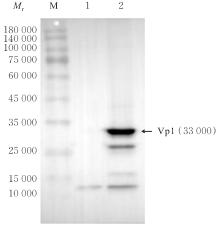
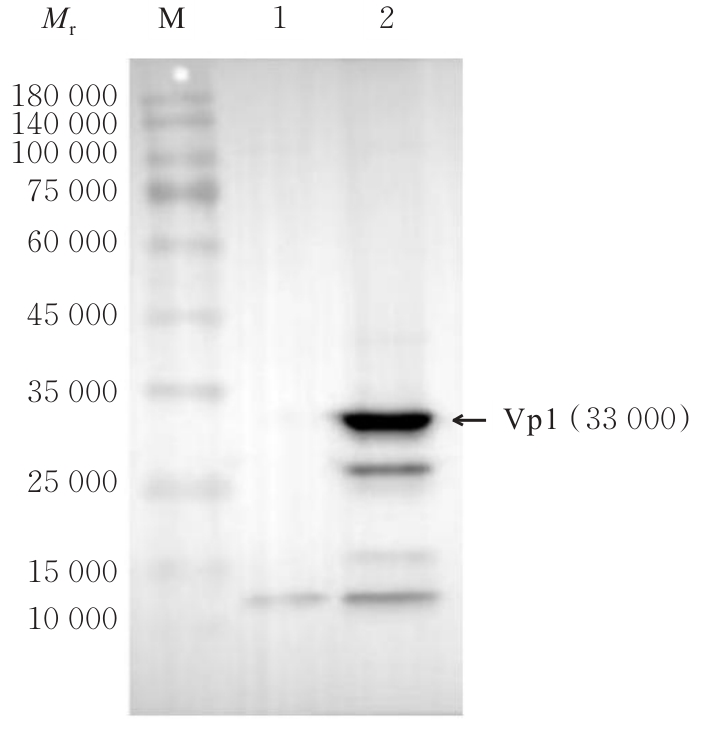
Fig. 11
Rabbit anti-Vp1 protein polyclonal antibodies detected by Western blotting method"
| [1] | ZHANG C, LIU C X, SHI J P, et al. Molecular mechanism of antibody neutralization of coxsackievirus A16[J]. Nat Commun, 2022, 13(1): 7854. |
| [2] | REN J S, WANG X X, ZHU L, et al. Structures of coxsackievirus A16 capsids with native antigenicity: implications for particle expansion, receptor binding, and immunogenicity[J]. J Virol, 2015, 89(20): 10500-10511. |
| [3] | LEGAY F, LÉVÊQUE N, GACOUIN A, et al. Fatal coxsackievirus A-16 pneumonitis in adult[J]. Emerg Infect Dis, 2007, 13(7): 1084-1086. |
| [4] | GOTO K, SANEFUJI M, KUSUHARA K, et al. Rhombencephalitis and coxsackievirus A16[J]. Emerg Infect Dis, 2009, 15(10): 1689-1691. |
| [5] | ASTRUP B S, JOHNSEN I B G, ENGSBRO A L. The role of Coxsackievirus A16 in a case of sudden unexplained death in an infant-A SUDI case[J]. Forensic Sci Int, 2016, 259: e9-13. |
| [6] | LIANG Z C, LIN C Y, HUO D, et al. First detection of multiple cases related to CV-A16 strain of B1c clade in Beijing in 2022[J]. J Med Virol, 2024, 96(7): e29796. |
| [7] | DIWATE S, YADAV P D, YADAV J, et al. Enterovirus Coxsackie A16 detected in hand, foot, and mouth disease outbreak among children in western Uttar pradesh, India, may to June 2022[J]. Asia Pac J Public Health, 2024, 36(1): 143-145. |
| [8] | NOISUMDAENG P, PUTHAVATHANA P. Molecular evolutionary dynamics of enterovirus A71, coxsackievirus A16 and coxsackievirus A6 causing hand, foot and mouth disease in Thailand, 2000-2022[J]. Sci Rep, 2023, 13(1): 17359. |
| [9] | LI R Q, LIN C Y, DONG S B, et al. Phylogenetics and phylogeographic characteristics of coxsackievirus A16 in hand foot and mouth disease and herpangina cases collected in Beijing, China from 2019 to 2021[J]. J Med Virol, 2023, 95(8): e28991. |
| [10] | YUAN X L, LIU Z W, WAN L, et al. Recent advances in anti-coxsackievirus A16 viral drug research[J]. Future Med Chem, 2023, 15(1): 97-117. |
| [11] | YANG D D, LIU W M, WANG W P, et al. Analysis of the impact of inactivated A71 vaccine on the incidence of hand-foot-mouth disease in Pudong new area, Shanghai[J]. Vaccines, 2024, 12(9): 962. |
| [12] | TAN X H, CHONG W L, LEE V S, et al. Substitution of coxsackievirus A16 VP1 BC and EF loop altered the protective immune responses in chimera enterovirus A71[J]. Vaccines, 2023, 11(8): 1363. |
| [13] | YI E J, KIM Y I, KIM S Y, et al. A bivalent inactivated vaccine prevents enterovirus 71 and coxsackievirus A16 infections in the Mongolian gerbil[J]. Biomol Ther, 2023, 31(3): 350-358. |
| [14] | YI E J, KIM Y I, SONG J H, et al. Potential of a bivalent vaccine for broad protection against enterovirus 71 and Coxsackie virus 16 infections causing hand, foot, and mouth disease[J]. Vaccine, 2023, 41(41): 6055-6063. |
| [15] | ZHANG G B, HU B, HUO Y Q, et al. Amino acid substitutions in VP2, VP1, and 2C attenuate a Coxsackievirus A16 in mice[J]. Microb Pathog, 2021, 150: 104603. |
| [16] | ZHAO Z L, LI Z L, HUAN C, et al. SAMHD1 inhibits multiple enteroviruses by interfering with the interaction between VP1 and VP2 proteins[J]. J Virol, 2021, 95(13): e00620-21. |
| [17] | DE COLIBUS L, WANG X X, TIJSMA A, et al. Structure elucidation of coxsackievirus A16 in complex with GPP3 informs a systematic review of highly potent capsid binders to enteroviruses[J]. PLoS Pathog, 2015, 11(10): e1005165. |
| [18] | 宋亚荣, 王 杰, 李 杰. HBV母婴传播的分子病毒学机制[J]. 临床肝胆病杂志, 2024, 40(11): 2168-2172. |
| [19] | 刘希佳, 何小华, 刘万红. 一种新的柯萨奇病毒A组16型中国湖北分离株(CV-A16WH16)全基因组序列测定及分析[J]. 中国病毒病杂志, 2015, 5(2): 96-103. |
| [20] | MA Z L, ZHA J. Characterization of VP1 gene of coxsackievirus A16 prevalent among hand foot mouth disease suffered children in Taizhou, P. R. China, between 2010 and 2013[J]. J Med Virol, 2016, 88(2): 202-210. |
| [21] | 赵言龙, 郑浩然. 基于代谢分析的SARS-CoV-2药物靶点预测方法[J]. 中国医学物理学杂志, 2023, 40(11): 1433-1440. |
| [22] | 张彩霞, 叶黎文, 黄春艳. 病原体靶向测序技术在疑似肺部感染患者中的应用价值分析[J]. 解放军医学杂志, 2024, 49(9): 1022-1028. |
| [23] | SHI J P, HUANG X L, LIU Q W, et al. Identification of conserved neutralizing linear epitopes within the VP1 protein of coxsackievirus A16[J]. Vaccine, 2013, 31(17): 2130-2136. |
| [24] | POROWIŃSKA D, WUJAK M, ROSZEK K, et al. Prokaryotic expression systems[J]. Postepy Hig Med Dosw, 2013, 67: 119-129. |
| [25] | MURAKAMI M, MURAKAMI A M, ITAGAKI S. A dual prokaryotic (E.coli) expression system (pdMAX)[J]. PLoS One, 2021, 16(10): e0258553. |
| [26] | 李 丹, 宋浩志, 高维崧, 等. 小反刍兽疫病毒H蛋白的原核表达及免疫原性测定[J]. 生物技术进展, 2021, 11(6): 770-776. |
| [27] | 张喜文, 鲁绍芳, 李盼盼, 等. 鸭坦布苏病毒NS1蛋白的原核表达与多克隆抗体制备[J]. 养殖与饲料, 2023(4): 19-25. |
| [28] | 张树军, 狄建军, 张国文. 大肠杆菌yfiF基因原核表达系统构建、表达条件优化及蛋白纯化[J]. 生物技术, 2016, 26(3): 229-233. |
| [29] | 梁志鹏, 刘 静, 刘闰栀, 等. 三源重组H9N2亚型禽流感病毒NA蛋白原核表达及多克隆抗体制备[J]. 中国病原生物学杂志, 2024, 19(6): 625-630. |
| [30] | KIELKOPF C L, BAUER W, URBATSCH I L. Purification of polyhistidine-tagged proteins by immobilized metal affinity chromatography[J]. Cold Spring Harb Protoc, 2020, 2020(6): 102194. |
| [31] | ZHOU B, XU L F, ZHU R, et al. A bispecific broadly neutralizing antibody against enterovirus 71 and coxsackievirus A16 with therapeutic potential[J]. Antiviral Res, 2019, 161: 28-35. |
| [32] | GAO E Y, WU S W, XU Q, et al. Enterovirus type 71-immunized chicken egg yolk immunoglobulin has cross antiviral activity against coxsackievirus A16 in vitro [J]. Exp Ther Med, 2019, 18(1): 332-341. |
| [1] | Yuyi SHI,Shengqi GAN,Che LIU,Ziwen CHENG,Kuo CHENG,Baoling YANG,Dawei WANG. Expression purification, antibody preparation, and subcellular localization analysis of Toxoplasma gondii thioredoxin 20 [J]. Journal of Jilin University(Medicine Edition), 2025, 51(6): 1595-1606. |
| [2] | Fuxu YANG,Nannan HU,Chong GUO,Yeteng MU,Han XUE,Yuxin FAN,Fenglin GUO,Xingang GUAN. Preparation of tumor homing peptides-near-infrared fluorescent protein miRFP670-LyP1 fusion protein and its fluorescence characteristics [J]. Journal of Jilin University(Medicine Edition), 2022, 48(6): 1455-1461. |
| [3] | Yingying SHI,Shitong CHEN,Bo HU,Duo SHEN,Kuang ZHU,Siwei YE,Jinmei FENG. Induction of 3C protein of Coxsackievirus A16 in apoptosis of human rhabdomyosarcoma cells and its mechanism [J]. Journal of Jilin University(Medicine Edition), 2021, 47(4): 874-881. |
| [4] | FU Xin, GONG Fumei, DING Ning, ZHU Jing, YANG Chunguang, HU Xuejun. Preparation and purification of recombinant proteins of elastin-like polypeptide for displaying two epitopes of NT-proBNP [J]. Journal of Jilin University(Medicine Edition), 2020, 46(03): 458-463. |
| [5] | LI Shimeng, ZHAO Lichun, QIAO Lu, HE Chengyan, LIU Zhuo. Prokaryotic expressionof ATP5B and preparation and identification of its monoclonal antibody [J]. Journal of Jilin University(Medicine Edition), 2019, 45(01): 184-189. |
| [6] | LIU Shaowei, JIANG Huan, WANG Xiaolong, LI Menghong, CHEN Yu, TANG Zhongyuan, HU Min. Preparation and application of rabbit anti-osteoclastic protein tyrosine phosphatase polyclonal antibody [J]. Journal of Jilin University Medicine Edition, 2018, 44(03): 661-666. |
| [7] | LI Huimin, YI Huanfa. Prokaryotic expression and purification of Toxoplasma gondii profilin protein [J]. Journal of Jilin University Medicine Edition, 2017, 43(06): 1109-1114. |
| [8] | SHAO Min, WANG Xinying, LIU Xing, WANG Yan, ZHOU Hefeng, CE Zhenglong. Construction of prokaryotic expression vector of hISO gene and its expression in E.coli and identification [J]. Journal of Jilin University Medicine Edition, 2016, 42(01): 59-63. |
| [9] | YAN Yan, ZHANG Qian, MA Jing, LI Jianning, ZHANG Wei, SUN Yuning. Preparation of polyclonal antibody against non-structural NP1 of minute virus of canine and its property identification [J]. Journal of Jilin University Medicine Edition, 2015, 41(04): 864-869. |
| [10] | YANG Liu, WANG Xiaowan, WANG Bingyu, SONG Runmin, LI Jiang. Recombination of GST-hZimp fusion protein and preparation of anti-hZimp10 antibody [J]. Journal of Jilin University Medicine Edition, 2015, 41(03): 656-661. |
| [11] | LI Song,YANG Li-bin,ZHANG Shu-yan,JIN Yu,CHEN Xiu-hua,LI Xin,LIU Ling,LI Shu-lei,LI Shu-hong. Prokaryotic expression and identification of recombinant Cystatin of Cyprinus carpio var.Jian and preparation of its polyclonal antibody [J]. Journal of Jilin University Medicine Edition, 2014, 40(01): 204-209. |
| [12] | Suyalatu,ZHANG Yong-sheng,CHEN Yu-jie,HU Xiao-ping,WANG Li-ying,WAN Min,WU Qi-zhu. Construction of prokaryotic expression vector of recombinant mouse IFN-β and screening for solubilization conditions of inclusion body [J]. Journal of Jilin University Medicine Edition, 2013, 39(4): 841-846. |
| [13] | LIU Tong,LI Yang,LI Dan-ni*,GENG Nan-xi,LI Feng. Construction of GST-tagged prokaryotic expression plasmids of human PAK6 gene and expressions of their recombinant proteins [J]. Journal of Jilin University Medicine Edition, 2013, 39(3): 437-440. |
| [14] | SONG Tian-yi*,LI Jing-hua,ZHANG Zhe,SHI Hong-yan,SUN Yan-bo. Construction of prokaryotic expression vector of nonstructural protein 1 of Tick-borne encephalitis virus [J]. Journal of Jilin University Medicine Edition, 2013, 39(3): 620-624. |
| [15] | ZHANG Lei,ZHANG Shi-tao,ZENG Xian-yang,ZHANG Xiao-ping,HAO Fan-fan,WANG Feng,LI Wan-nan,FU Xue-qi. Cloning and expression of megakaryocyte protein tyrosine phosphatase 2 and its relationship with osteoporosis [J]. Journal of Jilin University Medicine Edition, 2013, 39(2): 227-231. |
|
||