Journal of Jilin University(Medicine Edition) ›› 2025, Vol. 51 ›› Issue (1): 255-265.doi: 10.13481/j.1671-587X.20250131
• Review • Previous Articles
Research progress in microglia-related susceptibility genes in Alzheimer’s disease and their mechanisms
Kuai WANG,Yu YANG( )
)
- Department of Neurology,First Hospital,Jilin University,Changchun 130021,China
-
Received:2023-09-05Accepted:2023-10-18Online:2025-01-28Published:2025-03-06 -
Contact:Yu YANG E-mail:yang_yu@jlu.edu.cn

CLC Number:
- R749.16
Cite this article
Kuai WANG,Yu YANG. Research progress in microglia-related susceptibility genes in Alzheimer’s disease and their mechanisms[J].Journal of Jilin University(Medicine Edition), 2025, 51(1): 255-265.
share this article
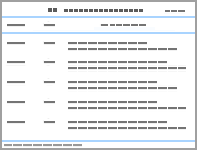
Tab.1
Microglia-related AD susceptibility genes and their functional regulation"
| Gene | Protein function in AD | Risk variant | Variants effect on microglial function | AD risk | Reference |
|---|---|---|---|---|---|
TREM2(6p21.1) | Phagocytosis Immune response Metabolic fitness | rs75932628 rs143332484 rs10947943 | Impaired phagocytosis Neuroinflammation Reduces mitochondrial respiratory capacity and glycolytic metabolic | Increase | [ |
SORL1(11q24.1) | Functions as endosomal trafficking receptor and mediates endocytosis Intracellular APP transportation and proteolysis | rs11218343 rs74685827 | Impaired endocytosis Affects DAM transition | Increase | [ |
CD33(19q13.41) | Binds sialic acids and inhibits phagocytosis mediated by TREM2 Immune response | rs3865444 rs12459419 | Alteration in alternative splicing of CD33 Affects activation of TREM2/DAP12 signaling pathway | Increase/Decrease | [ |
CR1(1q32.2) | Complement receptor for C3b/C4b and C1q Promotes phagocytosis as an opsonin | rs679515 rs3818361 rs6656401 | Reduces induced Aβ clearance by complement Affects complement system cascade | Increase | [ |
PLCG2(16q24.1) | Acts downstream of TREM2 signaling pathway Intracellular calcium release | rs72824905 rs12446759 | Regulates phagocytosis Regulates DAM related genes expression | Increase/Decrease | [ |
MS4A(11q12.2) | Intracellular protein trafficking Lipid sensing Phagocytosis | rs6591561 rs1582763 | Related to TREM2 processing Associated with the level of sTREM2 Immune response /complement system | Increase/Decrease | [ |
PILRA(7q22.1) | Binds sialic acids and inhibits phagocytosis mediated by TREM2 Mediates invasion of HSV-1 into cells | rs1859788 | Reduces inhibitory signaling in microglia Reduces microglial infection during HSV-1 recurrence | Decrease | [ |
CLU/APOJ(8p21.1) | Bind Aβ and lipids Phagocytosis Lipids metabolism Immune response | rs11787077 rs11136000 rs2279590 | Reduces Aβ phagocytic clearance | Increase | [ |
PICALM(11q14.2) | Endo-lysosomal trafficking Lipids metabolism | rs3851179 | Rescues endocytic defects caused by APOE4 Regulates microglial lipid droplet formation | Decrease | [ |
ABI3 (17q21.32) | Cytoskeleton rearrangement Focal adhesion Cell migration Phagocytosis | rs616338 | Impairs microglial migration and phagocytosis Increases Aβ deposition | Increase | [ |
| B1N1(2q14.3) | Endo-lysosomal trafficking Cytoskeleton | rs6733839 | Impaired phagocytosis Promotes inflammation | Increase | [ |
ZYX(7q34-q35) | Actin cytoskeletal rearrangement Cell migration Synaptic development and plasticity | rs11771145 | Affects immune response and endocy tosis Disruption of the blood-brain barrier integrity | Increase | [ |
GRN(17q21) | Lysosomal degradation | rs5848 | Lysosomal dysfunction Lipid dysregulation Microglial hyperactivation | Increase | [ |
APOE(19q13.2) | Acts as an opsonin and facilitates Phagocytosis Mediates cholesterol efflux | rs429358 rs7412 | Affects lipid transportation and cholesterol efflux Affects immune response Enhances or reduces Aβ phagocytosis | Increase/Decrease | [ |
ABCA7(19p13.3) | Lipids metabolism/Lipids homeostasis Immune response Aβ phagocytosis and clearance | rs12151021 rs3752246 rs115550680 | Abnormal lipid metabolism Promotes APP processing into Aβ Reduced microglial clearance of Aβ | Increase | [ |
INPP5D|(2q.37.1) | Interacts with DAP12 and inhibits downstream of TREM2 signaling pathway | rs10933431 | Reduces inhibitory signaling of TREM2 | Decrease | [ |
| SPI1/PU.1(11p11.2) | Regulates microglial transcriptome | rs10437655 rs3740688 | Decreases PU.1 expression and regulates microglial inflammatory response | Decrease | [ |
HLA-DRB1(6p21.32) | Involves in immune responses including antigen processing and presentation, as well as immune cell self-recognition | rs9271058 | Induces microglial activation | Increase | [ |
| 1 | KNOPMAN D S, AMIEVA H, PETERSEN R C,et al. Alzheimer disease[J].Nat Rev Dis Primers,2021,7(1): 33. |
| 2 | LI M L, WU S H, SONG B, et al. Single-cell analysis reveals transcriptomic reprogramming in aging primate entorhinal cortex and the relevance with Alzheimer’s disease[J]. Aging Cell, 2022, 21(11): e13723. |
| 3 | GAO C, JIANG J W, TAN Y Y, et al. Microglia in neurodegenerative diseases: mechanism and potential therapeutic targets[J]. Signal Transduct Target Ther, 2023, 8(1): 359. |
| 4 | BELLENGUEZ C, KÜÇÜKALI F, JANSEN I E,et al. New insights into the genetic etiology of Alzheimer’s disease and related dementias[J]. Nat Genet, 2022, 54(4): 412-436. |
| 5 | ANDREWS S J, RENTON A E, FULTON-HOWARD B, et al. The complex genetic architecture of Alzheimer’s disease: novel insights and future directions[J].EBioMedicine, 2023, 90: 104511. |
| 6 | NOVIKOVA G, KAPOOR M, TCW J, et al. Integration of Alzheimer’s disease genetics and myeloid genomics identifies disease risk regulatory elements and genes[J]. Nat Commun, 2021, 12(1): 1610. |
| 7 | SCHWARTZENTRUBER J, COOPER S, LIU J Z, et al. Genome-wide meta-analysis, fine-mapping, and integrative prioritization implicate new Alzheimer’s disease risk genes[J]. Nat Genet, 2021,53(3): 392-402. |
| 8 | DECZKOWSKA A, WEINER A, AMIT I. The physiology, pathology, and potential therapeutic applications of the TREM2 signaling pathway[J]. Cell, 2020, 181(6): 1207-1217. |
| 9 | YEH F L, WANG Y Y, TOM I, et al. TREM2 binds to apolipoproteins, including APOE and CLU/APOJ, and thereby facilitates uptake of amyloid-Beta by microglia[J]. Neuron, 2016, 91(2): 328-340. |
| 10 | FRANK S, BURBACH G J, BONIN M, et al. TREM2 is upregulated in amyloid plaque-associated microglia in aged APP23 transgenic mice[J]. Glia, 2008, 56(13): 1438-1447. |
| 11 | KEREN-SHAUL H, SPINRAD A, WEINER A,et al. A unique microglia type associated with restricting development of Alzheimer’s disease[J]. Cell, 2017, 169(7): 1276-1290.e17. |
| 12 | ULLAND T K, SONG W M, HUANG S C C, et al. TREM2 maintains microglial metabolic fitness in Alzheimer’s disease[J]. Cell, 2017, 170(4): 649-663.e13. |
| 13 | RIVEST S. TREM2 enables amyloid β clearance by microglia[J]. Cell Res, 2015, 25(5): 535-536. |
| 14 | WANG Y M, ULLAND T K, ULRICH J D, et al. TREM2-mediated early microglial response limits diffusion and toxicity of amyloid plaques[J]. J Exp Med, 2016, 213(5): 667-675. |
| 15 | YUAN P, CONDELLO C, KEENE C D, et al. TREM2 haplodeficiency in mice and humans impairs the microglia barrier function leading to decreased amyloid compaction and severe axonal dystrophy[J]. Neuron, 2016, 90(4): 724-739. |
| 16 | Daniel LEE C Y, DAGGETT A, GU X, et al. Elevated TREM2 gene dosage reprograms microglia responsivity and ameliorates pathological phenotypes in Alzheimer’s disease models[J]. Neuron, 2018, 97(5): 1032-1048.e5. |
| 17 | JAIN N, LEWIS C A, ULRICH J D, et al. Chronic TREM2 activation exacerbates Aβ-associated tau seeding and spreading[J]. J Exp Med, 2023, 220(1): e20220654. |
| 18 | HOU J, CHEN Y, GRAJALES-REYES G, et al. TREM2 dependent and independent functions of microglia in Alzheimer’s disease [J]. Mol Neurodegener, 2022, 17(1): 84. |
| 19 | KORVATSKA O, KIIANITSA K, RATUSHNY A, et al. Triggering receptor expressed on myeloid cell 2 R47H exacerbates immune response in Alzheimer’s disease brain[J]. Front Immunol, 2020, 11: 559342. |
| 20 | SAYED F A, KODAMA L, FAN L, et al. AD-linked R47H-TREM2 mutation induces disease-enhancing microglial states via AKT hyperactivation[J]. Sci Transl Med, 2021, 13(622): eabe3947. |
| 21 | SERRANO-POZO A, DAS S, HYMAN B T. APOE and Alzheimer’s disease: advances in genetics, pathophysiology, and therapeutic approaches[J]. The Lancet, Neurol, 2021, 20(1): 68-80. |
| 22 | LIU C C, LIU C C, KANEKIYO T, et al. Apolipoprotein E and Alzheimer disease: risk, mechanisms and therapy[J]. Nat Rev, Neurol, 2013,9(2): 106-118. |
| 23 | TCW J, QIAN L, PIPALIA N H, et al. Cholesterol and matrisome pathways dysregulated in astrocytes and microglia[J]. Cell, 2022, 185(13): 2213-2233.e25. |
| 24 | LIN Y T, SEO J, GAO F, et al. APOE4 causes widespread molecular and cellular alterations associated with Alzheimer’s disease phenotypes in human iPSC-derived brain cell types[J]. Neuron, 2018, 98:1141-1154.e7. |
| 25 | QIAN X H, CHEN S Y, LIU X L, et al. ABCA7-associated clinical features and molecular mechanisms in Alzheimer’s disease[J]. Mol Neurobiol, 2023, 60(10):5548-5556. |
| 26 | ROECK A D, VAN BROECKHOVEN C, SLEEGERS K. The role of ABCA7 in Alzheimer’s disease: evidence from genomics, transcriptomics and methylomics[J]. Acta Neuropathol, 2019, 138(2): 201-220. |
| 27 | JIAO B, XIAO X W, YUAN Z H, et al. Associations of risk genes with onset age and plasma biomarkers of Alzheimer’s disease: a large case-control study in mainland China[J]. Neuropsychopharmacology, 2022, 47(5): 1121-1127. |
| 28 | SAKAE N, LIU C C, SHINOHARA M, et al. ABCA7 deficiency accelerates amyloid-β generation and Alzheimer’s neuronal pathology[J]. J Neurosci, 2016, 36(13): 3848-3859. |
| 29 | AIKAWA T, REN Y X, YAMAZAKI Y, et al. ABCA7 haplodeficiency disturbs microglial immune responses in the mouse brain[J]. Proc Nat Acad Sci U S A, 2019, 116(47): 23790-23796. |
| 30 | FU Y, HSIAO J H T, PAXINOS G, et al. ABCA7 mediates phagocytic clearance of amyloid-β in the brain[J]. J Alzheimers Dis: JAD,2016,54(2): 569-584. |
| 31 | ESKANDARI-SEDIGHI G, JUNG J, MACAULEY M S. CD33 isoforms in microglia and Alzheimer’s disease: friend and foe[J]. Mol Aspect Med, 2023, 90: 101111. |
| 32 | GRICIUC A, SERRANO-POZO A, PARRADO A R, et al. Alzheimer’s disease risk gene CD33 inhibits microglial uptake of amyloid beta[J]. Neuron, 2013, 78(4): 631-643. |
| 33 | BHATTACHERJEE A, JUNG J, ZIA S, et al. The CD33 short isoform is a gain-of-function variant that enhances Aβ1-42 phagocytosis in microglia[J]. Mol Neurodegener, 2021, 16(1): 19. |
| 34 | TORTORA F, RENDINA A, ANGIOLILLO A,et al. CD33 rs2455069 SNP: correlation with Alzheimer’s disease and hypothesis of functional role[J]. Int J Mol Sci, 2022, 23(7): 3629. |
| 35 | MATTIOLA I, MANTOVANI A, LOCATI M. The tetraspan MS4A family in homeostasis, immunity, and disease[J]. Trends Immunol, 2021, 42(9): 764-781. |
| 36 | DEMING Y, FILIPELLO F, CIGNARELLA F,et al. The MS4A gene cluster is a key modulator of soluble TREM2 and Alzheimer’s disease risk[J]. Sci Transl Med, 2019, 11(505): eaau2291. |
| 37 | BRASE L, YOU S F, D’OLIVEIRA ALBANUS R D, et al. Single-nucleus RNA-sequencing of autosomal dominant Alzheimer disease and risk variant carriers[J]. Nat Commun, 2023, 14(1): 2314. |
| 38 | PIMENOVA A A, HERBINET M, GUPTA I, et al. Alzheimer’s-associated PU.1 expression levels regulate microglial inflammatory response[J]. Neurobiol Dis, 2021, 148: 105217. |
| 39 | VAN ACKER Z P, BRETOU M, ANNAERT W. Endo-lysosomal dysregulations and late-onset Alzheimer’s disease: impact of genetic risk factors[J]. Mol Neurodegener, 2019, 14(1): 20. |
| 40 | SUDWARTS A, RAMESHA S, GAO T W, et al. BIN1 is a key regulator of proinflammatory and neurodegeneration-related activation in microglia[J]. Mol Neurodegener, 2022, 17(1): 33. |
| 41 | MENDSAIKHAN A, TOOYAMA I, WALKER D G. Microglial progranulin: involvement in Alzheimer’s disease and neurodegenerative diseases[J]. Cells, 2019, 8(3): 230. |
| 42 | ROMERO-MOLINA C, GARRETTI F, ANDREWS S J, et al. Microglial efferocytosis: Diving into the Alzheimer’s disease gene pool[J].Neuron,2022,110(21):3513-3533. |
| 43 | ULRICH J D, ULLAND T K, COLONNA M, et al. Elucidating the role of TREM2 in Alzheimer’s disease[J]. Neuron, 2017, 94(2): 237-248. |
| 44 | CAMPION D, CHARBONNIER C, NICOLAS G. SORL1 genetic variants and Alzheimer disease risk: a literature review and meta-analysis of sequencing data[J]. Acta Neuropathol, 2019, 138(2): 173-186. |
| 45 | ZHU X C, YU J T, JIANG T, et al. CR1 in Alzheimer’s disease[J]. Mol Neurobio, 2015, 51(2): 753-765. |
| 46 | LI K, RAN B, WANG Y, et al. PLCγ2 impacts microglia-related effectors revealing variants and pathways important in Alzheimer’s disease[J]. Front Cell Dev Biol, 2022,10:999061. |
| 47 | RATHORE N, RAMANI S R, PANTUA H, et al. Paired immunoglobulin-like Type 2 Receptor Alpha G78R variant alters ligand binding and confers protection to Alzheimer’s disease[J]. PLoS Genet, 2018,14(11): e1007427. |
| 48 | HAROLD D, ABRAHAM R, HOLLINGWORTH P, et al. Genome-wide association study identifies variants at CLU and PICALM associated with Alzheimer’s disease, and shows evidence for additional susceptibility genes[J]. Nat Genet, 2009, 41(10): 1088-1093. |
| 49 | PADHY B, KAPUGANTI R S, HAYAT B, et al. Wide-spread enhancer effect of SNP rs2279590 on regulating epoxide hydrolase-2 and protein tyrosine kinase 2-beta gene expression[J]. Gene, 2023, 854: 147096. |
| 50 | KARAHAN H, SMITH D C, KIM B, et al. Deletion of Abi3 gene locus exacerbates neuropathological features of Alzheimer’s disease in a mouse model of Aβ amyloidosis[J]. Sci Adv, 2021, 7(45): eabe3954. |
| 51 | LI Y H, LAWS S M, MILES L A, et al. Genomics of Alzheimer’s disease implicates the innate and adaptive immune systems[J]. Cell Mol Life Sci, 2021, 78(23): 7397-7426. |
| 52 | SMITH A M, DAVEY K, TSARTSALIS S, et al. Diverse human astrocyte and microglial transcriptional responses to Alzheimer’s pathology[J]. Acta Neuropathol, 2022, 143(1): 75-91. |
| [1] | Yuanyuan LIU,Qibo CAI,Yan QU,Xiujin YANG,Rongchun GUAN,Chanjun LIU. Association analysis on rs562556 polymorphism of PCSK9 gene and degree of coronary artery stenosis of patients with acute myocardial infarction [J]. Journal of Jilin University(Medicine Edition), 2024, 50(6): 1712-1718. |
| [2] | Yan WANG,Xiaohui LI,Yao JI,Lili CUI,Yujie CAI. Differential effects of APOE polymorphism in neurotoxicity-responsive astrocytes induced by inflammatory factor [J]. Journal of Jilin University(Medicine Edition), 2024, 50(1): 33-41. |
| [3] | Zhikuan HU,Siqi HE,Weijie JIANG,Guifang ZHAO,Jia ZHANG,Ling QI. Effect of lipopolysaccharide on levels of inflammatory factors in retinal Müller cells and microglia co-culture system of mice and its mechanism [J]. Journal of Jilin University(Medicine Edition), 2023, 49(5): 1140-1146. |
| [4] | Xingye WANG,Xiangri KONG,Mengli JIN,Bingmei WANG,Mingquan LI. Improvement effect of β-sitosterol on cognitive function in Alzheimer’s disease model mice and its mechanism [J]. Journal of Jilin University(Medicine Edition), 2023, 49(3): 599-607. |
| [5] | Lianyuan WANG,Yi YANG,Huiwen CONG,Haohua WANG,Qihan BAO,Chengsheng LI,Liwen ZHOU,Zichen DING,Yanli LI,Fuyan SHI,Suzhen WANG. Bayesian quantile regression joint model analysis on risk factors of Alzheimer’s disease in people with different MMSE scores [J]. Journal of Jilin University(Medicine Edition), 2023, 49(2): 395-401. |
| [6] | Dehong ZHANG,Mingzhu ZHENG,Jiaqiu LI,Zhong LU. Bioinformatics analysis based on expressions of MSR1 mRNA and protein in pan-cancer tissue and its significance [J]. Journal of Jilin University(Medicine Edition), 2023, 49(2): 425-439. |
| [7] | Xiaohui WU,Fan YANG,Xinru GUO,Ke YUAN,Zongyi MA,Ting LIAN,Rajiv Kumar JHA. Effect of Orlistat combined with EZH2 inhibitor GSK126 on lipid metabolism reprogramming in pancreatic cancer cells [J]. Journal of Jilin University(Medicine Edition), 2023, 49(1): 55-66. |
| [8] | Qing YAO,Dan WANG,Xiaoshuang WANG,Yingjie WU,Liyuan RAN. Effect of ovariectomy on glucose and lipid metabolism in hyperinsulinemia MKR mice [J]. Journal of Jilin University(Medicine Edition), 2022, 48(5): 1229-1237. |
| [9] | Shuang HUANG,Chen CHEN,Bo HUANG. Effects of limonin on lipid metabolism and intestinal flora in nutritionally obese rats [J]. Journal of Jilin University(Medicine Edition), 2022, 48(4): 858-865. |
| [10] | Weigang WANG,Xiaohong LI,Bing LIU,Tao DING,Kang WEI,Jianming TIAN. Effect of genistein chromium complex on glucose and lipid metabolism in obese rats induced by sodium glutamate [J]. Journal of Jilin University(Medicine Edition), 2022, 48(4): 892-897. |
| [11] | . Improvement effect of Sanjiao acupuncture on permeability of blood-brain barrier in SAM mice and its mechanismWANG Yu1,2, KAN Bohong2,3,ZHAO Lan2,3,SHI Huiyan2,3,JIA Yujie2,3 [J]. Journal of Jilin University(Medicine Edition), 2021, 47(5): 1086-1091. |
| [12] | YANG Jiping, FEI Lin, CHAI Xuejun, GOU Xingchun. Inhibitory effect of MyD88 inhibitory peptide on polarization of BV2 microglial cells induced by LPS and its mechanism [J]. Journal of Jilin University(Medicine Edition), 2020, 46(05): 899-904. |
| [13] | ZHANG Yezhuo, YANG Yuefeng, YANG Yetong, ZHANG Ying, LIU Yajuan. Effects of poria cocos compound extract on blood glucose and lipid levels in rats with type 2 diabetes mellitus [J]. Journal of Jilin University(Medicine Edition), 2020, 46(05): 937-941. |
| [14] | PEI Dan, LIU Xue. Effect of inhibition of PDGFRα activation on glial cell proliferation and scar formation after brain injury in mice [J]. Journal of Jilin University(Medicine Edition), 2020, 46(05): 1023-1028. |
| [15] | LI Jinhua, JIN Ying, LI Junfeng, LI Li. Effects of sesamin on abilities of learning and memory in AD model mice and their mechanisms [J]. Journal of Jilin University(Medicine Edition), 2019, 45(06): 1275-1280. |
|
||