Journal of Jilin University(Medicine Edition) ›› 2025, Vol. 51 ›› Issue (1): 172-181.doi: 10.13481/j.1671-587X.20250121
• Research in clinical medicine • Previous Articles
Construction of prediction model for gastric cancer mismatch repair based on preoperative inflammatory indicators and clinicopathological features in gastric cancer patients
Xiuzhen WEI1,2,3,Yaling DONG1,2,Zhibo ZHU1,2,Zhengjie ZHANG1,3,Yuanjun TAN2,Jie BAI1,2,Xiayi SU2,Baihong ZHANG2( )
)
- 1.First Clinical Medical School,Gansu University of Chinese Medicine,Lanzhou 730030,China
2.Department of Oncology,940th Hospital of Joint Logistics Support Force of People’s Liberation Army,Lanzhou 730050,China
3.Department of Gastroenterology,Liangzhou Hospital,Wuwei City,Gansu Province,Wuwei 733000,China
-
Received:2024-02-01Accepted:2024-04-14Online:2025-01-28Published:2025-03-06 -
Contact:Baihong ZHANG E-mail:bhzhang@126.com

CLC Number:
- R735.2
Cite this article
Xiuzhen WEI,Yaling DONG,Zhibo ZHU,Zhengjie ZHANG,Yuanjun TAN,Jie BAI,Xiayi SU,Baihong ZHANG. Construction of prediction model for gastric cancer mismatch repair based on preoperative inflammatory indicators and clinicopathological features in gastric cancer patients[J].Journal of Jilin University(Medicine Edition), 2025, 51(1): 172-181.
share this article
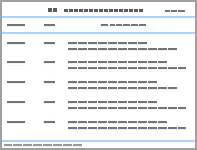
Tab.1
Expressions of MMR protein in dMMR patients"
| MLH1 | MSH2 | MSH6 | PMS2 | Expression[n(η/%)] |
|---|---|---|---|---|
| - | + | + | - | 14(5.5) |
| + | - | - | + | 1(0.4) |
| + | + | - | - | 1(0.4) |
| - | - | + | + | 0(0) |
| - | + | + | + | 8(3.1) |
| + | - | + | + | 1(0.4) |
| + | + | - | + | 0(0) |
| + | + | + | - | 7(2.8) |
| - | - | - | - | 1(0.4) |
Tab.2
Clinicopathological features of gastric cancer patients in two groups"
Clinicopathological feature | pMMR (n=221) | dMMR (n=33) | χ2 | P |
|---|---|---|---|---|
Gender Male Female | 172(77.8) 49(22.2) | 26(78.8) 7(21.2) | 0.015 | 0.901 |
Age(year) <60 ≥60 | 119(53.8) 102(46.2) | 11(33.3) 22(66.7) | 4.835 | 0.028 |
Maximum tumor diameter(cm) <4.5 ≥4.5 | 128(57.9) 93(42.1) | 10(30.3) 23(69.7) | 8.825 | 0.003 |
Tumor location Others Gastric antrum | 123(55.7) 98(44.3) | 8(24.2) 25(75.8) | 11.539 | 0.003 |
Mucus component Yes No | 18(8.1) 203(91.9) | 4(12.1) 29(87.9) | 0.181 | 0.670 |
Differentiation Low High/Moderate | 154(69.7) 67(30.3) | 15(45.5) 18(54.5) | 7.570 | 0.006 |
T stage T1-T2 T3-T4 | 55(24.9) 166(75.1) | 7(21.2) 26(78.8) | 0.210 | 0.647 |
N stage N0 N1-N3 | 80(36.2) 141(63.8) | 14(42.4) 19(57.6) | 0.477 | 0.490 |
M stage M0 M1 | 208(94.1) 13(5.9) | 32(97.0) 1(3.0) | 0.068 | 0.794 |
TNM stage Ⅰ-Ⅱ Ⅲ-Ⅳ | 104(47.1) 117(52.9) | 15(45.5) 18(54.5) | 0.030 | 0.863 |
Lymph-vascular invasion Yes No | 88(39.8) 133(60.2) | 17(51.5) 16(48.5) | 1.620 | 0.203 |
Perineural invasion Yes No | 47(21.3) 174(78.7) | 4(12.1) 29(87.9) | 1.497 | 0.221 |
Ki-67 <70% ≥70% | 189(85.5) 32(14.5) | 24(72.7) 9(27.3) | 3.472 | 0.062 |
Lymph node metastasis ratio <0.69% ≥0.69% | 203(91.9) 18(8.1) | 29(87.9) 4(12.1) | 0.181 | 0.670 |
Number of positive lymph node <4 ≥4 | 137(62.0) 84(38.0) | 25(75.8) 8(24.2) | 2.356 | 0.125 |
Number of lymph node yields <22 ≥22 | 143(64.7) 78(35.3) | 17(51.5) 16(48.5) | 2.143 | 0.143 |
CEA Negative Positive | 173(78.3) 48(21.7) | 29(87.9) 4(12.1) | 1.630 | 0.202 |
CA199 Negative Positive | 163(73.8) 58(26.2) | 29(87.9) 4(12.1) | 3.100 | 0.078 |
Tab.3
Inflammatory indicators of gastric cancer patients in two groups"
| Inflammatory indicator | pMMR (n=221) | dMMR (n=33) | χ2 | P |
|---|---|---|---|---|
WBC (×109 L-1) <6.30 ≥6.30 | 153 (69.2) 68 (30.8) | 20 (60.6) 13 (39.4) | 0.983 | 0.321 |
Neutrophils(×109 L-1) <3.28 ≥3.28 | 114 (51.6) 107 (48.4) | 14 (42.4) 19 (57.6) | 0.964 | 0.326 |
Lymphocytes(×109 L-1) <0.53 ≥0.53 | 12 (5.4) 209(94.6) | 0(0) 33(100.0) | 0.868 | 0.352 |
Monocytes(×109 L-1) <0.40 ≥0.40 | 158(71.5) 63(28.5) | 20(60.6) 13(39.4) | 1.623 | 0.203 |
PLT (×109 L-1) <236.5 ≥236.5 | 155 (70.1) 66 (29.9) | 18 (54.5) 15 (45.5) | 3.213 | 0.073 |
NLR <2.95 ≥2.95 | 142(64.3) 79(35.7) | 16(48.5) 17(51.5) | 3.037 | 0.081 |
PLR <275.65 ≥275.65 | 196(88.7) 25(11.3) | 24(72.7) 9(27.3) | 6.309 | 0.012 |
LMR <1.29 ≥1.29 | 7(3.2) 214(96.8) | 0(0) 33(100.0) | 0.218 | 0.641 |
SII <386.91 ≥386.91 | 84(38.0) 137(62.0) | 7(21.2) 26(78.8) | 3.523 | 0.061 |
NPS <0.01 ≥0.01 | 45(20.4) 176(79.6) | 7(21.2) 26(78.8) | 0.013 | 0.910 |
AL[ρB/(g·L-1)] <46.65 ≥46.65 | 211(95.5) 10(4.5) | 31(93.9) 2(6.1) | 0.150 | 0.698 |
γGGT[ρB/(U·L-1)] <14.5 ≥14.5 | 100(45.2) 121(54.8) | 10(30.3) 23(69.7) | 2.612 | 0.106 |
AKP[ρB/(U·L-1)] <89.5 ≥89.5 | 128(57.9) 93(42.1) | 13(39.4) 20(60.6) | 3.990 | 0.046 |
AAR <1.86 ≥1.86 | 115(52.0) 106(48.0) | 10(30.3) 23(69.7) | 5.426 | 0.020 |
GPR <0.05 ≥0.05 | 50(22.6) 171(77.4) | 5(15.2) 28(84.8) | 0.945 | 0.331 |
D-D[ρB/(mg·L-1)] <0.87 ≥0.87 | 169(76.5) 52(23.5) | 19(57.6) 14(42.4) | 5.330 | 0.021 |
FB [ρB/(g·L-1)] <3.44 ≥3.44 | 165(74.7) 56(25.3) | 16(48.5) 17(51.5) | 9.606 | 0.002 |
FLR <2.07 ≥2.07 | 118(53.4) 103(46.6) | 8(24.2) 25(75.8) | 9.761 | 0.002 |
FAR <0.09 ≥0.09 | 167(75.6) 54(24.4) | 15(45.5) 18(54.5) | 12.817 | <0.001 |
Tab.4
Assignment table of independent variables"
| Independent variable | Assignment method |
|---|---|
| Region(Gastric antrum) | Others=0, Gastric antrum=1 |
| Differentiation(High/Moderate) | Low=0, High/Moderate=1 |
| CA199(Positive) | Negative=0, Positive=1 |
| Age(≥60 years) | <60 years=0, ≥60 years=1 |
| Maximum tumor diameter(≥4.5 cm) | <4.5 cm=0, ≥4.5 cm=1 |
| AKP(≥89.5 U·L-1) | <89.5 U·L-1=0, ≥89.5 U·L-1=1 |
| FAR(≥0.09) | <0.09=0, ≥0.09=1 |
Tab.5
Multivariate Logistic regression analysis on influencing factors for MMR status"
| Predictor variable | β | SE | Wald χ2 | OR | 95%CI | P | |
|---|---|---|---|---|---|---|---|
| Lower limit | Upper limit | ||||||
| Region (Gastric antrum) | 1.389 | 0.470 | 8.723 | 4.013 | 1.596 | 10.089 | 0.003 |
| Differentiation (High/Moderate) | 1.101 | 0.448 | 6.044 | 3.006 | 1.250 | 7.230 | 0.014 |
| CA199 (Positive) | -1.277 | 0.614 | 4.327 | 0.279 | 0.084 | 0.929 | 0.038 |
| Age(≥60 year) | 0.807 | 0.449 | 3.222 | 2.241 | 0.929 | 5.406 | 0.073 |
| Maximum tumor diameter(≥4.5 cm) | 1.085 | 0.462 | 5.515 | 2.958 | 1.196 | 7.314 | 0.019 |
| AKP(≥89.5 U·L-1) | 0.793 | 0.427 | 3.456 | 2.211 | 0.958 | 5.102 | 0.063 |
| FAR(≥0.09) | 1.027 | 0.440 | 5.449 | 2.793 | 1.179 | 6.616 | 0.020 |
| Constant | -4.833 | 0.692 | 48.736 | 0.008 | — | — | <0.001 |
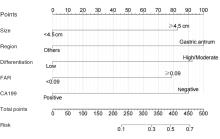
Fig. 1
Prediction model of MMR status of gastric cancer patients"
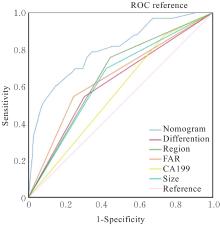
Fig. 2
ROC curves of prediction model of MMR status of gastric cancer patients"
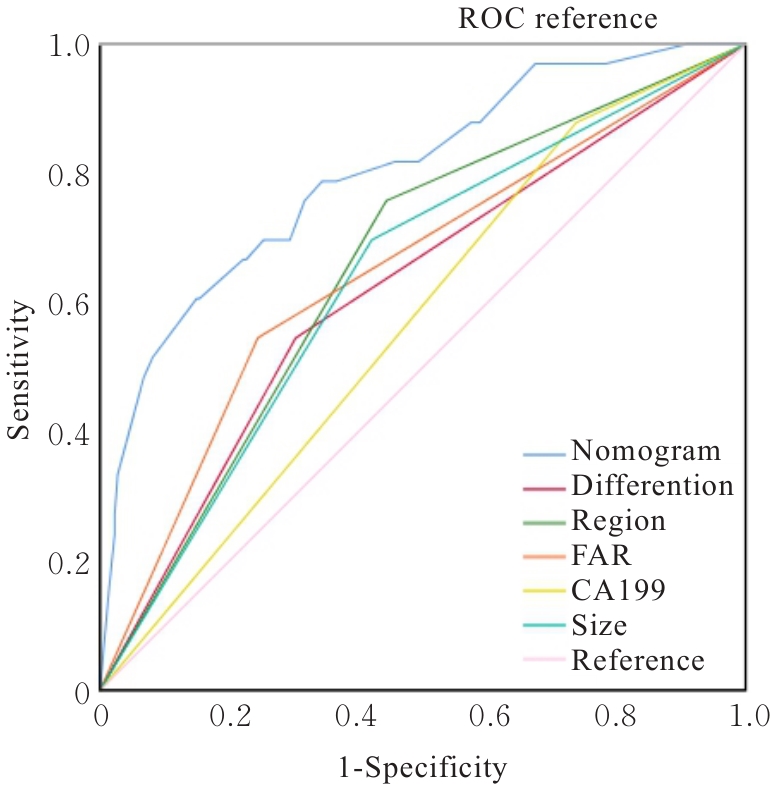
Fig. 3
Calibration curve of prediction model of MMR status of gastric cancer patients"
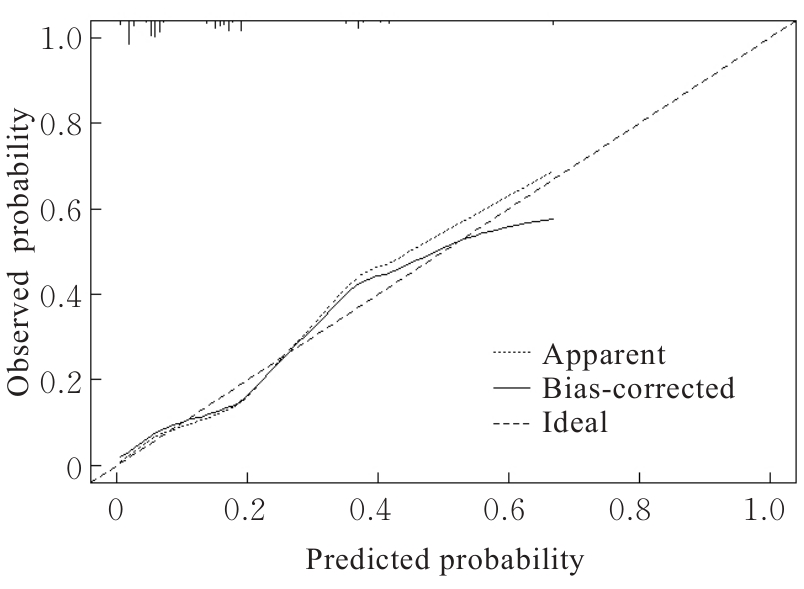
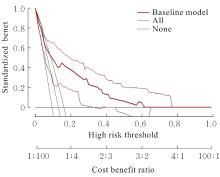
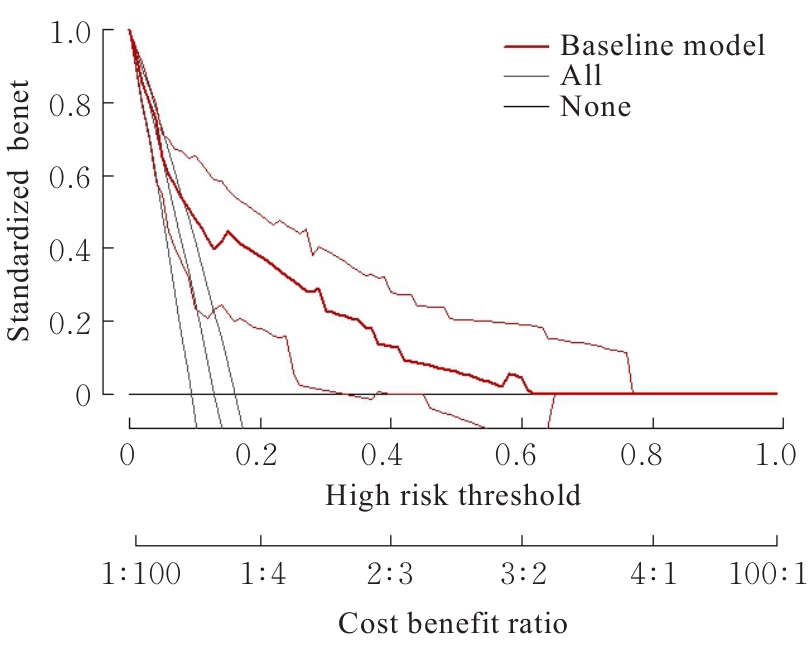
Fig. 4
Clinical decision curves of prediction model of MMR status of gastric cancer patients"
| 1 | ZHENG R S, CHEN R, HAN B F, et al. Cancer incidence and mortality in China, 2022[J]. Zhonghua Zhong Liu Za Zhi, 2024, 46(3): 221-231. |
| 2 | CHIA N Y, TAN P. Molecular classification of gastric cancer[J]. Ann Oncol, 2016, 27(5): 763-769. |
| 3 | DAGHER O K, SCHWAB R D, BROOKENS S K, et al. Advances in cancer immunotherapies[J]. Cell, 2023, 186(8): 1814-1814.e1. |
| 4 | CHAO J, FUCHS C S, SHITARA K, et al. Assessment of pembrolizumab therapy for the treatment of microsatellite instability-high gastric or gastroesophageal junction cancer among patients in the KEYNOTE-059, KEYNOTE-061, and KEYNOTE-062 clinical trials[J]. JAMA Oncol, 2021, 7(6): 895-902. |
| 5 | ANDRÉ T, BERTON D, CURIGLIANO G, et al. Antitumor activity and safety of dostarlimab monotherapy in patients with mismatch repair deficient solid tumors: a nonrandomized controlled trial[J]. JAMA Netw Open, 2023, 6(11): e2341165. |
| 6 | ZHAN P C, YANG S, LIU X, et al. A radiomics signature derived from CT imaging to predict MSI status and immunotherapy outcomes in gastric cancer: a multi-cohort study[J]. BMC Cancer, 2024,24(1):404. |
| 7 | SILVA J R, MASCARENHAS-LEMOS L, NETO D N C, et al. Role of endoscopic biopsies and morphologic features in predicting microsatellite instability status in gastric cancer: A multicenter comparative study of endoscopic biopsies and surgical specimens[J]. Am J Surg Pathol, 2023, 47(9):990-1000. |
| 8 | OZER M, VEGIVINTI C T R, SYED M, et al. Neoadjuvant immunotherapy for patients with dMMR/MSI-high gastrointestinal cancers: a changing paradigm[J]. Cancers, 2023, 15(15): 3833. |
| 9 | GUAN W L, HE Y, XU R H. Gastric cancer treatment: recent progress and future perspectives[J]. J Hematol Oncol, 2023, 16(1): 57. |
| 10 | WANG J Y, XIU J, FARRELL A, et al. Mutational analysis of microsatellite-stable gastrointestinal cancer with high tumour mutational burden: a retrospective cohort study[J]. Lancet Oncol, 2023, 24(2): 151-161. |
| 11 | SHITARA K, VAN CUTSEM E, BANG Y J, et al. Efficacy and safety of pembrolizumab or pembrolizumab plus chemotherapy vs chemotherapy alone for patients with first-line, advanced gastric cancer: the KEYNOTE-062 phase 3 randomized clinical trial[J]. JAMA Oncol, 2020, 6(10): 1571-1580. |
| 12 | JANJIGIAN Y Y, SHITARA K, MOEHLER M, et al. First-line nivolumab plus chemotherapy versus chemotherapy alone for advanced gastric, gastro-oesophageal junction, and oesophageal adenocarcinoma (CheckMate 649): a randomised, open-label, phase 3 trial[J]. Lancet, 2021, 398(10294): 27-40. |
| 13 | AJANI J A, D’AMICO T A, BENTREM D J, et al. Gastric cancer, version 2.2022, NCCN clinical practice guidelines in oncology[J]. J Natl Compr Canc Netw, 2022, 20(2): 167-192. |
| 14 | HANAHAN D, WEINBERG R A. Hallmarks of cancer: the next generation[J]. Cell, 2011, 144(5): 646-674. |
| 15 | HANAHAN D. Hallmarks of cancer: new dimensions[J]. Cancer Discov, 2022, 12(1): 31-46. |
| 16 | WANG F H, ZHANG X T, LI Y F, et al. The Chinese society of clinical oncology (CSCO): clinical guidelines for the diagnosis and treatment of gastric cancer, 2021[J]. Cancer Commun (Lond), 2021, 41(8): 747-795. |
| 17 | ZHAO F X, LI E X, SHEN G S, et al. Correlation between mismatch repair and survival of patients with gastric cancer after 5-FU-based adjuvant chemotherapy[J]. J Gastroenterol, 2023, 58(7): 622-632. |
| 18 | MESTRALLET G, BROWN M, BOZKUS C C, et al. Immune escape and resistance to immunotherapy in mismatch repair deficient tumors[J]. Front Immunol, 2023, 14: 1210164. |
| 19 | 杨军, 徐志杰, 朱卫东, 等. 微卫星不稳定性(MSI)检测技术专家共识[J]. 临床与实验病理学杂志, 2024,40(3): 228-235. |
| 20 | CUI M Y, LI P, MAO Y, et al. Implication of microsatellite instability in Chinese cohort of human cancers[J]. Cancer Manag Res, 2020, 12: 10287-10295. |
| 21 | ZHU Y J, WANG P, WANG B Z, et al. Dual-layer spectral-detector CT for predicting microsatellite instability status and prognosis in locally advanced gastric cancer[J]. Insights Imaging, 2023, 14(1): 151. |
| 22 | CHEN S, DU W Z, CAO Y H, et al. Preoperative contrast-enhanced CT imaging and clinicopathological characteristics analysis of mismatch repair-deficient colorectal cancer[J]. Cancer Imaging, 2023, 23(1): 97. |
| 23 | BELKOUCHI Y, NEBOT-BRAL L, LAWRANCE L, et al. Predicting immunotherapy outcomes in patients with MSI tumors using NLR and CT global tumor volume[J]. Front Oncol, 2022, 12: 982790. |
| [1] | Xi YANG,Qin YUAN,Lan YANG,Wenjie ZHANG. Bioinformatics analysis on PDE1B expression and prognosis of gastric cancer and tumor microenvironment [J]. Journal of Jilin University(Medicine Edition), 2024, 50(6): 1664-1676. |
| [2] | Haiyao PANG,Jun MENG. Research progress in relationship between 14-3-3ɛ protein and occurrence and development of tumor [J]. Journal of Jilin University(Medicine Edition), 2024, 50(2): 572-578. |
| [3] | Xiaopeng YU,Renyi YANG,Zuomei HE,Puhua ZENG. Establishment and validation of nomogram of cancer specific survival of patients with hepatocellular carcinoma with negative alpha fetoprotein based on SEER Database [J]. Journal of Jilin University(Medicine Edition), 2024, 50(1): 188-197. |
| [4] | Xue DONG, Jinfeng ZANG, Caifeng XU, Hebing LIU, Zhaohua CHENG. Construction and validation of risk prediction model of enteral nutrition feeding intolerance of patients with severe acute pancreatitis [J]. Journal of Jilin University(Medicine Edition), 2023, 49(6): 1586-1592. |
| [5] | Yifei SUN,Dinuo LI,Yubin WANG. Inhibitory effect of curcumin on proliferation and invasion of gastric cancer MGC-803 cells by down-regulating PI3K/Akt/mTOR signaling pathway protein expression [J]. Journal of Jilin University(Medicine Edition), 2023, 49(2): 332-340. |
| [6] | Yun LIU,Linqi ZHU,Shihe SHAO. Effects of circular RNA hsa_circ_0009735 on epithelial mesenchymal transformation, cell cycle, and autophagy of gastric cancer cells [J]. Journal of Jilin University(Medicine Edition), 2022, 48(6): 1498-1509. |
| [7] | Xianshun XIE,Wei WANG,Haibing JIANG. Effect of miR-431-3p on proliferation and apoptosis of gastric cancer cells and its mechanism of targeted regulation of CTDP1 gene expression [J]. Journal of Jilin University(Medicine Edition), 2022, 48(6): 1555-1565. |
| [8] | Qian ZHANG,Jing LI. Inhibitory effect of TLR4 gene overexpression on autophagy of gastric cancer cells and its mechanism [J]. Journal of Jilin University(Medicine Edition), 2022, 48(5): 1238-1246. |
| [9] | Chengsheng LI,Qihan BAO,Xiaoyan HAO,Qingzhong PAN,Suzhen WANG,Fuyan SHI. Establishment of prediction model for postoperative pancreatic cancer based on random forest algorithm [J]. Journal of Jilin University(Medicine Edition), 2022, 48(2): 426-435. |
| [10] | Guangsong XU,Haibing JIANG,Jing PAN,Guoqing LI. Inhibitory effects of betulinic acid on migration and invasion of gastric cancer MGC-803 cells and their mechanisms [J]. Journal of Jilin University(Medicine Edition), 2022, 48(1): 122-128. |
| [11] | Lili QIN,Xiaobo MA,Tianye ZHAO,Xuerong TAO,Min ZHENG,Xueying WANG,Jiaxin YI,Yanhua WU,Jing JIANG. Effects of MMP-9 and TIMP-1 expressions on prognostic evaluation of gastric cancer patients after radical gastrectomy [J]. Journal of Jilin University(Medicine Edition), 2022, 48(1): 163-171. |
| [12] | Runhong MU,Yijiu AI,Yupeng LI,Rui LIN,Siping YE,Fang MA,Xiao GUO. Expression of recombinant human IL-17A in gastric cancer tissue and its effects on proliferation, invasion, migration and apoptosis of gastric cancer BGC-823 cells [J]. Journal of Jilin University(Medicine Edition), 2021, 47(6): 1510-1517. |
| [13] | Nuan WANG,Lijuan YANG,Juanjuan DAI,Aili WANG,Yan WU,Chengxia LIU. Promotion effects of MARCH1 on migration and invasion of human gastric cancer cells through PI3K/AKT signaling pathway [J]. Journal of Jilin University(Medicine Edition), 2021, 47(2): 352-359. |
| [14] | Ruiying SUN,Yang LI,Xu ZHAO,Linlin QU,Wei XU,Yunli ZHANG. Detection of serum levels of gastric cancer-related cytokines and their clinical significances in diagnosis of gastric cancer [J]. Journal of Jilin University(Medicine Edition), 2020, 46(6): 1274-1282. |
| [15] | SHI Guanghuan, ZHOU Shiping, XU Dongsheng, WANG Xiu. Killing effect of amplified NK cells on gastric cancer cells and its mechanism [J]. Journal of Jilin University(Medicine Edition), 2020, 46(03): 530-535. |
|
||