吉林大学学报(工学版) ›› 2025, Vol. 55 ›› Issue (3): 1028-1036.doi: 10.13229/j.cnki.jdxbgxb.20240148
• 计算机科学与技术 • 上一篇
基于双分支通道先验和Retinex的低照度图像增强算法
李扬1,2,3( ),李现国1,3(),苗长云1,3,徐晟2
- 1.天津工业大学 电子与信息工程学院,天津 300387
2.天津中德应用技术大学 软件与通信学院,天津 300350
3.天津市光电检测技术与系统重点实验室,天津 300387
Low⁃light image enhancement algorithm based on dual branch channel prior and Retinex
Yang LI1,2,3(),Xian-guo LI1,3(),Chang-yun MIAO1,3,Sheng XU2
- 1.School of Electronics and Information Engineering,Tiangong University,Tianjin 300387,China
2.School of Software and Communications,Tianjin Sino-German University of Applied Sciences,Tianjin 300350,China
3.Tianjin Key Laboratory of Optoelectronic Detection Technology and Systems,Tianjin 300387,China
摘要:
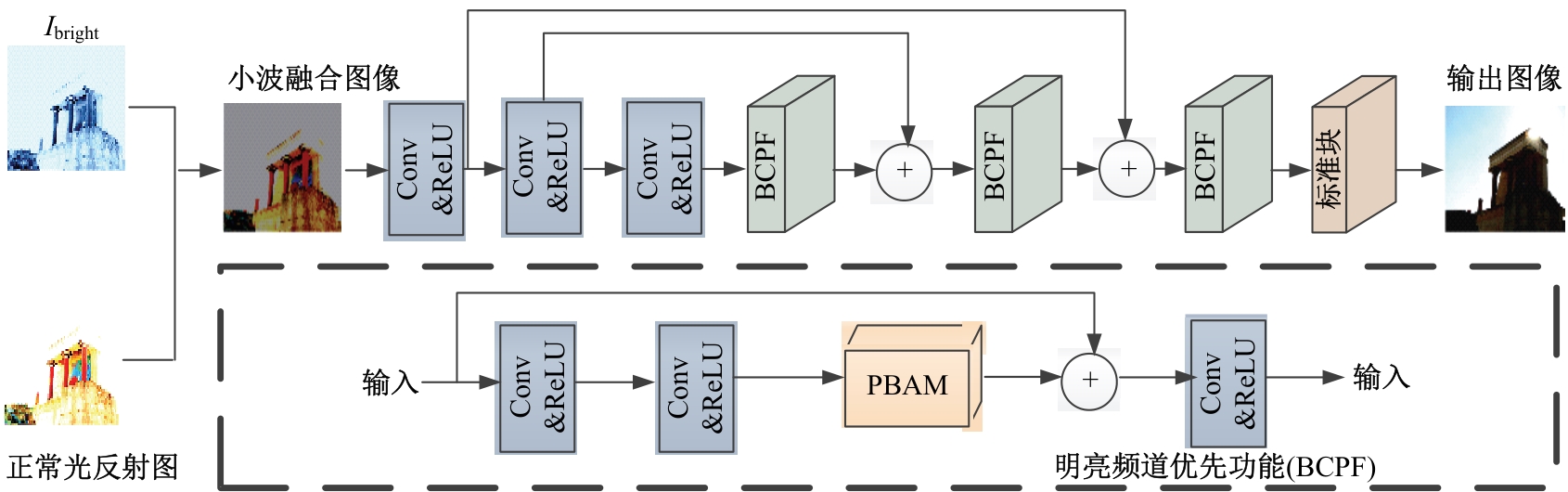
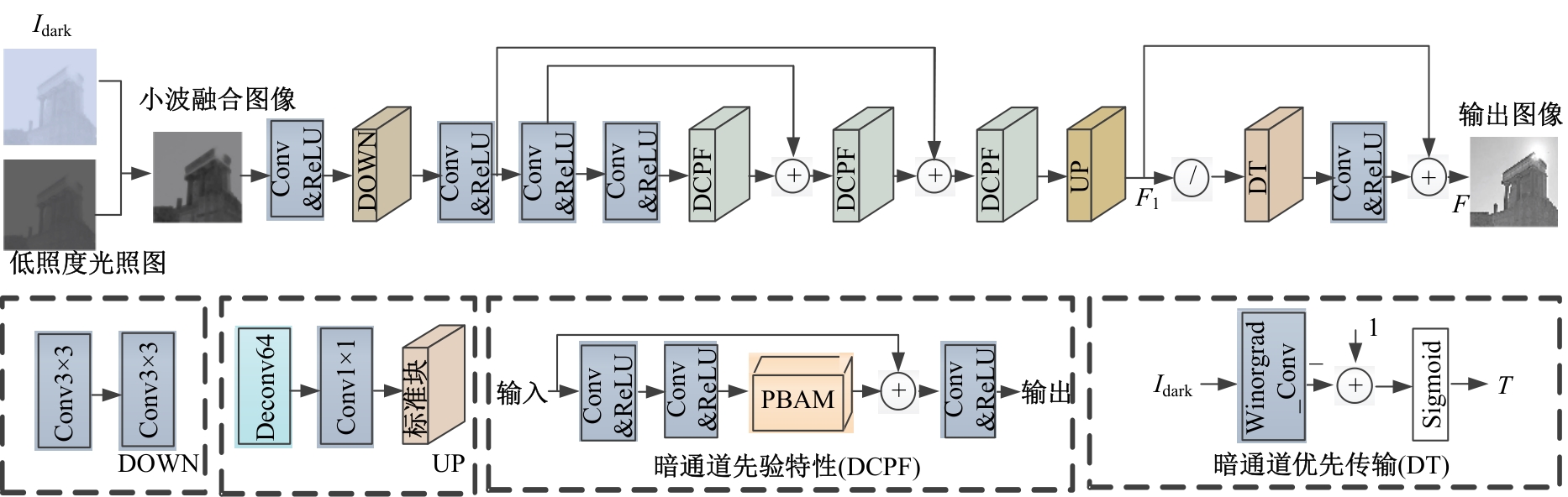
针对现有低照度图像增强算法存在的局部暗光、细节丢失和过增强等问题,提出了一种基于双分支通道先验和Retinex的低照度图像增强算法。在Retinex基础上,提出了双分支亮暗先验特征引导方法,设计了亮通道先验特征模块和暗通道先验特征模块,引导网络抑制反射分量噪声和提升光照分量亮度;设计了像素混合注意力机制模块,分别从通道、空间、像素3个维度对特征进行针对性学习;设计了暗通道折射率估算模块放大图像细节特征;采用混合损失函数,调节亮度、对比度、噪声和色彩约束。在公共数据集上的实验结果表明:与10种先进算法相比,本文算法在提升图像亮度的同时减少了颜色失真和细节丢失,获得了最优的视觉效果和质量指标。
中图分类号:
- TP391



| 1 | 万方, 雷光波, 徐丽. 基于阶跃滤波器的低照度图像边缘增强算法[J]. 计算机仿真, 2022, 39(5):220-224. |
| Wan Fang, Lei Guang-bo, Xu Li. Edge enhancement algorithm of low illumination image based on step filter[J]. Computer Simulation, 2022, 39(5): 220-224. | |
| 2 | 张锦洲, 姬世青, 谭创. 融合卷积神经网络和双边滤波的相贯线焊缝提取算法[J]. 吉林大学学报: 工学版,2024, 54(8): 2313-2318. |
| Zhang Jin-zhou, Ji Shi-qing, Tan Chuang. Fusion algorithm of convolution neural network and bilateral filtering for seam extraction[J]. Journal of Jilin University (Engineering and Technology Edition),2024, 54(8): 2313-2318. | |
| 3 | 王欣, 党电太. 基于视觉信息补偿的光照不均图像增强方法[J]. 吉林大学学报: 工学版, 2024, 54(8): 2301-2306. |
| Wang Xin, Dang Dian-tai. Image enhancement method of uneven illumination based on visual information compensation[J].Journal of Jilin University (Engineering and Technology Edition),2024, 54(8): 2301-2306. | |
| 4 | Lin Y H, Lu Y C. Low-light enhancement using a plug-and-play retinex model with shrinkage mapping for illumination estimation[J]. IEEE Transactions on Image Processing, 2022, 31(6): 4897-4908. |
| 5 | Ma Q, Wang Y, Zeng T. Retinex based variational framework for low light image enhancement and denoising[J]. IEEE Transactions on Multimedia, 2022, 25(6): 5580-5588. |
| 6 | Guo X J, Li Y, Ling H B. LIME: low-light image enhancement via illumination map estimation[J]. IEEE Transactions on Image Processing, 2017,26(2): 982-993. |
| 7 | Wang S H, Zheng J, Hu H M, et al. Naturalness preserved enhancement algorithm for non-uniform illumination images[J]. IEEE Transactions on Image Processing, 2013, 22(9): 3538-3548. |
| 8 | Tao L, Zhu C, Xiang G Q, et al. LLCNN: a convolutional neural network for low-light image enhancement[C]∥IEEE Visual Communication and Image Processing, St. Petersburg, USA, 2017: No.8305143. |
| 9 | Cai J R, Gu S H, Zhang L. Learning a deep single image contrast enhancer from multi-exposure images[J]. IEEE Transactions on Image Processing, 2018,27(4): 2049-2062. |
| 10 | Lyu F, Lu F, Wu J, et al. MBLLEN: low-light image/video enhancement using CNNs[C]∥British Machine Vision Conference, Newcastle,UK,2018: 220-232. |
| 11 | Zhang Y, Zhang J, Guo X. Kindling the darkness: a practical low-light image enhancer[C]∥ACM International Conference on Multimedia, Nice,France, 2019: 1632-1640. |
| 12 | Zhang Y, Guo X, Ma J, et al. Beyond brightening low-light images[J]. International Journal of Computer Vision, 2021, 129(4): 1013-1037. |
| 13 | Guo C, Li C, Guo J, et al. Zero-reference deep curve estimation for low-light image enhancement[C]∥IEEE Conference on Computer Vision and Pattern Recognition (CVPR), Seattle, USA, 2020: 1777-1786. |
| 14 | Li C, Guo C, Chen C L. Learning to enhance low-light image via zero-reference deep curve estimation[J]. IEEE Transactions on Pattern Analysis and Machine Intelligence, 2021, 44(8): 4225-4238. |
| 15 | Shen L, Yue Z, Feng F, et al. MSR-Net: low-light image enhancement using deep convolutional network[J/OL].[2025-01-20]. |
| 16 | Wei C, Wang W, Yang W, et al. Deep retinex decomposition for low-light enhancement[C]∥BritishMachine Vision Conference (BMVC), Newcastle, UK, 2018: 481-490. |
| 17 | Fan M H, Wang W J, Yang W H,et al. Integrating semantic segmentation and retinex model for low-light image enhancement[C]∥ACM International Conference on Multimedia, Seattle, WA, USA,2020: 2317-2325. |
| 18 | Wu W, Weng J, Zhang P, et al. URetinex-Net: retinex-based deep unfolding network for low-light image enhancement[C]∥IEEE Conference on Computer Vision and Pattern Recognition, New Orleans, USA, 2022: 5901-5910. |
| 19 | 陈广秋, 陈昱存, 李佳悦, 等.基于DNST 和卷积稀疏表示的红外与可见光图像融合[J]. 吉林大学学报:工学版, 2021, 51(3): 996-1010. |
| Chen Guang-qiu, Chen Yu-cun, Li Jia-yue,et al. Infrared and visible image fusion based on discrete nonseparable shearlet transform and convolutional sparse representation[J]. Journal of Jilin University (Engineering and Technology Edition), 2021, 51(3): 996-1010. | |
| 20 | Yan Y Y, Ren W Q, Guo Y F, et al. Image deblurring via extreme channels prior[C]∥IEEE Computer Vision and Pattern Recognition, Honolulu, USA, 2017: 6978-6986. |
| 21 | Lu Z, Long B, Yang S. Saturation based iterative approach for single image dehazing[J]. IEEE Signal Processing Letters, 2020, 27: 665-669. |
| 22 | Zhao Y L, Wang D H, Wang L O. Convolution accelerator designs using fast algorithms[J].Algorithms,2019,12(5): 112. |
| 23 | Ren X, Yang W, Cheng W H, et al. Lr3m: robust low-light enhancement via low rank regularized retinex model[J]. IEEE Transactions on Image Processing, 2020, 29: 5862-5876. |
| 24 | Yan W D, Tan R T, Dai D X. Nighttime defogging using high-low frequency decomposition and gray scale color networks[C]∥European Conference on Computer Vision, Glasgow, UK, 2020: 473-488. |
| 25 | Jiang Z Q, Li H T, Liu L J, et al. A switched view of Retinex: deep self-regularized low-light image enhancement[J]. Neurocomputing, 2021,454:361-372. |
| 26 | Ma K, Zeng K, Wang Z. Perceptual quality assessment for multi-exposure image fusion[J]. IEEE Transactions on Image Processing, 2015, 24(11):3345-3356. |
| 27 | Lee C, Lee C, Kim C S. Contrast enhancement based on layered difference representation of 2D histograms[J]. IEEE Transactions on Image Processing, 2013, 22(12): 5372-5384. |
| 28 | Fu Z, Yang Y, Tu X, et al. Learning a simple low-light image enhancer from paired low-light instances [C]∥IEEE Computer Vision and Pattern Recognition(CVPR),Vancouver, Canada, 2023: 22252-22261. |
| [1] | 王欣,党电太. 基于视觉信息补偿的光照不均图像增强方法[J]. 吉林大学学报(工学版), 2024, 54(8): 2301-2306. |
| [2] | 张锦洲,姬世青,谭创. 融合卷积神经网络和双边滤波的相贯线焊缝提取算法[J]. 吉林大学学报(工学版), 2024, 54(8): 2313-2318. |
| [3] | 王德兴,高凯,袁红春,杨钰锐,王越,孔令栋. 基于色彩校正和TransFormer细节锐化的水下图像增强[J]. 吉林大学学报(工学版), 2024, 54(3): 785-796. |
| [4] | 刘铭,杨雨航,邹松霖,肖志成,张永刚. 增强边缘检测图像算法在多书识别中的应用[J]. 吉林大学学报(工学版), 2022, 52(4): 891-896. |
| [5] | 蒋华伟,杨震,张鑫,董前林. 图像去雾算法研究进展[J]. 吉林大学学报(工学版), 2021, 51(4): 1169-1181. |
| [6] | 刘富,刘璐,侯涛,刘云. 基于优化MSR的夜间道路图像增强方法[J]. 吉林大学学报(工学版), 2021, 51(1): 323-330. |
| [7] | 徐岩,孙美双. 基于卷积神经网络的水下图像增强方法[J]. 吉林大学学报(工学版), 2018, 48(6): 1895-1903. |
| [8] | 吴一全, 吴诗婳, 张宇飞. 基于混沌粒子群优化的Contourlet域红外图像自适应增强[J]. 吉林大学学报(工学版), 2014, 44(5): 1466-1473. |
| [9] | 王书民, 张爱武, 王飞, 胡少兴, 孙卫东, 仰继连. 面向高空飞艇平台的视频增强与稳像[J]. 吉林大学学报(工学版), 2014, 44(01): 203-210. |
| [10] | 李骜, 李一兵, 刘丹丹, 杨晓冬. 基于非下采样轮廓波的多曝光工件图像Retinex增强方法[J]. , 2012, (06): 1592-1596. |
| [11] | 孙明超, 张崇, 刘晶红. 多尺度图像增强可见光与红外图像融合 [J]. , 2012, (03): 738-742. |
|
||