吉林大学学报(工学版) ›› 2025, Vol. 55 ›› Issue (12): 4045-4051.doi: 10.13229/j.cnki.jdxbgxb.20240474
• 计算机科学与技术 • 上一篇
基于跨度和语义特征的实体关系抽取模型
冯萍1,2( ),杨茈茜1,王韧杰1,冯师语1,吴航1,孙宇3
- 1.长春大学 计算机科学技术学院,长春 130022
2.长春大学 残障人士智能康复与无障碍教育部重点实验室,长春 130022
3.长春大学 特殊教育学院,长春 130022
Entity relationship extraction method based on span and semantic features
Ping FENG1,2(),Zi-qian YANG1,Ren-jie WANG1,Shi-yu FENG1,Hang WU1,Yu SUN3
- 1.College of Computer Science and Technology,Changchun University,Changchun 130022,China
2.Ministry of Education Key Laboratory of Intelligent Rehabilitation and Barrier-free Access for the Disabled,Changchun University,Changchun 130022,China
3.College of Special Education,Changchun University,Changchun 130022,China
摘要:
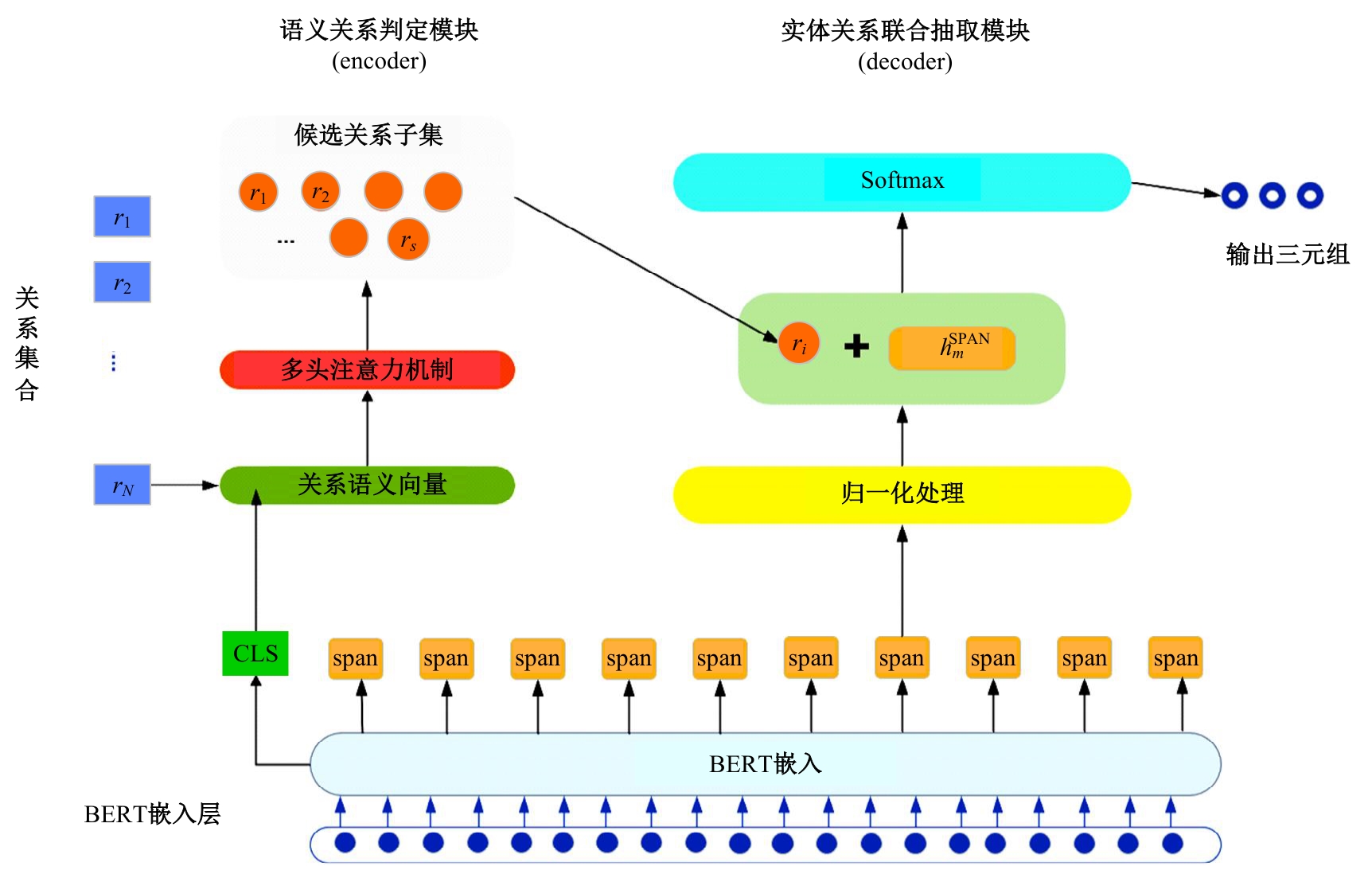
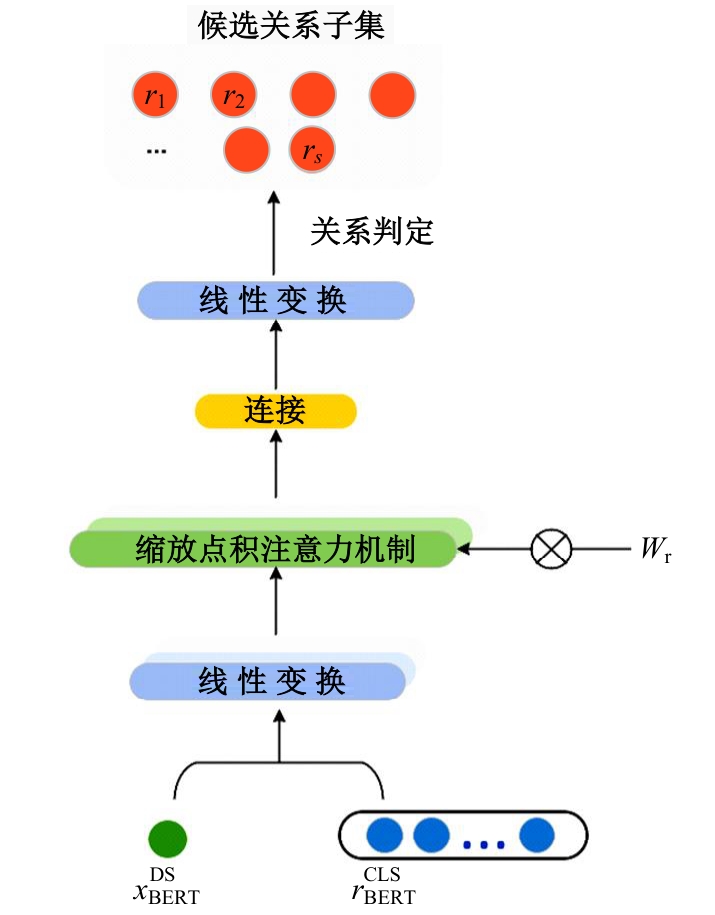
针对传统实体关系抽取方法依赖距离度量或简单跨度识别,难以捕捉实体间潜在关系,且模型计算复杂度高、易引发误差传递的问题,提出了一种基于跨度和语义特征的端到端实体关系抽取模型。首先,将文本向量随机分割成跨度序列,以便模型能够学习更广泛的语义特征信息。其次,对语义关系进行判定,以筛选出候选关系子集,从而减少信息冗余。最后,将候选关系转换为包含重要关系语义的关系-跨度组合,并利用Transformer解码器实现实体关系联合抽取。实验结果表明,相较于其他基线模型,该模型在NYT数据集和WebNLG数据集上的F1值均有显著提升,证明了其有效性。
中图分类号:
- TP391

| [1] | 李冬梅, 张扬, 李东远, 等. 实体关系抽取方法研究综述[J]. 计算机研究与发展, 2020, 57(7): 1424-1448. |
| Li Dong-mei, Zhang Yang, Li Dong-yuan, et al. Review of studies on entity relationship extraction methods[J]. Computer Research and Development, 2020,57(7): 1424-1448. | |
| [2] | Yang Y, Wu Z L, Yang Y X, et al.A Survey of information extraction based on deep learning[J].Applied Sciences, 2022, 12(19): No.9691. |
| [3] | Li J, Sun A X, Han J L, et al. A survey on deep learning for named entity recognition[J]. IEEE Transactionson Knowledge and Data Engineering, 2020: 50-70. |
| [4] | 王进, 蒋诗琪. 基于多路局部特征整合的嵌套命名实体识别方法[J]. 江苏大学学报:自然科学版, 2025, 46(4): 431-437. |
| Wang Jin, Jiang Shi-qi. Nested named entity recognition method based on multiplexed local feature integration[J]. Journal of Jiangsu University (Natural Science Edition), 2025, 46(4): 431-437. | |
| [5] | 王进, 王猛旗, 张昕跃, 等. 基于多头注意力机制字词联合的中文命名实体识别[J]. 江苏大学学报:自然科学版, 2024, 45(1): 77-84. |
| Wang Jin, Wang Meng-qi, Zhang Xin-yue, et al. Chinese named entity recognition based on multi-head attention character word integration[J]. Journal of Jiangsu University (Natural Science Edition), 2024, 45(1): 77-84. | |
| [6] | Tuo M, Yang W Z, Wei F Y, et al.A novel chinese overlapping entity relation extraction model using word-label based on cascade binary tagging[J]. Electronics, 2023, 12(4): No.1013. |
| [7] | Wang P. A survey of research on deep learning entity relationship extraction[J]. Natural Language Processing and Speech Recognition, 2019, 1(1): 1-5. |
| [8] | Li J L, Xu Y J, Lin H Z, et al.Semantic-consistent learning for one-shot joint entity and relation extraction[J]. Applied Intelligence, 2022,53(5): 5963-5976. |
| [9] | Lin Y, Shen S, Liu Z, et al. Neural relation extraction with selective attention over instances[C]∥Proceedings of the 54the Annual Meeting of the Association for Computational Linguistics. Berlin: Association for Computational Linguistics, 2016: 2124-2133. |
| [10] | Kalpit D, Yaser A.Span-Level Model for Relation Extraction[C]∥Proceedings of 57th Annual Meeting of the Association for Computational Linguistics (ACL 2019), Florence, Italy, 2019: 5308-5314. |
| [11] | Eberts M, Ulges A.Span-based joint entity and relation extraction with transformer pre-Training[C]∥ Proceedings of the 24th European Conference on Artificial Intelligence. Amsterdam: IOS Press, 2020: 2006-2013. |
| [12] | Wan Q, Wei L, Zhao S, et al.A span-based multi-modal attention network for joint entity-relation extraction[J].Knowledge-Based Systems, 2023, 262:No.110228. |
| [13] | Devlin J, Chang M W, Lee K, et al. BERT: pre-training of deep bidirectional transformers for language understanding[EB/OL]. [2024-03-15]. |
| [14] | Ma L, Ren H, Zhang X.Effective cascade dual-decoder model for joint entity and relation extraction[EB/OL]. [2024-03-17]. |
| [15] | Surdeanu M, Tibshirani J, Nallapati R, Manning C D. Multi-instance multi-label learning for relation extraction[C]∥Proceedings of the Joint Conference on Empirical Methods in Natural Language Processing and Computationl Natural Language Learning. Je ju Island: Association for Computational Linguistics, 2012: 455-465. |
| [16] | Riedel S, Yao L, McCallum A.Modeling relations and their mentions without labeled text[C]∥Proceedings of the European Conference on Machine Learning and Knowledge Discovery in Databases (ECML PKDD). Berlin: Springer, 2010: 148-163. |
| [17] | Zeng X R, Zeng D J, He S Z,et al.Extracting relational facts by an end-to-end neural model with copy mechanism[C]∥Proceedings of the 56th Annual Meeting of the Association for Computational Linguistics,Melbourne, Australia, 2018: 506-514. |
| [18] | Ren F L, Zhang L H, Yin S J,et al.A novel global feature-oriented relational triple extraction model based on table filling[C]∥Proceedings of the Conference on Empirical Methods in Natural Language Processing, Online and Punta Cana, Dominican Republic, 2021: 2646-2656. |
| [19] | Xie X Y, Xie M, Moshayedi A J, et al. A hybrid improved neural networks algorithm based on L2 and dropout regularization[J].Mathematical Problems in Engineering, 2022: 1-19. |
| [1] | 才华,王玉瑶,付强,马智勇,王伟刚,张晨洁. 基于注意力机制和特征融合的语义分割网络[J]. 吉林大学学报(工学版), 2025, 55(4): 1384-1395. |
| [2] | 郭晓然,王铁君,闫悦. 基于局部注意力和本地远程监督的实体关系抽取方法[J]. 吉林大学学报(工学版), 2025, 55(1): 307-315. |
| [3] | 张磊,焦晶,李勃昕,周延杰. 融合机器学习和深度学习的大容量半结构化数据抽取算法[J]. 吉林大学学报(工学版), 2024, 54(9): 2631-2637. |
| [4] | 王春华,李恩泽,肖敏. 多特征融合和孪生注意力网络的高分辨率遥感图像目标检测[J]. 吉林大学学报(工学版), 2024, 54(1): 240-250. |
| [5] | 冯宇,郝键铭,王峰,张久鹏,黄晓明. 非平稳极端风作用下大跨桥梁瞬态风致效应分析[J]. 吉林大学学报(工学版), 2023, 53(6): 1638-1649. |
| [6] | 王雪,李占山,吕颖达. 基于多尺度感知和语义适配的医学图像分割算法[J]. 吉林大学学报(工学版), 2022, 52(3): 640-647. |
| [7] | 郭殊伦,钟铁毅,闫志刚. 大跨度斜拉桥拉索的抖振响应计算方法[J]. 吉林大学学报(工学版), 2021, 51(5): 1756-1762. |
| [8] | 蔡健,陈国栋,左志亮,吴轶 . 受压弦杆填充混凝土的带悬挑预应力矩形钢管桁架[J]. 吉林大学学报(工学版), 2009, 39(02): 393-0397. |
|
||