吉林大学学报(医学版) ›› 2025, Vol. 51 ›› Issue (5): 1211-1220.doi: 10.13481/j.1671-587X.20250507

• 基础研究 • 上一篇    

血必净注射液对抗NMDAR脑炎小鼠血脑屏障损伤的改善作用及其对Th17/Treg失衡的调控作用

曾超胜(),陈琳,闫丽敏,邢槐杰,李莉,黄少珠,陈敏,常勇,匡冰,黎晓艳   

  1. 海南医科大学第二附属医院神经内科,海南 海口 570311
  • 收稿日期:2024-11-11 接受日期:2025-03-21 出版日期:2025-09-28 发布日期:2025-11-05
  • 通讯作者: 曾超胜 E-mail:mou106@sina.com
  • 作者简介:曾超胜(1968-),男,海南省临高县人,主任医师,主要从事神经病学神经重症基础和临床等方面的研究。
  • 基金资助:
    海南省科技厅重点研发项目(ZDYF2022SHFZ291)

Improvement effect of Xuebijing injection on blood-brain barrier damage in mice with anti-NMDAR encephalitis and its regulatory effect on Th17/Treg imbalance

Chaosheng ZENG(),Lin CHEN,Limin YAN,Huaijie XING,Li LI,Shaozhu HUANG,Min CHEN,Yong CHANG,Bing KUANG,Xiaoyan LI   

  1. Department of Neurology,Second Affiliated Hospital,Hainan Medical University,Haikou 570311,China
  • Received:2024-11-11 Accepted:2025-03-21 Online:2025-09-28 Published:2025-11-05
  • Contact: Chaosheng ZENG E-mail:mou106@sina.com

摘要:

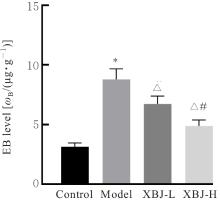
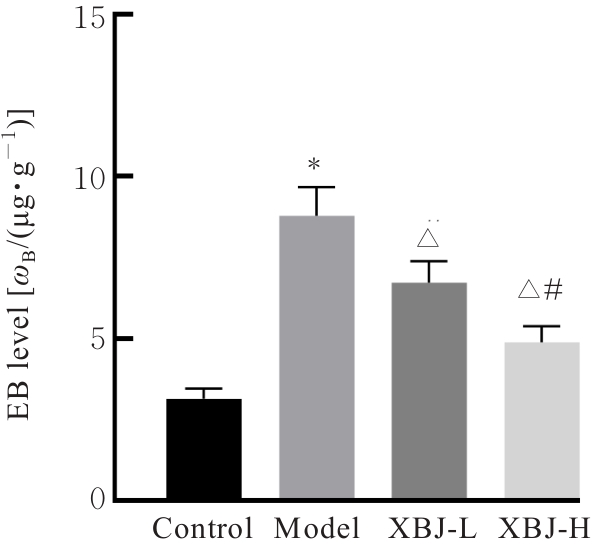
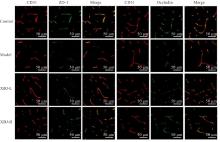
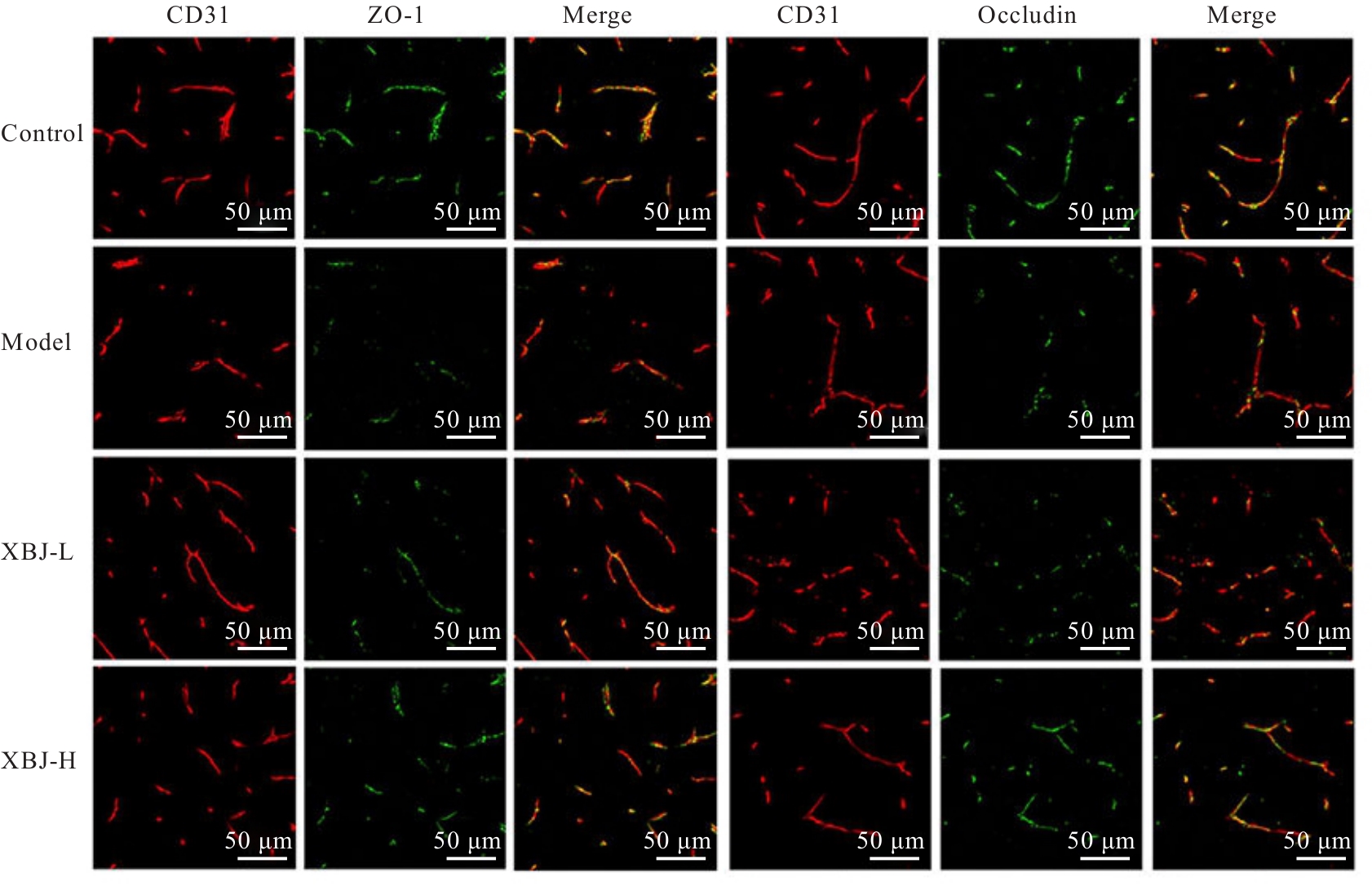
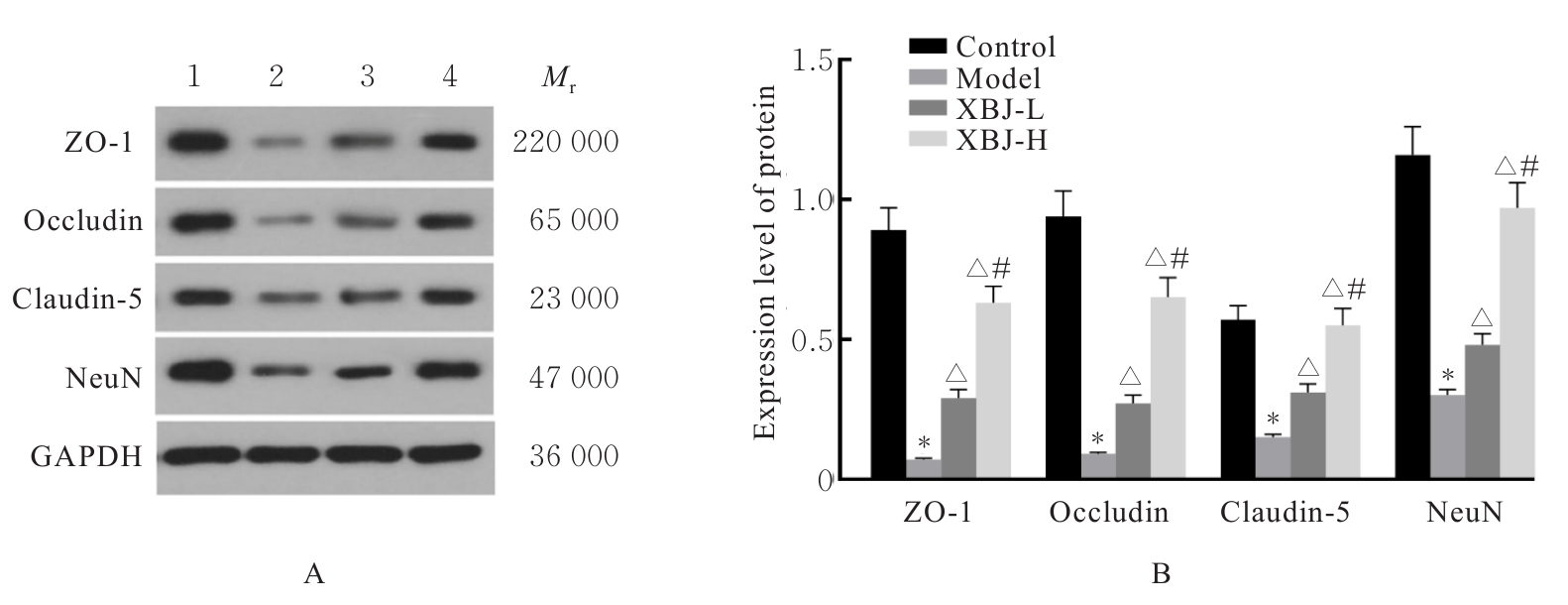
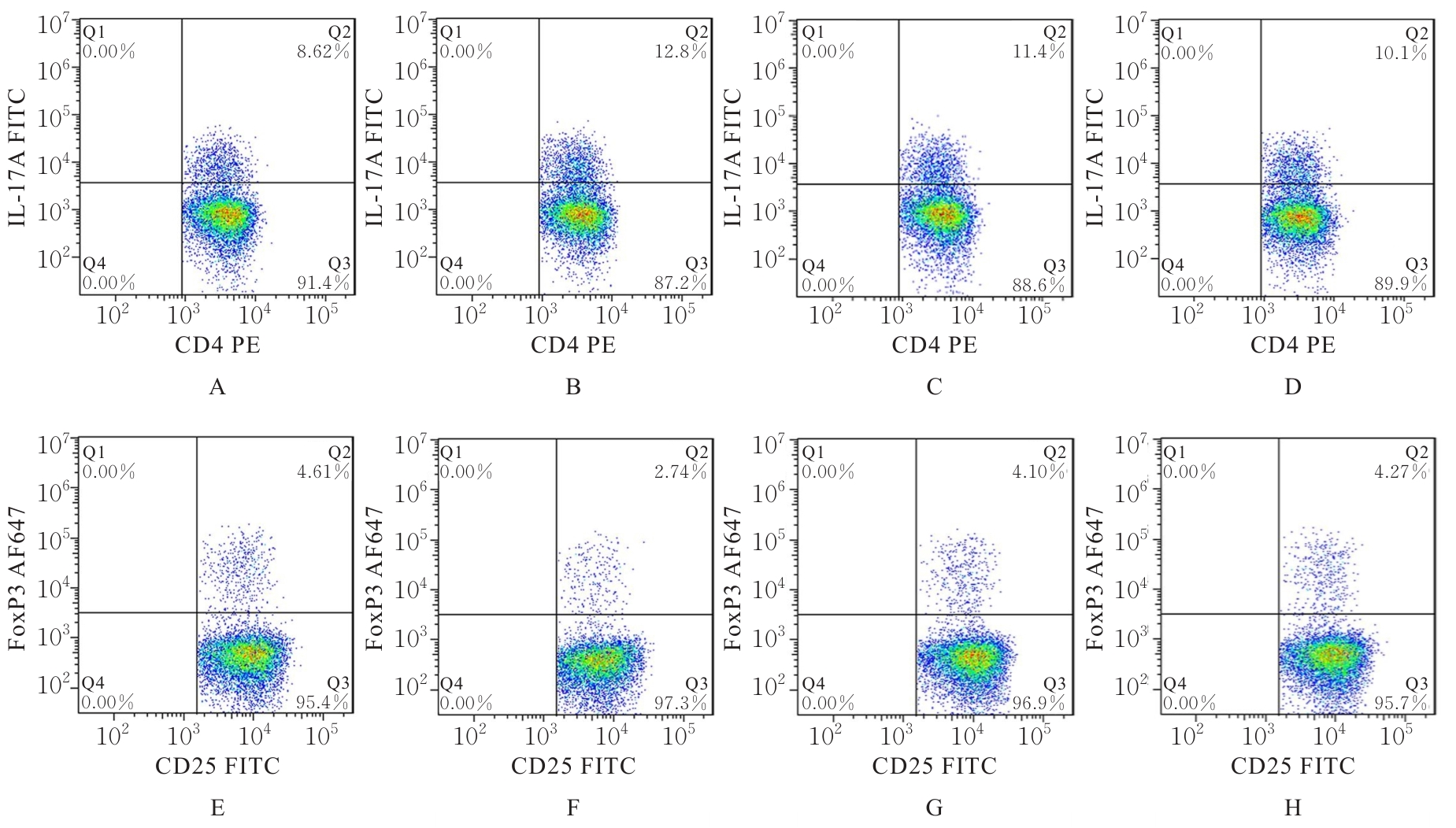
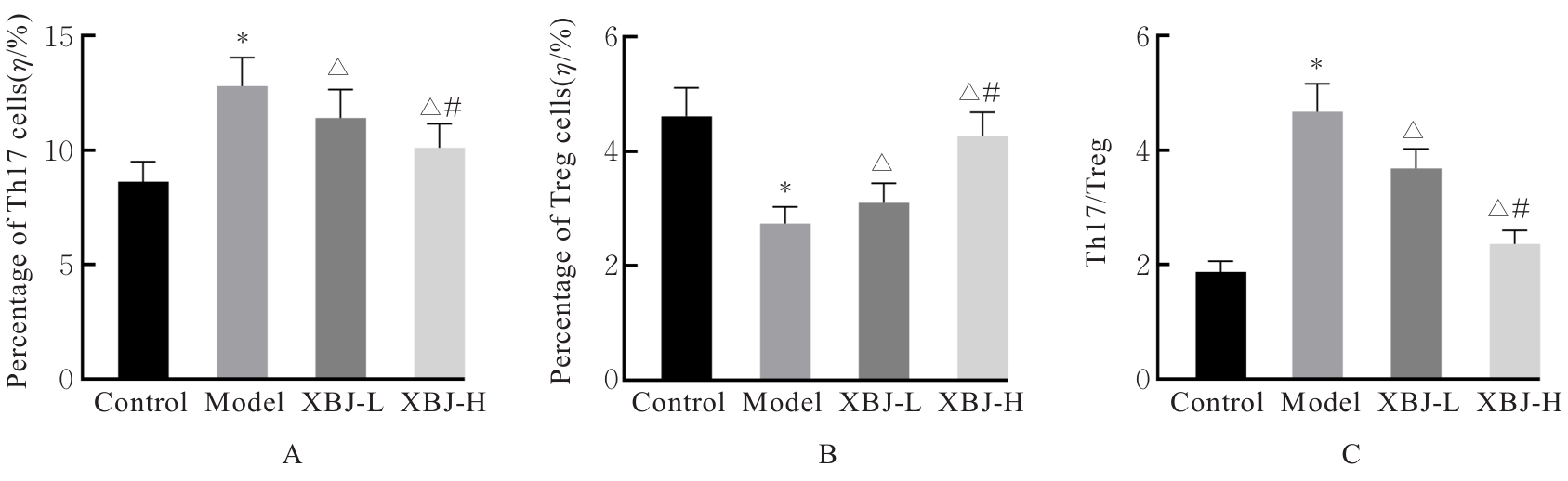
目的 探讨血必净注射液对抗N-甲基-D-天冬氨酸受体(NMDAR)脑炎小鼠血脑屏障(BBB)损伤的作用,并阐明其对辅助性T细胞17(Th17)/调节性T细胞(Treg)失衡的调控作用。 方法 采用谷氨酸受体N1亚基(GluN1)356-385抗原肽诱导建立主动免疫抗NMDAR脑炎小鼠模型,酶联免疫吸附试验(ELISA)法检测小鼠血清中抗NMDAR免疫球蛋白G(IgG)抗体水平。选取健康未建模小鼠为对照组,建模成功小鼠随机分为模型组、低剂量血必净注射液(XBJ-L)组和高剂量血必净注射液(XBJ-H)组,每组10只,XBJ-L组和XBJ-H组小鼠于建模后分别腹腔注射5和10 mL·kg-1血必净注射液。采用Longa评分法评估各组小鼠神经功能损伤情况,伊文思蓝(EB)染色检测各组小鼠BBB通透性,免疫荧光染色法检测各组小鼠大脑皮质中闭锁小带蛋白1(ZO-1)和闭合蛋白(Occludin)表达情况,Western blotting法检测各组小鼠大脑皮质中ZO-1、Occludin、紧密连接蛋白5(Claudin-5)和神经特异核蛋白(NeuN)蛋白表达水平,ELISA法检测各组小鼠血清中Th17和Treg相关细胞因子白细胞介素(IL)-17、IL-22和IL-10水平,流式细胞术检测各组小鼠外周血中Th17和Treg细胞百分率并计算Th17/Treg比值。 结果 经GluN1 356-385抗原肽诱导的小鼠血清中NMDAR IgG抗体呈阳性,说明造模成功。与对照组比较,模型组小鼠神经功能损伤评分明显升高(P<0.05);脑组织中EB水平明显升高(P<0.05),大脑皮质中ZO-1和Occludin荧光染色强度降低,大脑皮质中ZO-1、Occludin、Claudin-5和NeuN蛋白表达水平明显降低(P<0.05),血清中IL-17和IL-22水平明显升高(P<0.05),IL-10水平明显降低(P<0.05),外周血中Th17细胞百分率明显升高(P<0.05),Treg细胞百分率明显降低(P<0.05),Th17/Treg比值明显增加(P<0.05)。与模型组比较,XBJ-L组和XBJ-H组小鼠神经功能损伤评分明显降低(P<0.05);脑组织中EB水平明显降低(P<0.05);大脑皮质中ZO-1和Occludin荧光染色强度升高,ZO-1、Occludin、Claudin-5和NeuN蛋白表达水平明显升高(P<0.05);血清中IL-17和IL-22水平明显降低(P<0.05),IL-10水平明显升高(P<0.05);外周血中Th17细胞百分率明显降低(P<0.05),Treg细胞百分率明显升高(P<0.05),Th17/Treg比值明显减小(P<0.05)。与XBJ-L组比较,XBJ-H组小鼠神经功能损伤评分明显降低(P<0.05);脑组织中EB水平明显降低(P<0.05);大脑皮质中ZO-1和Occludin荧光染色强度升高(P<0.05),ZO-1、Occludin、Claudin-5和NeuN蛋白表达水平明显升高(P<0.05);血清中IL-17和IL-22水平明显降低(P<0.05),IL-10水平明显升高(P<0.05);外周血Th17细胞百分率明显降低(P<0.05),Treg细胞百分率明显升高(P<0.05),Th17/Treg比值明显减小(P<0.05)。 结论 血必净注射液能够改善抗NMDAR脑炎小鼠BBB损伤,调节Th17/Treg趋于平衡,从而减轻抗NMDAR脑炎神经功能损伤。

关键词: 血必净注射液, 抗N?甲基?D?天冬氨酸受体脑炎, 血脑屏障, 神经功能, 辅助性T细胞17, 调节性T细胞

Abstract:

Objective To investigate the effect of Xuebijing injection against blood-brain barrier (BBB) ??damage in the mice with anti-N-methyl-D-aspartate receptor (NMDAR) encephalitis, and to elucidate its regulatory effect on the imbalance of helper T cells 17 (Th17)/regulatory T cells (Treg). Methods The active immunization models of anti-NMDAR encephalitis in the mice were established using glutamate receptor N1 subunit (GluN1) 356-385 antigen peptide, and the serum anti-NMDAR immunoglobulin G (IgG) antibody levels were detected by enzyme-linked immunosorbent assay(ELISA). The healthy mice without modeling were served as control group, and the mice with successful modeling were randomly divided into model group, low dose of Xuebijing injection (XBJ-L) group, and high dose of Xuebijing injection (XBJ-H) group, with 10 mice in each group. After modeling, the mice in XBJ-L and XBJ-H groups were intraperitoneally injected with 5 and 10 mL·kg-1 Xuebijing injection, respectively. The Longa score was used to assess the neurological impairment of the mice in various groups; evans blue (EB) staining was used to determine the BBB permeability; immunofluorescence staining was used to detect the expressions of zonula occludens 1 (ZO-1) and Occludin in cerebral cortex of the mice in various groups; Western blotting method was used to determine the expression levels of ZO-1, Occludin, Claudin-5, and neuron-specific nuclear protein (NeuN) in cerebral cortex of the mice in various groups; ELISA method was used to determine the levels of Th17- and Treg-related cytokines including interleukin (IL)-17, IL-22, and IL-10 in serum of the mice; flow cytometry was used to determine the percentages of Th17 and Treg cells in peripheral blood of the mice in various groups, and the Th17/Treg ratio was calculated. Results The serum of the mice induced with the GluN1 356-385 antigen peptide was positive for NMDAR IgG antibodies, indicating that the models were successfully established. Compared with control group, the neurological impairment score of the mice in model group was significantly increased (P<0.05), and the EB level in brain tissue was significantly increased (P<0.05); the fluorescence staining intensities of ZO-1 and Occludin in the cerebral cortex were decreased, and the expression levels of ZO-1, Occludin, Claudin-5, and NeuN proteins in the cerebral cortex were significantly decreased (P<0.05); the serum levels of IL-17 and IL-22 were significantly increased (P<0.05), while the IL-10 level was significantly decreased (P<0.05); the percentage of Th17 cells in peripheral blood was significantly increased (P<0.05), while the percentage of Treg cells was significantly decreased (P<0.05), and the Th17/Treg ratio was significantly increased (P<0.05). Compared with model group, the neurological impairment scores of the mice in XBJ-L and XBJ-H groups were significantly decreased (P<0.05), the EB levels in brain tissue were significantly decreased (P<0.05), the fluorescence staining intensities of ZO-1 and Occludin in cerebral cortex were increased, and the expression levels of ZO-1, Occludin, Claudin-5, and NeuN proteins were significantly increased (P<0.05); the levels of IL-17 and IL-22 in serum were significantly decreased (P<0.05), and the level of IL-10 was significantly increased (P<0.05); the percentages of Th17 cells in peripheral blood were significantly decreased (P<0.05), the percentages of Treg cells were significantly increased (P<0.05), and the Th17/Treg ratios were significantly decreased (P<0.05). Compared with XBJ-L group, the neurological function injury score of the mice in XBJ-H group was significantly decreased (P<0.05), the EB level in brain tissue was significantly decreased (P<0.05); the fluorescence staining intensities of ZO-1 and Occludin in the cerebral cortex were increased, and the expression levels of ZO-1, Occludin, Claudin-5, and NeuN proteins were significantly increased (P<0.05); the serum levels of IL-17 and IL-22 were significantly decreased (P<0.05), and the level of IL-10 was significantly increased (P<0.05); the percentage of Th17 cells in peripheral blood was significantly decreased (P<0.05), the percentage of Treg cells was significantly increased (P<0.05), and the Th17/Treg ratio was significantly decreased (P<0.05). Conclusion Xuebijing injection can improve BBB injury, regulate Th17/Treg balance, and thereby alleviate the neurological functional damage in anti-NMDAR encephalitis.

Key words: Xuebijing injection, Anti-N-methyl-D-aspartic acid receptor encephalitis, Blood-brain barrier, Neurological function, Helper T cell 17, Regulatory T cell

中图分类号: 

  • R742