吉林大学学报(医学版) ›› 2025, Vol. 51 ›› Issue (5): 1312-1317.doi: 10.13481/j.1671-587X.20250518

• 临床研究 • 上一篇    

大疱性类天疱疮患者发生感染的临床转归及危险因素分析

李晓1,王莉2,武文3,王瑞1,张爱英2,张烁2,姜汝佳2,孟亚宁2()   

  1. 1.山东大学齐鲁医院德州医院皮肤科,山东 德州 253000
    2.山东大学齐鲁医院德州医院医院感染 管理科,山东 德州 253000
    3.山东大学齐鲁医院德州医院神经外科,山东 德州 253000
  • 收稿日期:2024-08-05 接受日期:2024-12-08 出版日期:2025-09-28 发布日期:2025-11-05
  • 通讯作者: 孟亚宁 E-mail:18561191573@163.com
  • 作者简介:李 晓(1992-),女,山东省滨州市人,主治医师,医学硕士,主要从事皮肤性病学基础和临床方面的研究。
  • 基金资助:
    山东省卫健委中医药科技项目(M-2022113)

Clinical outcomes and risk factors analysis on infection in patients with bullous pemphigoid

Xiao LI1,Li WANG2,Wen WU3,Rui WANG1,Aiying ZHANG2,Shuo ZHANG2,Rujia JIANG2,Yaning MENG2()   

  1. 1.Department of Dermatology,Dezhou Hospital,Qilu Hospital,Shandong University,Dezhou 253000,China
    2.Department of Hospital Infection Management,Dezhou Hospital,Qilu Hospital,Shandong University,Dezhou 253000,China
    3.Department of Neurosurgery,Dezhou Hospital,Qilu Hospital,Shandong University,Dezhou 253000,China
  • Received:2024-08-05 Accepted:2024-12-08 Online:2025-09-28 Published:2025-11-05
  • Contact: Yaning MENG E-mail:18561191573@163.com

摘要:

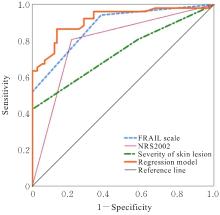
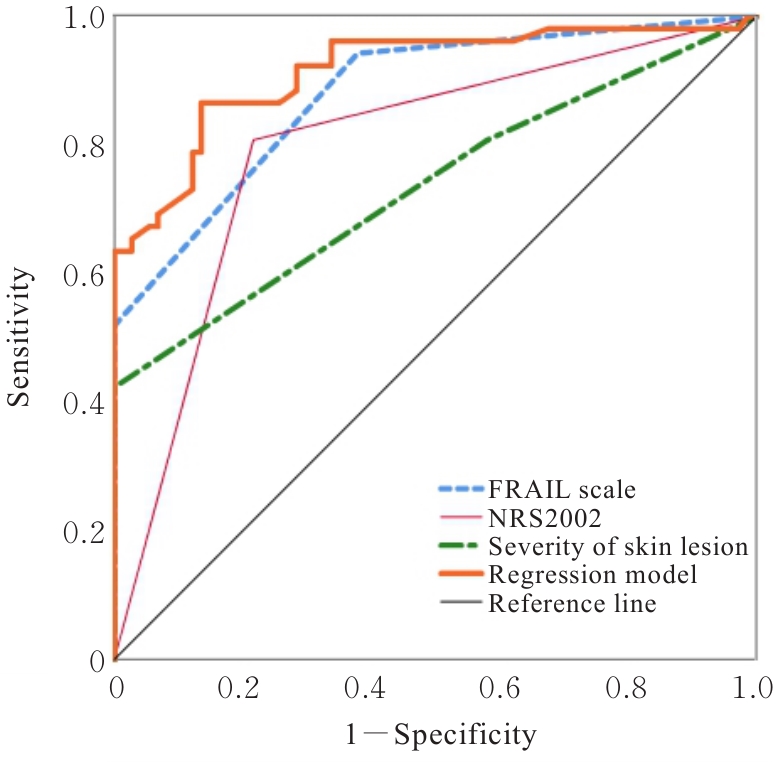
目的 探讨大疱性类天疱疮(BP)患者的感染情况及临床转归,分析BP住院患者发生感染的危险因素,构建并评价风险预测模型。 方法 选择首次确诊为BP的住院患者126例,根据BP患者是否发生感染分为感染组52例和未感染组74例,记录2组患者感染情况及转归情况,对2组患者的一般资料、实验室检查结果、衰弱筛查FRAIL量表评分、NRS2002评分和皮损严重程度进行统计学分析,采用多因素Logistic回归模型识别患者发生感染的危险因素,采用拟合优度检验评价模型,受试者工作特征(ROC)曲线评价模型对感染的预测价值。 结果 126例BP住院患者中,发生感染52例,感染率41.27%。感染组患者死亡率高于未感染组(P<0.05),未感染组患者缓解率高于感染组(P<0.05)。未感染组和感染组患者衰弱筛查FRAIL量表评分、NRS2002评分、血清白蛋白水平、前白蛋白水平、住院次数及皮损严重程度比较差异有统计学意义(P<0.05);多因素Logistic回归分析回归方程:Logistic(P)=-7.63+0.922×皮损严重程度+2.565×衰弱筛查FRAIL量表评分+1.214×NRS2002评分,Logistic回归模型曲线下面积为0.916。 结论 衰弱筛查FRAIL量表评分、NRS2002评分和皮损严重程度是BP住院患者发生感染的危险因素,据此构建的感染风险预测模型具有良好预测价值,可为预防BP住院患者发生感染提供新的防控思路。

关键词: 大疱性类天疱疮, 衰弱筛查FRAIL量表, 营养风险筛查工具2002评分, 感染, 危险因素, 预测模型

Abstract:

Objective To discuss the infection status and clinical outcomes in the patients with bullous pemphigoid (BP), and to analyze the risk factors for infection in hospitalized BP patients, as well as to construct and evaluate the risk prediction model. Methods A total of 126 patients first diagnosed with BP were selected. According to the occurrence of infection, the patients were divided into infection group (52 cases) and non-infection group (74 cases). The infection status and outcomes of the patients in two groups were recorded; statistical analysis was performed on the general data, laboratory examination results, FRAIL scale scores for frailty screening, NRS2002 scores, and skin lesion severity of the patients in two groups; multivariate Logistic regression model was used to identify the risk factors for infection in the patients; the goodness-of-fit test was used to evaluate the model; receiver operating characteristic (ROC) curve was used to evaluate the predictive value of the model for infection. Results Among the 126 hospitalized BP patients, 52 cases had infection, with an infection rate of 41.27%. The mortality rate of the patients in infection group was higher than that in non-infection group (P<0.05), and the remission rate of the patients in non-infection group was higher than that in infection group (P<0.05). The FRAIL scale score for frailty screening, NRS2002 score, serum albumin level, prealbumin level, number of hospitalization, skin lesion severity, and time of hospital stay of the patients in infection group were significantly higher than those in non-infection group (P<0.05). The multivariate Logistic regression analysis results derived the regression equation: Logistic(P)=-7.63+0.922×skin lesion severity+2.565×FRAIL scale score for frailty screening+1.214×NRS2002 score. The area under the curve of the Logistic regression model was 0.916. Conclusion The FRAIL scale score for frailty screening, NRS2002 score, and skin lesion severity are the risk factors for infection in the hospitalized BP patients. The constructed infection risk prediction model based on these factors has good predictive value and may provide new ideas for the prevention and control of infection in the hospitalized BP patients.?

Key words: Bullous pemphigoid, FRAIL scale score for frailty screening, Nutrition Risk Screening 2002 score, Infection, Risk factor, Prediction model

中图分类号: 

  • R758.66