Journal of Jilin University(Medicine Edition) ›› 2026, Vol. 52 ›› Issue (3): 872-880.doi: 10.13481/j.1671-587X.20260330
• Review • Previous Articles
Research progress in formation mechanism of tumor radioresistance and inhibitory effect of low-dose radiotherapy combination with novel sensitization strategies on tumor radioresistance
Yang YU1,2,Sheyu YE3,Kexin WEI4,Zhicheng WANG2( )
)
- 1.Department of Radiology,Affiliated Hospital,Beihua University,Jilin 132011,China
2.NHC Key Laboratory of Radiobiology,School of Public Health,Jilin University,Changchun 130021,China
3.Depatment of Radiotogy,Affiliated Hospital,North Sichuan Medical College,Nanchong,637504,China
4.Department of Hand Surgery,Affiliated Hospital,Beihua University,Jilin 132011,China
-
Received:2025-09-02Accepted:2025-11-10Online:2026-05-28Published:2026-06-08 -
Contact:Zhicheng WANG E-mail:zhicheng@jlu.edu.cn

CLC Number:
- R815.2
Cite this article
Yang YU,Sheyu YE,Kexin WEI,Zhicheng WANG. Research progress in formation mechanism of tumor radioresistance and inhibitory effect of low-dose radiotherapy combination with novel sensitization strategies on tumor radioresistance[J].Journal of Jilin University(Medicine Edition), 2026, 52(3): 872-880.
share this article
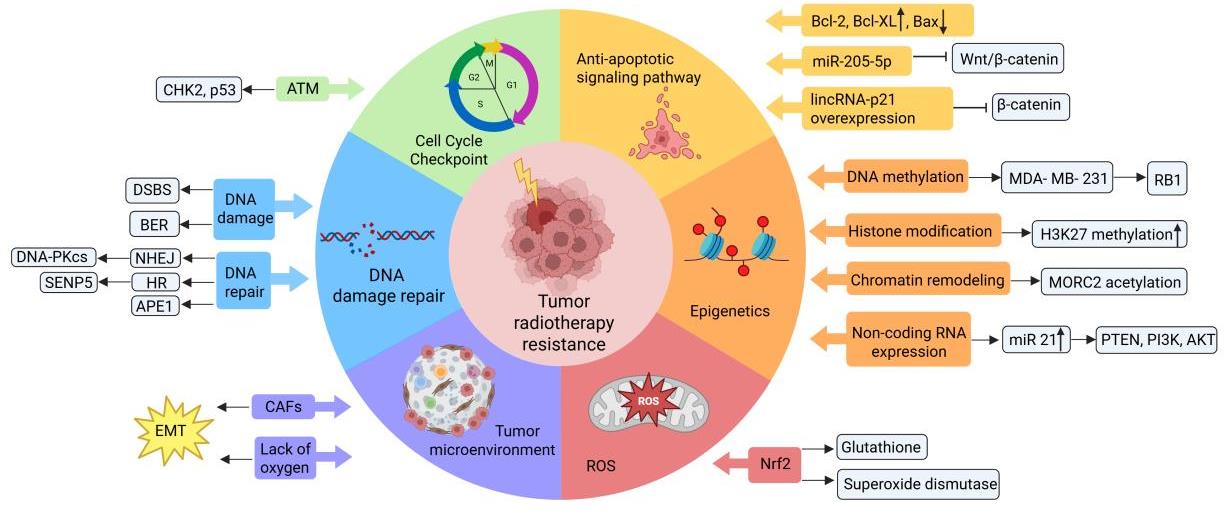
Fig. 1
Mechanism of tumor radioresistance"
| [1] | SCHAUE D, MCBRIDE W H. Opportunities and challenges of radiotherapy for treating cancer[J]. Nat Rev Clin Oncol, 2015, 12(9): 527-540. |
| [2] | FENG Y, LI Z J, SONG L Q, et al. A ZIF-8-based dual-modal smart responsive nanoplatform for overcoming radiotherapy resistance in advanced tumors[J]. Nanoscale, 2025, 17(19): 12134-12148. |
| [3] | WANG K, TEPPER J E. Radiation therapy-associated toxicity: Etiology, management, and prevention[J]. CA Cancer J Clin, 2021, 71(5): 437-454. |
| [4] | ZHOU L Y, LIU Y X, WU Y J, et al. Low-dose radiation therapy mobilizes antitumor immunity: New findings and future perspectives[J]. Int J Cancer, 2024, 154(7): 1143-1157. |
| [5] | YIN L M, XUE J X, LI R, et al. Effect of low-dose radiation therapy on abscopal responses to hypofractionated radiation therapy and anti-PD1 in mice and patients with non-small cell lung cancer[J]. Int J Radiat Oncol Biol Phys, 2020, 108(1): 212-224. |
| [6] | 崔 羽, 杨 露, 杜 雪, 等. 低剂量放疗联合免疫治疗在恶性肿瘤综合治疗中的研究进展[J]. 癌症进展, 2022, 20(14): 1424-1427, 1433. |
| [7] | 张羲茜, 翟素娜, 李冰妍. 中枢神经细胞瘤切除程度和辅助放疗与术后肿瘤进展的关系[J]. 郑州大学学报(医学版), 2025, 60(5): 689-691. |
| [8] | GONG L Y, ZHANG Y J, LIU C C, et al. Application of radiosensitizers in cancer radiotherapy[J]. Int J Nanomedicine, 2021, 16: 1083-1102. |
| [9] | LI Q, QIAN W Y, ZHANG Y, et al. A new wave of innovations within the DNA damage response[J]. Sig Transduct Target Ther, 2023, 8(1): 338. |
| [10] | RASS E, WILLAUME S, BERTRAND P. 53BP1: keeping it under control, even at a distance from DNA damage[J]. Genes, 2022, 13(12): 2390. |
| [11] | DESHPANDE R A, MYLER L R, SONIAT M M, et al. DNA-dependent protein kinase promotes DNA end processing by MRN and CtIP[J]. Sci Adv, 2020, 6(2): eaay0922. |
| [12] | ZHANG J N, DONG M M, CAO W, et al. Disruption of DNA-PKcs-mediated cGAS retention on damaged chromatin potentiates DNA damage-inducing agent-induced anti-multiple myeloma activity[J]. Br J Cancer, 2024, 131(3): 430-443. |
| [13] | LIU T T, WANG H, CHEN Y Y, et al. SENP5 promotes homologous recombination-mediated DNA damage repair in colorectal cancer cells through H2AZ deSUMOylation[J]. J Exp Clin Cancer Res, 2023, 42(1): 234. |
| [14] | ZHOU J, WEI Z X, YANG C, et al. APE1 promotes radiation resistance against radiation-induced pyroptosis by inhibiting the STING pathway in lung adenocarcinoma[J]. Transl Oncol, 2023, 36: 101749. |
| [15] | VAKILI-SAMIANI S, KHANGHAH O J, GHOLIPOUR E, et al. Cell cycle involvement in cancer therapy; WEE1 kinase, a potential target as therapeutic strategy[J]. Mutat Res, 2022, 824: 111776. |
| [16] | ZHANG W H, LI Q L, YIN R T. Targeting WEE1 kinase in gynecological malignancies[J]. Drug Des Devel Ther, 2024, 18: 2449-2460. |
| [17] | LI C L, DENG C S, WANG S W, et al. A novel role for the ROS-ATM-Chk2 axis mediated metabolic and cell cycle reprogramming in the M1 macrophage polarization[J]. Redox Biol, 2024, 70: 103059. |
| [18] | COSENTINO K, HERTLEIN V, JENNER A, et al. The interplay between BAX and BAK tunes apoptotic pore growth to control mitochondrial-DNA-mediated inflammation[J]. Mol Cell, 2022, 82(5): 933-949. |
| [19] | PARK D, ANISUZZAMAN A S M, MAGIS A T, et al. Discovery of small molecule bak activator for lung cancer therapy[J]. Theranostics, 2021, 11(17): 8500-8516. |
| [20] | SAFA A R. Drug and apoptosis resistance in cancer stem cells: a puzzle with many pieces[J]. Cancer Drug Resist, 2022, 5(4): 850-872. |
| [21] | LOPEZ A, REYNA D E, GITEGO N, et al. Co-targeting of BAX and BCL-XL proteins broadly overcomes resistance to apoptosis in cancer[J]. Nat Commun, 2022, 13(1): 1199. |
| [22] | 张玉宇, 王利波, 赵 钦, 等. 肿瘤微环境与肿瘤细胞放射敏感性关系的研究进展[J]. 吉林大学学报(医学版), 2016, 42(5): 1038-1044. |
| [23] | LI Y, MA X, LI J, et al. LncRNA gas5 regulates granulosa cell apoptosis and viability following radiation by X-ray through sponging miR-205-5p and Wnt/β-catenin signaling pathway ingranulosa cell tumor of ovary[J]. Trop J Pharm Res, 2021, 19(12): 2491-2498. |
| [24] | CHEN L J, YUAN D F, YANG Y C, et al. LincRNA-p21 enhances the sensitivity of radiotherapy for gastric cancer by targeting the β-catenin signaling pathway[J]. J Cell Biochem, 2019, 120(4): 6178-6187. |
| [25] | DEEPAK K G K, VEMPATI R, NAGARAJU G P, et al. Tumor microenvironment: Challenges and opportunities in targeting metastasis of triple negative breast cancer[J]. Pharmacol Res, 2020, 153: 104683. |
| [26] | ZHOU S N, ZHANG M X, ZHOU C, et al. The role of epithelial-mesenchymal transition in regulating radioresistance[J]. Crit Rev Oncol Hematol, 2020, 150: 102961. |
| [27] | HUANG R X, ZHOU P K. HIF-1 signaling: a key orchestrator of cancer radioresistance[J]. Radiat Med Prot, 2020, 1(1): 7-14. |
| [28] | YI M, BAN Y Y, TAN Y X, et al. 6-Phosphofructo-2-kinase/fructose-2, 6-biphosphatase 3 and 4: a pair of valves for fine-tuning of glucose metabolism in human cancer[J]. Mol Metab, 2019, 20: 1-13. |
| [29] | YANG X G, LU Y, HANG J J, et al. Lactate-modulated immunosuppression of myeloid-derived suppressor cells contributes to the radioresistance of pancreatic cancer[J]. Cancer Immunol Res, 2020, 8(11): 1440-1451. |
| [30] | FIORI M E, DI FRANCO S, VILLANOVA L, et al. Cancer-associated fibroblasts as abettors of tumor progression at the crossroads of EMT and therapy resistance[J]. Mol Cancer, 2019, 18(1): 70. |
| [31] | GOULET C R, CHAMPAGNE A, BERNARD G, et al. Cancer-associated fibroblasts induce epithelial-mesenchymal transition of bladder cancer cells through paracrine IL-6 signalling[J]. BMC Cancer, 2019, 19(1): 137. |
| [32] | NARAYANAN D, MA S N, ÖZCELIK D. Targeting the redox landscape in cancer therapy[J]. Cancers, 2020, 12(7): 1706. |
| [33] | NAKAMURA T, SAKAMOTO K. Forkhead transcription factor FOXO subfamily is essential for reactive oxygen species-induced apoptosis[J]. Mol Cell Endocrinol, 2008, 281(1/2): 47-55. |
| [34] | PATWARDHAN R S, SHARMA D, SANDUR S K. Thioredoxin reductase: an emerging pharmacologic target for radiosensitization of cancer[J]. Transl Oncol, 2022, 17: 101341. |
| [35] | RAKOTOMALALA A, ESCANDE A, FURLAN A, et al. Hypoxia in solid tumors: how low oxygenation impacts the “six rs” of radiotherapy[J]. Front Endocrinol, 2021, 12: 742215. |
| [36] | LEE M, NAM H Y, KANG H B, et al. Epigenetic regulation of p62/SQSTM1 overcomes the radioresistance of head and neck cancer cells via autophagy-dependent senescence induction[J]. Cell Death Dis, 2021, 12(3): 250. |
| [37] | ANTWIH D A, GABBARA K M, LANCASTER W D, et al. Radiation-induced epigenetic DNA methylation modification of radiation-response pathways[J]. Epigenetics, 2013, 8(8): 839-848. |
| [38] | PARK J, LEE H J, HAN Y K, et al. Identification of DNA methylation biomarkers for evaluating cardiovascular disease risk from epigenome profiles altered by low-dose ionizing radiation[J]. Clin Epigenetics, 2024, 16(1): 19. |
| [39] | ORONSKY B, SCICINSKI J, KIM M M, et al. Turning on the radio: epigenetic inhibitors as potential radiopriming agents[J]. Biomolecules, 2016, 6(3): 32. |
| [40] | WANG Y X, HAN Y, JIN Y Z, et al. The advances in epigenetics for cancer radiotherapy[J]. Int J Mol Sci, 2022, 23(10): 5654. |
| [41] | WANG N, MA T, YU B. Targeting epigenetic regulators to overcome drug resistance in cancers[J]. Sig Transduct Target Ther, 2023, 8(1): 69. |
| [42] | JIE X H, FONG W P, ZHOU R, et al. USP9X-mediated KDM4C deubiquitination promotes lung cancer radioresistance by epigenetically inducing TGF-β2 transcription[J]. Cell Death Differ, 2021, 28(7): 2095-2111. |
| [43] | OGIWARA H, UI A, OTSUKA A, et al. Histone acetylation by CBP and p300 at double-strand break sites facilitates SWI/SNF chromatin remodeling and the recruitment of non-homologous end joining factors[J]. Oncogene, 2011, 30(18): 2135-2146. |
| [44] | LIN R K, HSU H S, CHANG J W, et al. Alteration of DNA methyltransferases contributes to 5'CpG methylation and poor prognosis in lung cancer[J]. Lung Cancer, 2007, 55(2): 205-213. |
| [45] | ZHAO H J, WU X, WANG Y H, et al. Histone variant H2AZ1 drives lung cancer progression through the RELA-HIF1A-EGFR signaling pathway[J]. Cell Commun Signal, 2024, 22(1): 453. |
| [46] | CHENG J Y, REN S F, FU H P, et al. Effective BiOBr(I)-BP nanocomposite for synergistic photothermal and radiodynamic therapy against hypoxic tumor to complement low-dose radiotherapy[J]. Colloids Surf A Physicochem Eng Aspects, 2025, 711: 136411. |
| [47] | CHEN L, ZHANG J H, XU L H, et al. Composition tunability of semiconductor radiosensitizers for low-dose X-ray induced photodynamic therapy[J]. J Nanobiotechnology, 2022, 20(1): 293. |
| [48] | ZHU S C, YAN F H, YANG L L, et al. Low-dose X-ray radiodynamic therapy solely based on gold nanoclusters for efficient treatment of deep hypoxic solid tumors combined with enhanced antitumor immune response[J]. Theranostics, 2023, 13(3): 1042-1058. |
| [49] | HU A K, ZHOU W Y, LUO X Y, et al. Impact of oxygen on DNA damage distribution in 3D genome and its correlation to oxygen enhancement ratio after high-LET irradiation[J]. Radiat Res, 2025: 41196811. |
| [50] | JIA S C, GE S F, FAN X Q, et al. Promoting reactive oxygen species generation: a key strategy in nanosensitizer-mediated radiotherapy[J]. Nanomedicine (Lond), 2021, 16(9): 759-778. |
| [51] | ZHU D M, LIU Z M, LI Y, et al. Delivery of manganese carbonyl to the tumor microenvironment using Tumor-Derived exosomes for cancer gas therapy and low dose radiotherapy[J]. Biomaterials, 2021, 274: 120894. |
| [52] | SHAO N, YANG Y Q, HU G W, et al. Synergistic enhancement of low-dose radiation therapy via cuproptosis and metabolic reprogramming for radiosensitization in in situ hepatocellular carcinoma[J]. J Nanobiotechnology, 2024, 22(1): 772. |
| [53] | ZHANG R, JIA M C, LV H Y, et al. Assembling Au8 clusters on surfaces of bifunctional nanoimmunomodulators for synergistically enhanced low dose radiotherapy of metastatic tumor[J]. J Nanobiotechnology, 2024, 22(1): 20. |
| [54] | ZHUANG W J, PAN K W, WU J, et al. Harnessing the power of traceable system C-GAP: homologous-targeting to fire up T-cell immune responses with low-dose irradiation[J]. J Nanobiotechnology, 2025, 23(1): 207. |
| [55] | KLUG F, PRAKASH H, HUBER P E, et al. Low-dose irradiation programs macrophage differentiation to an iNOS⁺/M1 phenotype that orchestrates effective T cell immunotherapy[J]. Cancer Cell, 2013, 24(5): 589-602. |
| [56] | 张羲茜, 翟素娜, 李冰妍. 中枢神经细胞瘤切除程度和辅助放疗与术后肿瘤进展的关系[J]. 郑州大学学报(医学版), 2025, 60(5): 689-691. |
| [57] | CLEARY J M, AGUIRRE A J, SHAPIRO G I, et al. Biomarker-guided development of DNA repair inhibitors[J]. Mol Cell, 2020, 78(6): 1070-1085. |
| [58] | DUKE K, PAPANIKOLAOU N. Artificial intelligence in radiation therapy: from imaging to delivery: a comprehensive review[J]. BJR Artif Intell, 2025, 2(1): ubaf012. |
| [59] | 吴晓勤, 汪珍光, 刘 辉. 人工智能结合多模态影像融合技术在肝脏外科中的应用[J]. 临床肝胆病杂志, 2025, 41(11): 2201-2206. |
| [60] | SUN L M, LIU H M, YE Y Q, et al. Smart nanoparticles for cancer therapy[J]. Sig Transduct Target Ther, 2023, 8: 418. |
| [61] | CUI R W, WU Q, WANG J, et al. Hydrogel-by-design:smart delivery system for cancer immunotherapy[J]. Front Bioeng Biotechnol, 2021, 9: 723490. |
| [1] | Changfeng LIU,Guangjun JIN,Yonggang WANG. Primary renal angiosarcoma with multiple abdominal haemorrhages: A case repert and literature review [J]. Journal of Jilin University(Medicine Edition), 2026, 52(3): 821-827. |
| [2] | Dongxin JIANG, Yunqian LI. Research progress in clinical diagnosis and treatment of oligodendroglioma [J]. Journal of Jilin University(Medicine Edition), 2026, 52(1): 272-280. |
| [3] | Jia YANG,Lingling TONG,Jinshu MA,Huafeng GENG. Misdiagnosis of ovarian sclerosing stromal tumor as malignant tumor: A case report and literature review [J]. Journal of Jilin University(Medicine Edition), 2025, 51(4): 1115-1120. |
| [4] | Xinyi YU,Zhifang JIA,Yuzheng ZHANG,Yuchen PAN,Yangyu ZHANG,Yanhua WU,Donghui CAO,Jing JIANG. Analysis on distribution and trend of malignant tumor incidence and mortality in Dehui City and Yanji City in Jilin Province from 2009 to 2016 [J]. Journal of Jilin University(Medicine Edition), 2025, 51(3): 797-806. |
| [5] | Luyao WANG,Chenxi ZHAO,Wanze ZHANG,Linlin LIU. Second primary tracheal adenoid cystic carcinoma:A case report and literature review [J]. Journal of Jilin University(Medicine Edition), 2025, 51(1): 215-221. |
| [6] | Honghong LI,Na YU,Minghao SHI,Ying SUN,Yao LI,Zhongjun SHEN,Xiaoyi LIU,Liyan ZHAO. Predictive value of new thrombotic risk assessment model for venous thromboembolism in patients with malignant tumors [J]. Journal of Jilin University(Medicine Edition), 2024, 50(5): 1390-1399. |
| [7] | Dehong ZHANG,Mingzhu ZHENG,Jiaqiu LI,Zhong LU. Bioinformatics analysis based on expressions of MSR1 mRNA and protein in pan-cancer tissue and its significance [J]. Journal of Jilin University(Medicine Edition), 2023, 49(2): 425-439. |
| [8] | Min WANG,Pengyue YU,Yan WANG,Yanke SONG,Yao LI,Ying SUN,Liyan ZHAO. Evaluation values of peripheral blood coagulation indexes, platelet count and NLR in coagulation state in patients with malignant tumors before treatment [J]. Journal of Jilin University(Medicine Edition), 2022, 48(1): 203-210. |
| [9] | Cong WANG, Xiu GUO, Hao CHI, Jie ZHANG, Mingyu XU, Chunling DONG. Application values of simplified Wells score, revised Geneva score and D-dimer level in diagnosis of malignant tumor complicated with pulmonary thromboembolism [J]. Journal of Jilin University(Medicine Edition), 2021, 47(3): 707-713. |
| [10] | ZHENG Jianxiao, ZHAN Wenting, ZHOU Xiaochun, KONG Yilin, GAO Lei, LI Gong, WANG Sumei. Radiosensitization of Compound Sophora Flavescens Injection on nasopharyngeal carcinoma CNE-2 cells [J]. Journal of Jilin University(Medicine Edition), 2019, 45(06): 1384-1388. |
| [11] | ZOU Jun, CHEN Bing, FANG Minghui, HU Zheng. Establishment and identification of humanized mouse models with human immune system and allogeneic human melanoma growth [J]. Journal of Jilin University(Medicine Edition), 2019, 45(03): 718-724. |
| [12] | WANG Jianan, FENG Hui, WANG Qian, HE Yueming, SONG Yanqiu, ZHU Jihong. Killer effect of natural killer cells combined with tamoxifen on breast cancer cells in vitro and its mechanism [J]. Journal of Jilin University Medicine Edition, 2017, 43(02): 281-287. |
| [13] | WANG Ruibin, HE Dongyun, ZOU Jiyan, SHENG Minjia. Influence of DC-CIK immunotherapy in blood coagulation function and D-dimer levels in patients with ovarian cancer [J]. Journal of Jilin University Medicine Edition, 2017, 43(01): 120-124. |
| [14] | SONG Chenxue, WANG Yubo, LIU Chuangui, XIE Jingshu, LU Yanjiao, WANG Ting, WANG Guoqiang, WANG Yawei, WANG Fang, ZHENG Jingtong. Treatment of Helicobacter pylori induced chronic atrophic gastritiswith traditional Chinese medicine combined standard triple therapyand its mechanisms [J]. Journal of Jilin University Medicine Edition, 2016, 42(04): 789-792. |
| [15] | JIN Zhonghui, LYU Zhongwen, ZHU Huici, LIU Jun, HE Ping, LI Xinxin, SONG Le, LIU Yuliang. Feasibility of glucose loading at delayed phase of FDG PET/CT scaning in predicting influence of hyperglycemiain multi- drug resistance protein or P-glycoprotein [J]. Journal of Jilin University Medicine Edition, 2015, 41(01): 125-128. |
|
||