吉林大学学报(工学版) ›› 2025, Vol. 55 ›› Issue (6): 1873-1882.doi: 10.13229/j.cnki.jdxbgxb.20230926
基于改进鸽群优化算法的燃料电池汽车模糊能量管理策略
肖纯1,2( ),易子淳1,2,周炳寅3,张少睿1,2
- 1.武汉理工大学 自动化学院,武汉 430070
2.国家能源氢能及氨氢融合新能源技术重点实验室(佛山仙湖实验室),广东 佛山 528200
3.西安比亚迪半导体有限公司,西安 710061
Fuzzy energy management strategy of fuel cell electric vehicle based on improved pigeon⁃inspired optimization
Chun XIAO1,2(),Zi-chun YI1,2,Bing-yin ZHOU3,Shao-rui ZHANG1,2
- 1.School of Automation,Wuhan University of Technology,Wuhan 430070,China
2.National Energy Key Laboratory for New Hydrogen-Ammonia Energy Technologies,Foshan Xianhu Laboratory,Foshan 528200,China
3.Xi'an BYD Semiconductor Co. ,Ltd. ,Xi'an 710061,China
摘要:
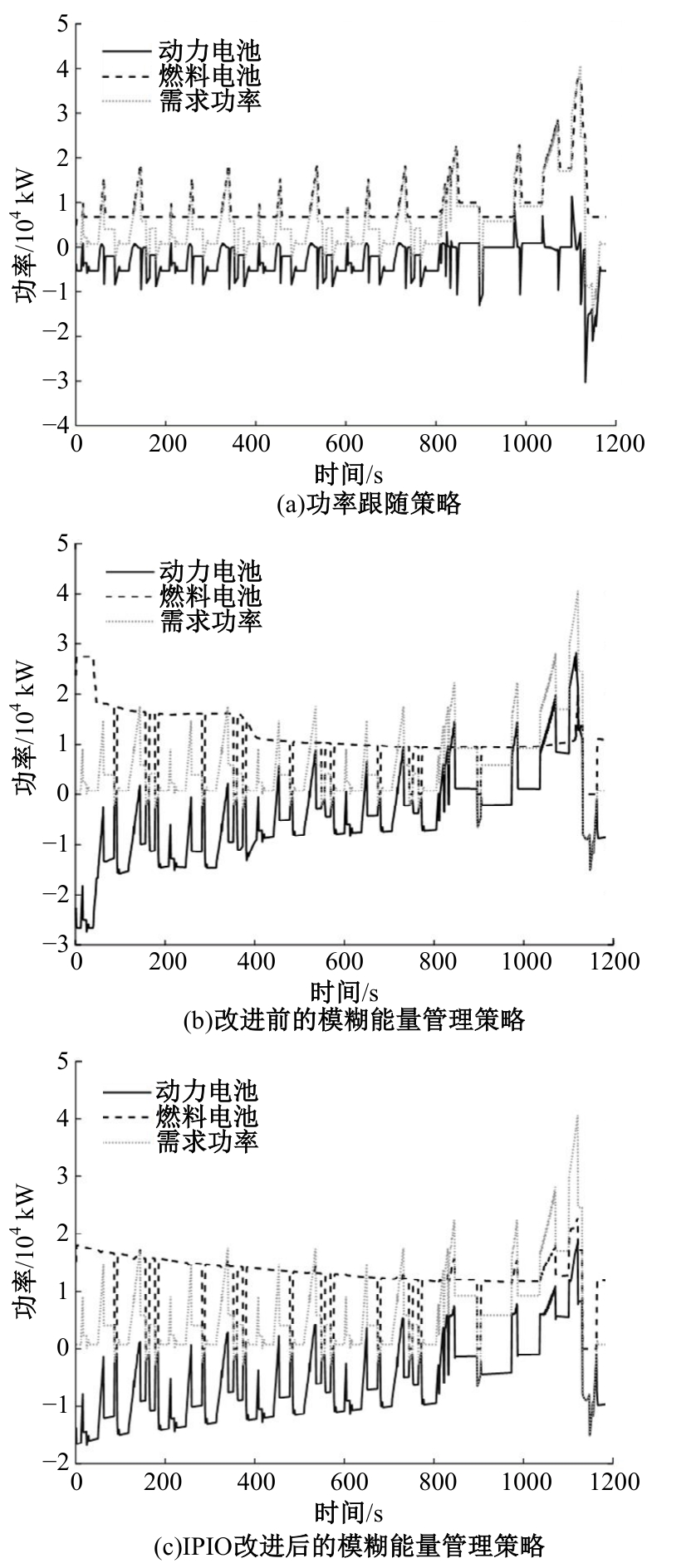
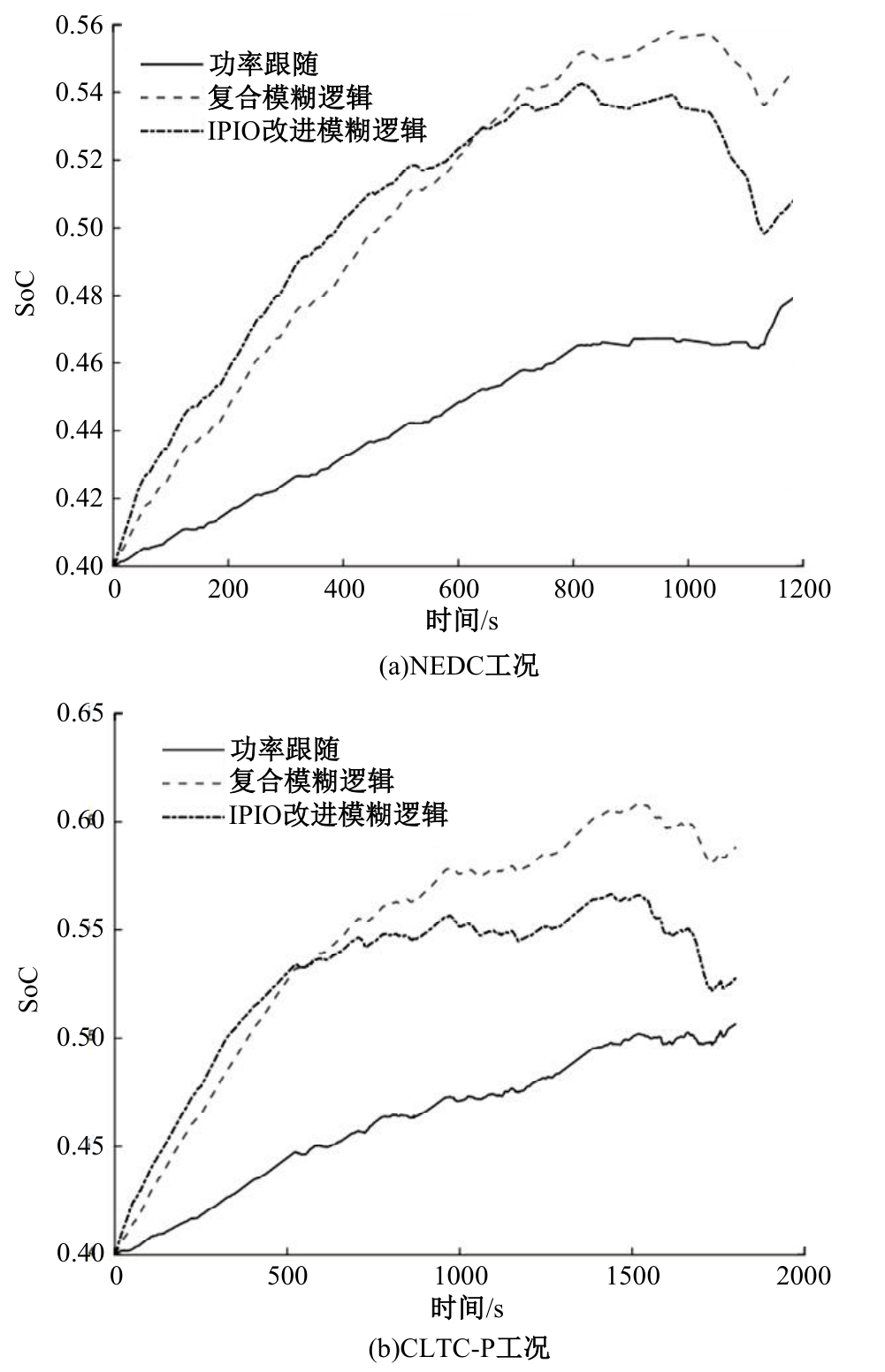
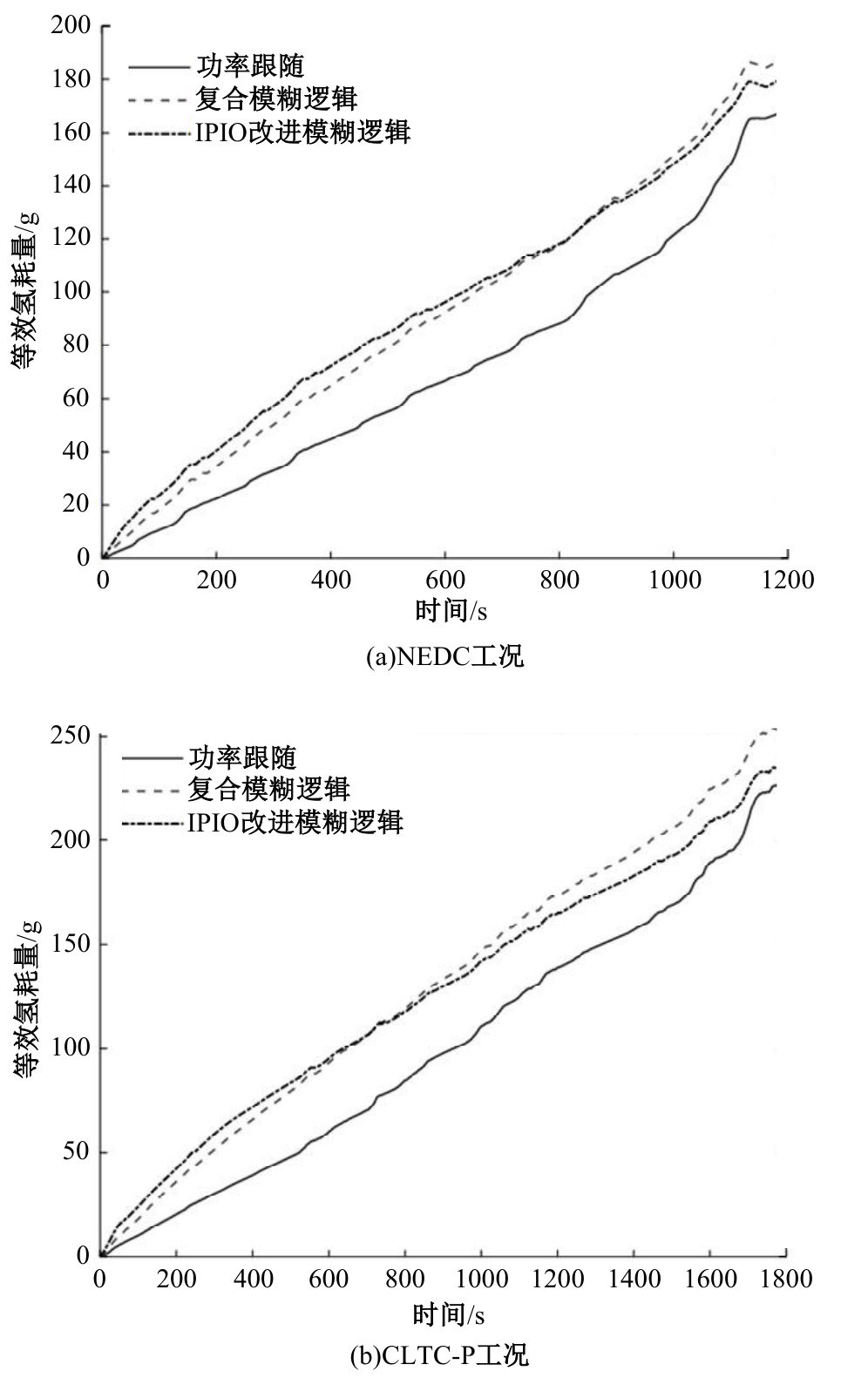
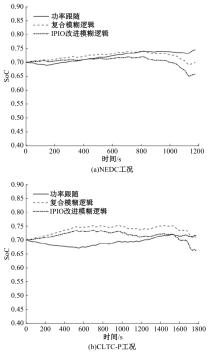
以提高辅助能量源动力电池的寿命为目标提出复合模糊能量管理策略,采用改进鸽群优化算法(IPIO)更新模糊隶属度函数,同时确保动力电池长时间工作在适宜区间并降低等效氢耗量。对现有ADVISOR模型进行二次开发建立FCEV混合动力系统的仿真模型,并在NEDC、CLTC-P两种工况下进行仿真实验。结果表明:本文提出的复合模糊能量管理策略在初始SoC较低的情况下充电速度是功率跟随策略的2倍以上,能更快达到适宜的SoC区间,可以延长动力电池寿命;在初始SoC较高的情况下,本文提出的复合模糊能量管理策略等效氢耗量相比改进前在两种工况下分别降低了11.8%和9.09%,显著降低了氢耗量,提高了氢燃料电池汽车的经济性。
中图分类号:
- U461.8

| [1] | 崔鹏飞, 沈英, 赵剀烨. 基于模糊控制的燃料电池汽车动力源能量管理[J]. 机械制造与自动化, 2020, 49(4): 177-179, 187. |
| Cui Peng-fei, Shen Ying, Zhao Kai-ye. Energy management of fuel cell vehicle power source based on fuzzy control[J]. Machine Building & Automation, 2020, 49(4): 177-179, 187. | |
| [2] | 严陈希, 耿文冉, 黄明宇, 等. 基于工况识别的混合动力汽车能量管理策略[J]. 机械设计与制造, 2022, 373(3): 24-29. |
| Yan Chen-xi, Geng Wen-ran, Huang Ming-yu, et al. Energy management strategy for hybrid electric vehicles based on condition recognition[J]. Machinery Design & Manufacture, 2022, 373(3): 24-29. | |
| [3] | Song K, Li F Q, Hu X, et al. Multi-mode energy management strategy for fuel cell electric vehicles based on driving pattern identification using learning vector quantization neural network algorithm[J]. Journal of Power Sources, 2018, 389: 230-239. |
| [4] | Liu Y G, Liu J J, Zhang Y J, et al. Rule learning based energy management strategy of fuel cell hybrid vehicles considering multi-objective optimization[J]. Energy, 2020, 207: No.118212. |
| [5] | Wang Y, Sun Z, Chen Z. Energy management strategy for battery/supercapacitor/fuel cell hybrid source vehicles based on finite state machine[J]. Applied energy, 2019, 254: No.113707. |
| [6] | Zhang Q, Fu X L. A neural network fuzzy energy management strategy for hybrid electric vehicles based on driving cycle recognition[J]. Applied Sciences, 2020, 10(2): No.696. |
| [7] | 张宇. 基于模糊规则学习的燃料电池混合动力汽车能量管理策略[D]. 长春: 吉林大学通信工程学院, 2021. |
| Zhang Yu. Energy management strategy for fuel cell hybrid electric vehicles based on fuzzy rule learning [D]. Changchun: College of Communication Engineering, Jilin University, 2021. | |
| [8] | 周健豪, 顾诚, 刘军, 等. 基于IGWO的燃料电池汽车模糊控制能量管理策略[J]. 重庆理工大学学报: 自然科学, 2021, 35(5): 33-41. |
| Zhou Jian-hao, Gu Cheng, Liu Jun, et al. Fuzzy control energy management strategy for fuel cell vehicles based on IGWO[J]. Journal of Chongqing University of Technology(Natural Science), 2021, 35(5): 33-41. | |
| [9] | Hu X, Liu S K, Song K, et al. Novel fuzzy control energy management strategy for fuel cell hybrid electric vehicles considering state of health[J]. Energies, 2021, 14(20): No.6481. |
| [10] | Zhou S Y, Chen Z Q, Huang D Y,et al. Model prediction and rule based energy management strategy for a plug-in hybrid electric vehicle with hybrid energy storage system[J]. IEEE Transactions on Power Electronics, 2020, 36(5): 5926-5940. |
| [11] | 霍梦真, 段海滨. 基于自适应变异的多目标鸽群优化的无人机目标搜索[J]. 控制理论与应用, 2020, 37(3): 584-591. |
| Huo Meng-zhen, Duan Hai-bin. Unmanned aerial vehicle target search based on adaptive mutation for multi-objective pigeon swarm optimization[J]. Control Theory and Applications, 2020, 37(3): 584-591. | |
| [12] | 夏小刚, 罗建婷, 王欣. 模糊变异算子的改进鸽群优化算法[J]. 河南科技大学学报: 自然科学版, 2022, 43(3): 39-44. |
| Xia Xiao-gang, Luo Jian-ting, Wang Xin.Improved pigeon-inspired optimization algorithm of fuzzy variation operator[J].Journal of Henan University of Science and Technology(Natural Science), 2022, 43(3): 39-44. |
| [1] | 宋学伟,于泽平,肖阳,王德平,袁泉,李欣卓,郑迦文. 锂离子电池老化后性能变化研究进展[J]. 吉林大学学报(工学版), 2025, 55(6): 1817-1833. |
| [2] | 贾美霞,胡建军,肖凤. 基于多软件联合的车用电机变工况多物理场仿真方法[J]. 吉林大学学报(工学版), 2025, 55(6): 1862-1872. |
| [3] | 李伟东,马草原,史浩,曹衡. 基于分层强化学习的自动驾驶决策控制算法[J]. 吉林大学学报(工学版), 2025, 55(5): 1798-1805. |
| [4] | 卢荡,索艳茹,孙宇航,吴海东. 基于无量纲格式的轮胎侧倾侧偏力学特性预测[J]. 吉林大学学报(工学版), 2025, 55(5): 1516-1524. |
| [5] | 张涛,林黄达,余中军. 混合动力车辆换挡的实时滚动优化控制方法[J]. 吉林大学学报(工学版), 2025, 55(4): 1215-1224. |
| [6] | 高镇海,郑程元,赵睿. 真实与虚拟场景下自动驾驶车辆的主动安全性验证与确认综述[J]. 吉林大学学报(工学版), 2025, 55(4): 1142-1162. |
| [7] | 卢荡,王晓凡,吴海东. TWEEL轮胎接地压力均布特性分析[J]. 吉林大学学报(工学版), 2025, 55(3): 811-819. |
| [8] | 曲俊龙,史文库,玄圣夷,陈志勇. 面向汽车传动系统多挡共振的多级吸振器参数设计方法[J]. 吉林大学学报(工学版), 2025, 55(2): 444-455. |
| [9] | 朱冰,范天昕,赵文博,李伟男,张培兴. 自动驾驶汽车连续测试场景复杂度评估方法[J]. 吉林大学学报(工学版), 2025, 55(2): 456-467. |
| [10] | 陈鑫,张祥源,武子涛,于贵申,杨立飞. 工艺顺序对车用铝薄板胶-PFSSW接头拉剪性能的影响[J]. 吉林大学学报(工学版), 2025, 55(2): 468-475. |
| [11] | 王军年,曹宇靖,罗智仁,李凯旋,赵文伯,孟盈邑. 基于双目视觉的道路水深在线检测算法[J]. 吉林大学学报(工学版), 2025, 55(1): 175-184. |
| [12] | 谭草,任浩鑫,葛文庆,宋亚东,陆佳瑜. 直驱阀控液压振动平台改进自抗扰控制[J]. 吉林大学学报(工学版), 2025, 55(1): 84-92. |
| [13] | 胡宏宇,张争光,曲优,蔡沐雨,高菲,高镇海. 基于双分支和可变形卷积网络的驾驶员行为识别方法[J]. 吉林大学学报(工学版), 2025, 55(1): 93-104. |
| [14] | 李寿涛,杨路,屈如意,孙鹏鹏,于丁力. 基于模型预测控制的滑移率控制方法[J]. 吉林大学学报(工学版), 2024, 54(9): 2687-2696. |
| [15] | 吴量,顾义凡,邢彪,马芳武,倪利伟,贾微微. 基于线性二次型调节器的四轮转向与分布式集成控制方法[J]. 吉林大学学报(工学版), 2024, 54(9): 2414-2422. |
|