吉林大学学报(工学版) ›› 2025, Vol. 55 ›› Issue (4): 1287-1297.doi: 10.13229/j.cnki.jdxbgxb.20230682
考虑用户成本和泊位利用率的停车预约分配模型
宋现敏( ),湛天舒,李海涛(),刘博,张云翔
- 吉林大学 交通学院,长春 130022
Reservation and allocation model considering user cost and utilization of parking space
Xian-min SONG(),Tian-shu ZHAN,Hai-tao LI(),Bo LIU,Yun-xiang ZHANG
- School of Transportation,Jilin University,Changchun 130022,China
摘要:
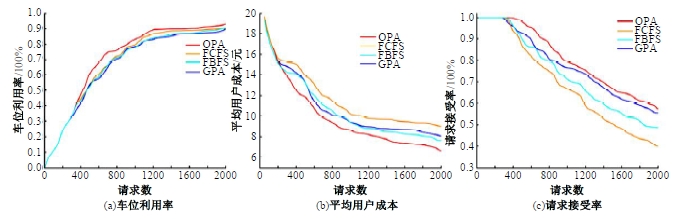
为提高停车资源利用率以缓解停车供需失衡问题,考虑停车分配过程中用户利益与系统效益间的博弈关系,建立了预约模式下停车泊位利用率最大和用户成本最小的联合优化目标函数;构建了融合用户偏好特性的最优停车分配整数规划模型(OPA),并设计了增广拉格朗日-交替乘子算法进行预约泊位分配方案求解。为检验模型的有效性,在不同停车供需情况下将本文模型与多种经典停车分配模型对比,结果表明:本文OPA模型在泊位利用率、用户平均成本和请求接收率3个评价指标上的表现均明显优于经典分配模型,本文研究成果可为停车预约平台的决策管理提供理论参考。
中图分类号:
- U491.5

| [1] | Shoup D. Cruising for parking[J]. Transport Policy, 2006, 13(6): 479-486. |
| [2] | 宁瑞昌. 基于预约模式的停车选择模型研究[D]. 西安: 长安大学交通学院, 2017. |
| Ning Rui-chang. Research on parking selection model based on reservation mode[D]. Xi´an: School of Transportation, Chang´an University, 2017. | |
| [3] | He H, Zhang Z X, Yan P Y. A real-time reservation service for smart parking system[C]∥The 15th International Conference on Service Systems and Service Management (ICSSSM), Hangzhou, China, 2018: 1-6. |
| [4] | Said A M, Kamal A, Afifi H. An intelligent parking sharing system for green and smart cities based IoT[J]. Computer Communications, 2021, 172: 10-18. |
| [5] | 盖松雪, 曾小清, 岳晓园, 等. 基于用户-系统双层优化算法的车位引导模型[J]. 吉林大学学报:工学版, 2022, 52(6): 1344-1352. |
| Gai Song-xue, Zeng Xiao-qing, Yue Xiao-yuan, et al. Parking guidance model based on user and system bi⁃level optimization algorithm[J]. Journal of Jilin University(Engineering and Technology Edition), 2022, 52(6): 1344-1352. | |
| [6] | Liu W, Graham D J, Yang H, et al. Modeling and managing the joint equilibrium of destination and parking choices under hybrid supply of curbside and shared parking[J]. Transportation Research Part C—Emerging Technologies, 2021, 130: No. 103301. |
| [7] | Zhang F N, Liu W, Wang X L, et al. Parking sharing problem with spatially distributed parking supplies[J]. Transportation Research Part C—Emerging Technologies, 2020, 117:No.102676. |
| [8] | Shao C Y, Yang H, Zhang Y, et al. A simple reservation and allocation model of shared parking lots[J]. Transportation Research Part C—Emerging Technologies, 2016, 71: 303-312. |
| [9] | Xie M H, Zhang X Y, Wu Z H, et al. A shared parking optimization framework based on dynamic resource allocation and path planning[J]. Physica D: Nonlinear Phenomena, 2023, 616: No.128649. |
| [10] | 孙会君, 傅丹华, 吕莹, 等. 基于共享停车的泊位租用与分配模型[J]. 交通运输系统工程与信息, 2020, 20(3): 130-136. |
| Sun Hui-jun, Fu Dan-hua, Ying Lyu, et al. Parking spaces renting and allocation model for shared parking[J]. Journal of Transportation Systems Engineering and Information Technology, 2020, 20(3): 130-136. | |
| [11] | Zhao P F, Guan H Z, Wei H, et al. Mathematical modeling and heuristic approaches to optimize shared parking resources: a case study of Beijing, China[J]. Transportation Research Interdisciplinary Perspectives, 2021, 9: 2590-1982. |
| [12] | Wang S F, Li Z H, Xie N. A reservation and allocation model for shared-parking addressing the uncertainty in drivers' arrival/departure time[J]. Transportation Research Part C—Emerging Technologies, 2022, 135: No. 103484. |
| [13] | Kim O T T, Tran N H, Pham C, et al. Parking assignment: minimizing parking expenses and balancing parking demand among multiple parking lots[J]. IEEE Transactions on Automation Science and Engineering, 2020, 17(3): 1320-1331. |
| [14] | 戴静. 居住区共享停车泊位分配模型研究[D]. 哈尔滨: 东北林业大学交通学院, 2018. |
| Dai Jing. Shared parking spaces induction model in residential areas[D]. Harbin: School of Transportation, Northeast Forestry University, 2018. | |
| [15] | Wang Y, Chen Q. Dynamic parking allocation model in a multidestination multiple parking lot system[J]. IEEE Intelligent Transportation Systems Magazine, 2022, 14(5): 195-208. |
| [16] | 杨博. 基于时间窗约束的居住区共享停车泊位预订分配模型研究[D]. 北京:北京交通大学交通运输学院, 2018. |
| Yang Bo. The study on shared parking slots allocation model for residential areas based on time window constraint[D]. Beijing: School of Transportation, Beijing Jiaotong University, 2018. | |
| [17] | Choi H G, Seiler P J, Dhople S V. Propagating uncertainty in power flow with the alternating direction method of multipliers[J]. IEEE Transactions on Power Systems, 2018, 33(4): 4124-4133. |
| [18] | Jiang B W, Fan Z P. Optimal allocation of shared parking slots considering parking unpunctuality under a platform-based management approach[J]. Transportation Research Part E: Logistics and Transportation Review, 2020, 142:No. 102062. |
| [19] | Xie M H, Lin S Y, Wu Z H, et al. Optimal allocation and adjustment mechanism of shared parking slots considering combined parking resources[J]. Transportation Letters, 2023,15(7): 730-741. |
| [20] | Richardson A J. An improved parking duration study method[C]∥Proceedings of the 7th Australian Road Research Board Conference, Adelaide, Australia, 1974: 397-413. |
| [21] | Xue Z J, Cheng J H, Ji K F. An allocation model of shared parking with continuous time windows[C]∥Conference on Industrial Electronics and Applications, Chengdu, China, 2021:253-258. |
| [1] | 潘义勇,徐家聪,尤逸文,全勇俊. 网约车出行需求影响因素多尺度空间异质性分析[J]. 吉林大学学报(工学版), 2025, 55(5): 1567-1575. |
| [2] | 卢凯明,陈艳艳,仝瑶,张健,李永行,罗莹. 数据驱动的信号交叉口排队尾车驶离状态预测[J]. 吉林大学学报(工学版), 2025, 55(4): 1275-1286. |
| [3] | 周成栋,宋菲,赵小梅,姚俊杰. 基于多模式双动态演化的拥堵收费模型[J]. 吉林大学学报(工学版), 2025, 55(4): 1319-1327. |
| [4] | 张河山,范梦伟,谭鑫,郑展骥,寇立明,徐进. 基于改进YOLOX的无人机航拍图像密集小目标车辆检测[J]. 吉林大学学报(工学版), 2025, 55(4): 1307-1318. |
| [5] | 秦严严,肖腾飞,罗钦中,王宝杰. 雾天高速公路车辆跟驰安全分析与控制策略[J]. 吉林大学学报(工学版), 2025, 55(4): 1241-1249. |
| [6] | 郭祎,魏书威,姜涛. 基于区位势能和多源数据的城市客运交通规划算法[J]. 吉林大学学报(工学版), 2025, 55(4): 1328-1335. |
| [7] | 潘义勇,徐翔宇. 数据不平衡的MobileViT网络交通事故严重程度预测模型[J]. 吉林大学学报(工学版), 2025, 55(3): 947-953. |
| [8] | 陈永恒,杨家伟,孙经宇. 借道左转交叉口的网联左转车辆最佳轨迹控制[J]. 吉林大学学报(工学版), 2025, 55(2): 614-622. |
| [9] | 陈发城,鲁光泉,林庆峰,张浩东,马社强,刘德志,宋会军. 有条件自动驾驶下驾驶人接管行为综述[J]. 吉林大学学报(工学版), 2025, 55(2): 419-433. |
| [10] | 何永明,冯佳,魏堃,万亚楠. 超高速公路曲线路段车辆制动侧滑影响因素分析[J]. 吉林大学学报(工学版), 2025, 55(2): 591-602. |
| [11] | 吴娇蓉,刘旭东. 不同住房类型空间单元的建成环境对通勤方式选择的影响分析[J]. 吉林大学学报(工学版), 2025, 55(2): 554-565. |
| [12] | 王长帅,徐铖铖,任卫林,彭畅,佟昊. 自动驾驶接管过程中驾驶能力恢复状态对交通流振荡特性的影响[J]. 吉林大学学报(工学版), 2025, 55(1): 150-161. |
| [13] | 张娜,陈峰,王剑坡,朱亚迪. 基于时空序列相似性的城轨乘客出行模式识别[J]. 吉林大学学报(工学版), 2024, 54(9): 2588-2599. |
| [14] | 周锡浈,宫贺,李敦敦,季彦婕,严杰. 建成环境对路内停车泊位使用率的非线性影响模型[J]. 吉林大学学报(工学版), 2024, 54(9): 2520-2530. |
| [15] | 严利鑫,曾涛,贺宜,郭军华,胡鑫辉. 共驾型智能车辆人机接管行为序列编码与解析[J]. 吉林大学学报(工学版), 2024, 54(9): 2547-2556. |
|