吉林大学学报(工学版) ›› 2025, Vol. 55 ›› Issue (4): 1319-1327.doi: 10.13229/j.cnki.jdxbgxb.20230717
基于多模式双动态演化的拥堵收费模型
周成栋( ),宋菲,赵小梅(),姚俊杰
- 北京交通大学 系统科学学院,北京 100044
Congestion pricing model in multi-modal network based on doubly dynamical evolution
Cheng-dong ZHOU(),Fei SONG,Xiao-mei ZHAO(),Jun-jie YAO
- School of Systems Science,Beijing Jiaotong University,Beijing 100044,China
摘要:
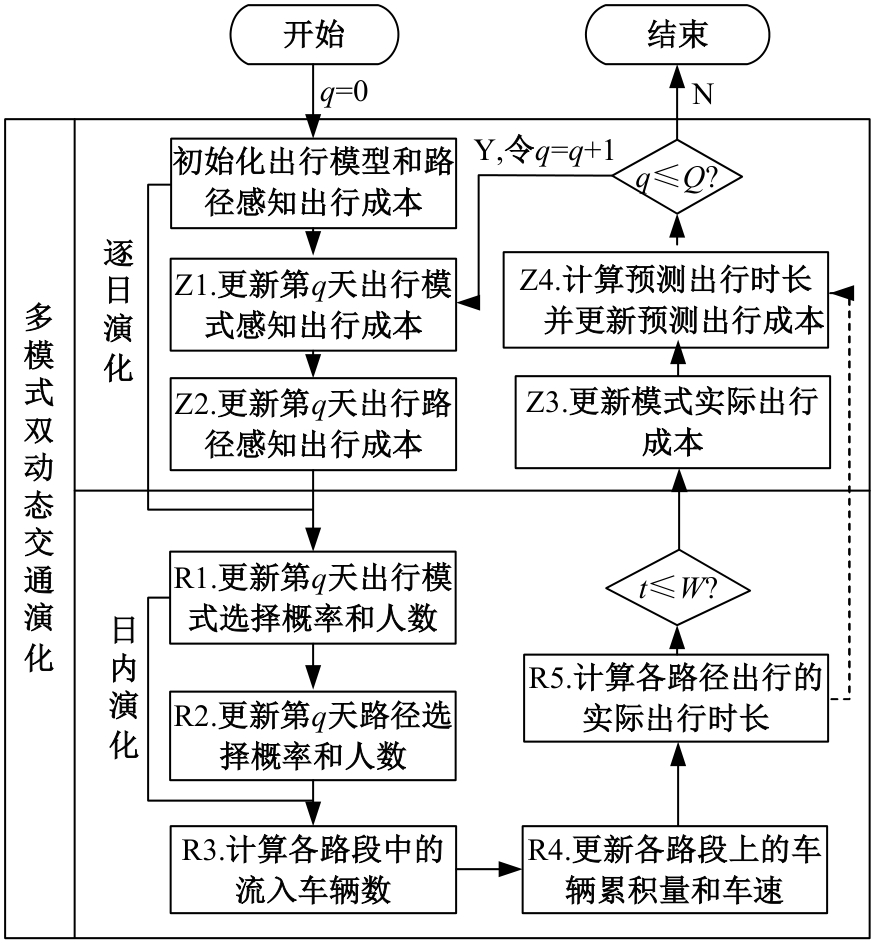
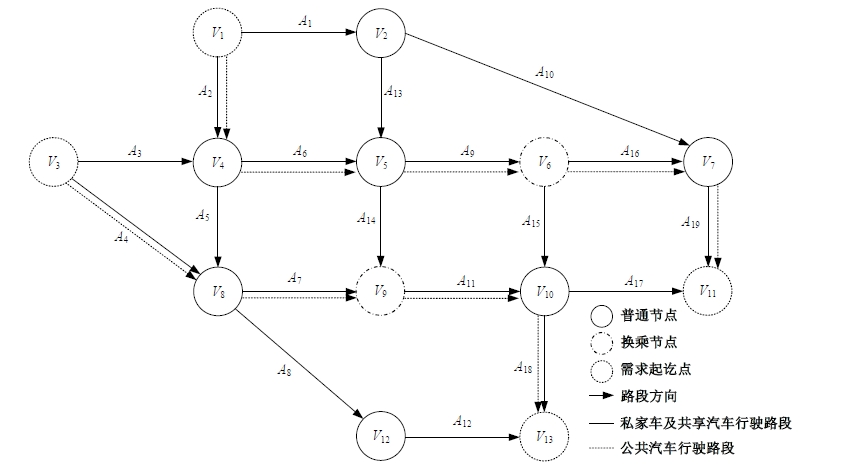
针对多模式交通系统的拥堵收费问题,本文构建了双层规划模型。上层是以最小化系统总出行成本为目标的优化模型,决策各路段的拥堵收费价格;下层是基于路径的多模式双动态演化模型,包含逐日和日内动态演化。采用遗传算法对模型进行求解。本文对比了无拥堵收费(NCP)、对私家车收费(CPC)以及对私家车和共享汽车均收费(CPCS)下的系统特征。结果表明,相比NCP,CPC和CPCS中私家车出行减少17.44%和14.89%,车辆平均出行时间降低7.54%和30.18%;在CPC中,共享汽车系统能够获得最大的收入,并成为系统中承担出行量最大(39.97%)的出行模式。
中图分类号:
- U491

| [1] | Li X, Shaw J W, Liu D, et al. Acceptability of Beijing congestion charging from a business perspective[J]. Transportation, 2019, 46(3): 753-776. |
| [2] | 常玉林, 徐文倩, 孙超, 等. 车联网环境下考虑遵从程度的混合流量逐日均衡[J]. 吉林大学学报:工学版, 2023, 53(4): 1085-1093. |
| Chang Yu-lin, Xu Wen-qian, Sun Chao, et al. Day⁃to⁃day equilibrium of hybrid traffic considering obedience degree under Internet of vehicles environment[J]. Journal of Jilin University(Engineering and Technology Edition), 2023, 53(4): 1085-1093. | |
| [3] | 祝俪菱, 杨达, 吴丹红, 等. 考虑有限理性和认知更新的日变交通分配模型[J]. 北京交通大学学报, 2018, 42(1): 75-80. |
| Zhu Li-ling, Yang Da, Wu Dan-hong, et al. Day-to-day traffic assignment model considering travelers' bounded rationality and perception updating[J]. Journal of Beijing Jiaotong University, 2018, 42(1): 75-80. | |
| [4] | Liu W, Geroliminis N. Doubly dynamics for multi-modal networks with park-and-ride and adaptive pricing[J]. Transportation Research Part B: Methodological, 2017, 102: 162-179. |
| [5] | Wei B, Sun D. A two-layer network dynamic congestion pricing based on macroscopic fundamental diagram[J]. Journal of Advanced Transportation, 2018. |
| [6] | Wei B, Saberis M, Zhang F, et al. Modeling and managing ridesharing in a multi-modal network with an aggregate traffic representation: a doubly dynamical approach[J]. Transportation Research Part C: Emerging Technologies, 2020, 117: No.102670. |
| [7] | Friesz T L, Bernstein D, Kydes N. Dynamic congestion pricing in disequilibrium[J]. Networks and Spatial Economics, 2004, 4: 181-202. |
| [8] | Tan Z, Yang H, Guo R Y. Dynamic congestion pricing with day-to-day flow evolution and user heterogeneity[J]. Transportation Research Part C: Emerging Technologies, 2015, 61: 87-105. |
| [9] | 刘鹏煌. 基于势博弈的拥堵收费双层定价模型[J]. 物流科技, 2020, 43(5): 109-115, 118. |
| Liu Peng-huang. A two-tier pricing model for congestion pricing based on potential game[J]. Logistics Technology, 2020, 43(5): 109-115, 118. | |
| [10] | Cascetta E, Nuzzolo A, Russo F, et al. A modified Logit route choice model overcoming path overlapping problems: Specification and some calibration results for interurban networks[C]∥Transportation and Traffic Theory Proceedings of the 13th International Symposium on Transportation and Traffic Theory, Lyon, France, 1996(7):24-26. |
| [11] | Zhou Z, Chen A, Bekhor S. C-logit stochastic user equilibrium model: formulations and solution algorithm[J]. Transportmetrica, 2012, 8(1): 17-41. |
| [12] | Zhang S, Sun H J, Lyu Y, et al. Day-to-day dynamics of traveler learning behavior and the incentivization scheme of the operator for one-way carsharing services[J]. Computers & Industrial Engineering, 2021, 155: No.107170. |
| [13] | Zhou B, Xu M, Meng Q, et al. A day-to-day route flow evolution process towards the mixed equilibria[J]. Transportation Research Part C: Emerging Technologies, 2017, 82: 210-228. |
| [1] | 潘义勇,徐家聪,尤逸文,全勇俊. 网约车出行需求影响因素多尺度空间异质性分析[J]. 吉林大学学报(工学版), 2025, 55(5): 1567-1575. |
| [2] | 卢凯明,陈艳艳,仝瑶,张健,李永行,罗莹. 数据驱动的信号交叉口排队尾车驶离状态预测[J]. 吉林大学学报(工学版), 2025, 55(4): 1275-1286. |
| [3] | 张河山,范梦伟,谭鑫,郑展骥,寇立明,徐进. 基于改进YOLOX的无人机航拍图像密集小目标车辆检测[J]. 吉林大学学报(工学版), 2025, 55(4): 1307-1318. |
| [4] | 秦严严,肖腾飞,罗钦中,王宝杰. 雾天高速公路车辆跟驰安全分析与控制策略[J]. 吉林大学学报(工学版), 2025, 55(4): 1241-1249. |
| [5] | 宋现敏,湛天舒,李海涛,刘博,张云翔. 考虑用户成本和泊位利用率的停车预约分配模型[J]. 吉林大学学报(工学版), 2025, 55(4): 1287-1297. |
| [6] | 郭祎,魏书威,姜涛. 基于区位势能和多源数据的城市客运交通规划算法[J]. 吉林大学学报(工学版), 2025, 55(4): 1328-1335. |
| [7] | 潘义勇,徐翔宇. 数据不平衡的MobileViT网络交通事故严重程度预测模型[J]. 吉林大学学报(工学版), 2025, 55(3): 947-953. |
| [8] | 孙峣,姚宝珍,白子建. 基于随机森林模型的交通拥堵疏导效果评估[J]. 吉林大学学报(工学版), 2025, 55(2): 512-519. |
| [9] | 陈永恒,杨家伟,孙经宇. 借道左转交叉口的网联左转车辆最佳轨迹控制[J]. 吉林大学学报(工学版), 2025, 55(2): 614-622. |
| [10] | 陈发城,鲁光泉,林庆峰,张浩东,马社强,刘德志,宋会军. 有条件自动驾驶下驾驶人接管行为综述[J]. 吉林大学学报(工学版), 2025, 55(2): 419-433. |
| [11] | 何永明,冯佳,魏堃,万亚楠. 超高速公路曲线路段车辆制动侧滑影响因素分析[J]. 吉林大学学报(工学版), 2025, 55(2): 591-602. |
| [12] | 吴娇蓉,刘旭东. 不同住房类型空间单元的建成环境对通勤方式选择的影响分析[J]. 吉林大学学报(工学版), 2025, 55(2): 554-565. |
| [13] | 王长帅,徐铖铖,任卫林,彭畅,佟昊. 自动驾驶接管过程中驾驶能力恢复状态对交通流振荡特性的影响[J]. 吉林大学学报(工学版), 2025, 55(1): 150-161. |
| [14] | 年光跃,潘海啸,孙健. 城市建成环境与道路交通运行关系[J]. 吉林大学学报(工学版), 2025, 55(1): 141-149. |
| [15] | 周锡浈,宫贺,李敦敦,季彦婕,严杰. 建成环境对路内停车泊位使用率的非线性影响模型[J]. 吉林大学学报(工学版), 2024, 54(9): 2520-2530. |
|