吉林大学学报(工学版) ›› 2025, Vol. 55 ›› Issue (1): 141-149.doi: 10.13229/j.cnki.jdxbgxb.20230337
城市建成环境与道路交通运行关系
年光跃1( ),潘海啸1(),孙健2
- 1.同济大学 建筑与城市规划学院,上海 200092
2.长安大学 未来交通学院,西安 710021
Exploring relationship between urban built environment and road traffic performance
Guang-yue NIAN1(),Hai-xiao PAN1(),Jian SUN2
- 1.College of Architecture and Urban Planning,Tongji University,Shanghai 200092,China
2.School of Future Transportation,Chang'an University,Xi'an 710021,China
摘要:
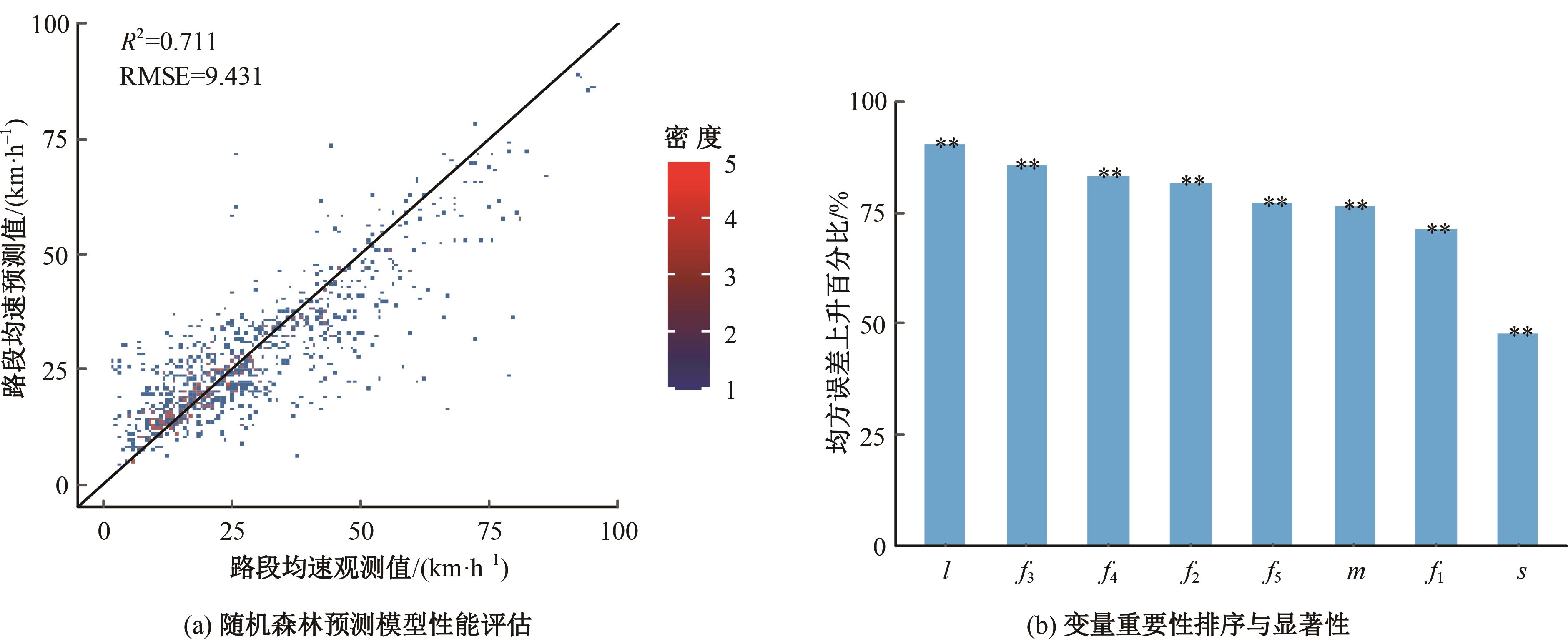
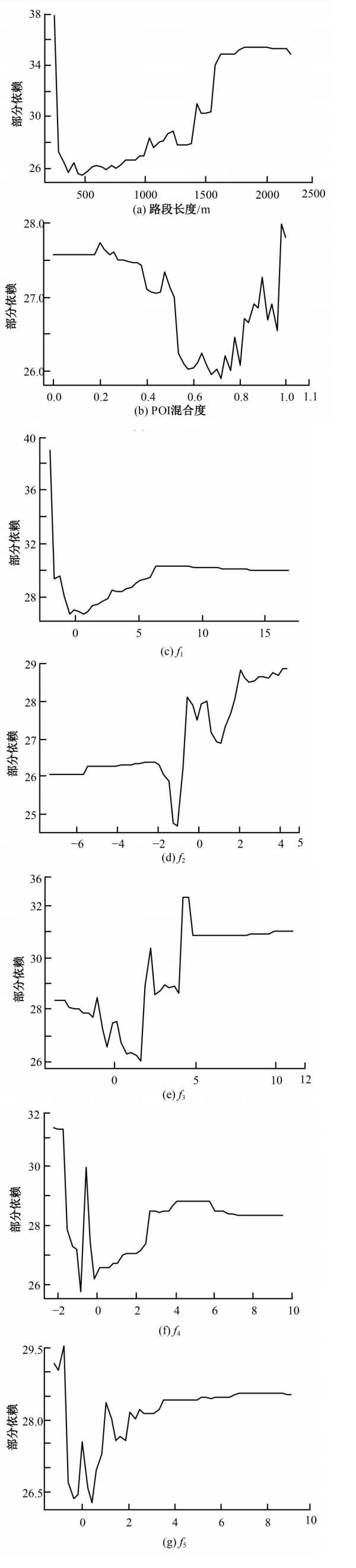
为解决建成环境与道路交通运行之间的量化描述和解释问题,本文以路段平均行程速度表征交通运行状况,基于面板数据构建随机森林预测模型,以建成环境预测路段车速。结果表明:构建的随机森林预测模型表现出优秀的性能,道路交通运行与建成环境显著相关,并呈现多样化的非线性关系。本文研究弥补了先前相关研究中交通运行动态特性考虑不足、小范围片区研究偶然性偏差、非线性关系缺乏等问题,同时本文研究结果可为城市与交通规划、管理决策等提供支持。
中图分类号:
- U121

| 1 | 住房和城乡建设部城市交通基础设施监测与治理实验室. 2022年度中国主要城市道路网密度与运行状态监测报告[R]. 北京:住房和城乡建设部, 2022. |
| 2 | 陆化普. 城市交通拥堵机理分析与对策体系[J]. 综合运输, 2014, 392(3): 10-19. |
| Lu Hua-pu. Analysis of urban traffic congestion mechanism and countermeasure system[J]. China Transportation Review, 2014, 392(3): 10-19. | |
| 3 | 袁浩, 任杰, 杨睿, 等. 考虑空间异质性的城市建成环境对交通拥堵状态的影响[J]. 武汉理工大学学报:交通科学与工程版, 2021, 45(5): 840-845. |
| Yuan Hao, Ren Jie, Yang Rui, et al. Influence of urban building environment on traffic congestion considering spatial heterogeneity[J]. Journal of Wuhan University of Technology(Transportation Science & Engineering), 2021, 45(5): 840-845. | |
| 4 | 李佳敏, 张彪, 郭亮. 大城市交通与建成环境综合规划的范式扩展与深化——中美案例的比较与启示[J]. 西部人居环境学刊, 2021, 36(4): 36-44. |
| Li Jia-min, Zhang Biao, Guo Liang. The paradigm expansion and deepening of the comprehensive planning of transportation & built environment in metropolis: comparison and enlightenment of the Sino-American case[J]. Journal of Human Settlements in West China, 2021, 36(4): 36-44. | |
| 5 | Wang M, Debbage N. Urban morphology and traffic congestion: longitudinal evidence from US cities[J]. Computers, Environment and Urban Systems, 2021, 89: No.101676. |
| 6 | Handy S L, Boarnet M G, Ewing R, et al. How the built environment affects physical activity: views from urban planning[J]. American Journal of Preventive Medicine, 2002, 23(Sup.2): 64-73. |
| 7 | 韩会然, 杨成凤. 建成环境对出行行为的影响研究进展与展望[J]. 安徽师范大学学报:自然科学版, 2019, 42(2): 166-173. |
| Han Hui-ran, Yang Cheng-feng. Progress and prospects of the research on built environment and residents´travel behavior[J]. Journal of Anhui Normal University(Natural Science), 2019, 42(2): 166-173. | |
| 8 | Ewing R, Cervero R. Travel and the built environment—a meta-analysis[J]. Journal of the American Planning Association, 2010, 76(3): 265-294. |
| 9 | Handy S, Cao X, Mokhtarian P. Correlation or causality between the built environment and travel behavior? Evidence from northern California[J]. Transportation Research Part D: Transport and Environment, 2005, 10(6): 427-444. |
| 10 | Cao J. Heterogeneous effects of neighborhood type on commute mode choice: an exploration of residential dissonance in the twin cities[J]. Journal of Transport Geography, 2015, 48(C): 188-196. |
| 11 | Zhang Q, Clifton K J, Moeckel R, et al. Household trip generation and the built environment: does more density mean more trips?[J]. Transportation Research Record, 2019, 2673(5): 596-606. |
| 12 | 尹超英, 邵春福, 黄兆国, 等. 基于梯度提升决策树的多尺度建成环境对小汽车拥有的影响[J]. 吉林大学学报:工学版, 2022, 52(3): 572-577. |
| Yin Chao-ying, Shao Chun-fu, Huang Zhao-guo, et al. Investigating influences of multi⁃scale built environment on car ownership behavior based on gradient boosting decision trees[J]. Journal of Jilin University(Engineering and Technology Edition), 2022, 52(3): 572-577. | |
| 13 | 颜冉, 杨新刚, 杨婷. 城市建成环境对道路服务水平的影响研究[J]. 安徽建筑大学学报, 2020, 28(5): 70-75. |
| Yan Ran, Yang Xin-gang, Yang Ting. Research on road service level influenced by urban built environment[J]. Journal of Anhui Jianzhu University, 2020, 28(5): 70-75. | |
| 14 | 钟绍鹏, 何璟, 朱康丽, 等. 基于建成环境和低频浮动车数据的路段行程时间估计[J]. 交通运输系统工程与信息, 2021, 21(4): 125-131,147. |
| Zhong Shao-peng, He Jing, Zhu Kang-li, et al. Travel time estimation based on built environment and low frequency floating car data[J]. Journal of Transportation Systems Engineering and Information Technology, 2021, 21(4): 125-131,147. | |
| 15 | Pan Y, Chen S, Niu S, et al. Investigating the impacts of built environment on traffic states incorporating spatial heterogeneity[J]. Journal of Transport Geography, 2020, 83: No.102663. |
| 16 | Zhang K S, Sun D, Shen S W, et al. Analyzing spatiotemporal congestion pattern on urban roads based on taxi GPS data[J]. Journal of Transport and Land Use, 2017, 10(1): 675-694. |
| 17 | Zhong S, Wang Z, Wang Q, et al. Exploring the spatially heterogeneous effects of urban built environment on road travel time variability[J]. Journal of Transportation Engineering, Part A: Systems, 2021, 147(1): No.4020142. |
| 18 | 王东炜, 李辉, 李岩, 等. 城市道路网络路段状态相关性与道路间距分析[J]. 交通运输工程学报, 2017, 17(1): 101-108. |
| Wang Dong-wei, Li Hui, Li Yan, et al. Analysis of road section state correlation and road distance in urban road network[J]. Journal of Traffic and Transportation Engineering, 2017, 17(1): 101-108. | |
| 19 | Cervero R. Mixed land-uses and commuting: evidence from the American housing survey[J]. Transportation Research Part A: Policy and Practice, 1996, 30(5): 361-377. |
| 20 | Breiman L. Random forests[J]. Machine Learning, 2001, 45(1): 5-32. |
| [1] | 董春娇,陆育霄,马社强,李鹏辉. 考虑等待忍耐时间的电动自行车违规行为研判[J]. 吉林大学学报(工学版), 2024, 54(9): 2540-2546. |
| [2] | 马书红,廖国美,黄岩,张俊杰. 建成环境对交通小区地铁通勤客流的异质性影响[J]. 吉林大学学报(工学版), 2024, 54(7): 1913-1922. |
| [3] | 熊志华,董黛悦,董春娇,郑炎,解超. 考虑个人偏好的观赛人群组合决策选择行为[J]. 吉林大学学报(工学版), 2024, 54(4): 979-986. |
| [4] | 吴娇蓉,林清凯,邓泳淇. 基于公交线路运行稳定性的潜在公交专用道需求识别方法[J]. 吉林大学学报(工学版), 2024, 54(3): 692-699. |
| [5] | 庄焱,董春娇,米雪玉,张小雨,王菁. 基于随机参数Logit的中小城市居民出行方式选择建模[J]. 吉林大学学报(工学版), 2024, 54(2): 461-468. |
| [6] | 张文会,伊静. 考虑通行能力和排队延误的公交停靠系统优化[J]. 吉林大学学报(工学版), 2024, 54(1): 146-154. |
| [7] | 宋世军,樊敏. 基于随机森林算法的大数据异常检测模型设计[J]. 吉林大学学报(工学版), 2023, 53(9): 2659-2665. |
| [8] | 尹超英,陆颖,邵春福,马健霄,许得杰. 考虑空间自相关的建成环境对通勤方式选择的影响[J]. 吉林大学学报(工学版), 2023, 53(7): 1994-2000. |
| [9] | 杨亚让,吴云虎. 基于随机森林的无线传感器通信网络阻塞故障检测[J]. 吉林大学学报(工学版), 2023, 53(5): 1490-1495. |
| [10] | 王斌,何丙辉,林娜,王伟,李天阳. 基于随机森林特征选择的茶园遥感提取[J]. 吉林大学学报(工学版), 2022, 52(7): 1719-1732. |
| [11] | 邝先验,陈自如. 基于CA的无信号灯控制路段行人过街横道处动态博弈礼让行为[J]. 吉林大学学报(工学版), 2022, 52(4): 837-846. |
| [12] | 贾洪飞,邵子函,杨丽丽. 终点不确定条件下网约车合乘匹配模型及算法[J]. 吉林大学学报(工学版), 2022, 52(3): 564-571. |
| [13] | 尹超英,邵春福,黄兆国,王晓全,王晟由. 基于梯度提升决策树的多尺度建成环境对小汽车拥有的影响[J]. 吉林大学学报(工学版), 2022, 52(3): 572-577. |
| [14] | 董春娇,董黛悦,诸葛承祥,甄理. 电动自行车出行特性及骑行决策行为建模[J]. 吉林大学学报(工学版), 2022, 52(11): 2618-2625. |
| [15] | 吴静娴,申华鹏,韩印,杨敏. 考虑城市建成环境非线性作用的通勤时间模型[J]. 吉林大学学报(工学版), 2022, 52(11): 2568-2573. |
|
||