吉林大学学报(医学版) ›› 2025, Vol. 51 ›› Issue (6): 1551-1560.doi: 10.13481/j.1671-587X.20250611

• 基础研究 • 上一篇    

16s rRNA测序技术检测复方地黄颗粒作用下肺炎链球菌诱导肺炎模型大鼠肠道菌群的变化及其意义

张雨涵1,孔令娟2,柳金英3,郭建恩4()   

  1. 1.承德医学院中医基础理论教研室,河北 承德 067000
    2.承德医学院方剂教研室,河北 承德 067000
    3.承德医学院针灸推拿教研室,河北 承德 067000
    4.承德医学院中医临床基础教研室,河北 承德 067000
  • 收稿日期:2025-01-16 接受日期:2025-02-22 出版日期:2025-11-28 发布日期:2025-12-15
  • 通讯作者: 郭建恩 E-mail:que8310036@163.com
  • 作者简介:张雨涵(1990—),女,河北省承德市人,讲师,医学硕士,主要从事中医辨证理论和方法论方面的研究。
  • 基金资助:
    河北省中医药管理局中医药类科学研究项目(2025089)

Changes of intestinal flora in rats with Streptococcus pneumoniae-induced pneumonia treated with Compound Dihuang Granules detected by 16s rRNA sequencing technology and its significance

Yuhan ZHANG1,Lingjuan KONG2,Jinying LIU3,Jianen GUO4()   

  1. 1.Department of Basic Theory of Traditional Chinese Medicine,Chengde Medical University,Chengde 067000,China
    2.Department of Prescriptions of Traditional Chinese Medicine,Chengde Medical University,Chengde 067000,China
    3.Department of Acupuncture,Moxibustion and Tuina,Chengde Medical University,Chengde 067000,China
    4.Department of Clinical Foundation of Traditional Chinese Medicine,Chengde Medical University,Chengde 067000,China
  • Received:2025-01-16 Accepted:2025-02-22 Online:2025-11-28 Published:2025-12-15
  • Contact: Jianen GUO E-mail:que8310036@163.com

摘要:

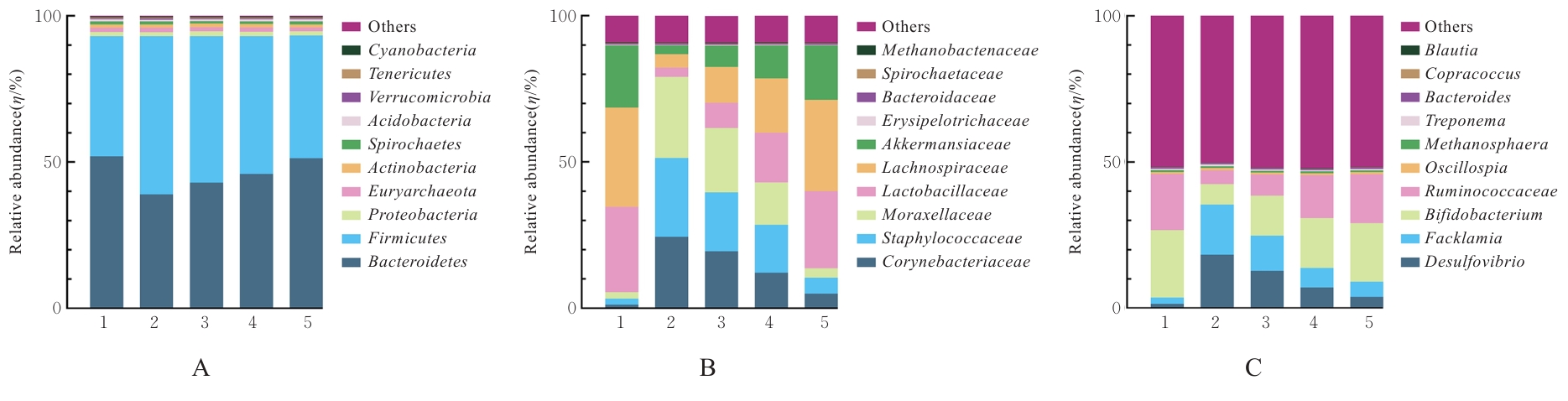
目的 通过16s rRNA测序技术探讨复方地黄颗粒对肺炎链球菌(Spn)诱导肺炎模型大鼠肠道菌群的影响,并阐明其潜在机制。 方法 将30只大鼠随机分为对照组(正常大鼠)、模型组(Spn诱导肺炎大鼠模型)、低剂量复方地黄颗粒组(肺炎大鼠模型灌胃1.75 g·kg-1复方地黄颗粒)、中剂量复方地黄颗粒组(肺炎大鼠模型灌胃3.50 g·kg-1复方地黄颗粒)和高剂量复方地黄颗粒组(肺炎大鼠模型灌胃7.00 g·kg-1复方地黄颗粒),每组6只。测定大鼠肺组织湿/干重(W/D)比值并分析血气指标,HE染色观察各组大鼠肺组织病理形态表现并评估肺组织损伤程度,试剂盒检测各组大鼠肺泡灌洗液(BALF)中细菌负荷水平和白细胞介素(IL)-6、IL-8及IL-10水平,进行16s rRNA肠道菌群测序分析。 结果 与对照组比较,模型组大鼠动脉血二氧化碳分压(PaCO2)明显升高(P<0.05),动脉血氧分压(PaO2)和血氧饱和度(SaO2)明显降低(P<0.05);与模型组比较,低、中和高剂量复方地黄颗粒组大鼠PaCO2明显降低(P<0.05),PaO2和SaO2明显升高(P<0.05),并呈剂量依赖性。HE染色,对照组大鼠肺组织未见明显损伤;模型组大鼠肺组织细胞排列紊乱,大量炎性细胞浸润,肺泡壁毛细血管明显扩张;与模型组比较,低、中和高剂量复方地黄颗粒组大鼠肺组织形态损伤均有所改善。与对照组比较,模型组大鼠肺组织W/D比值和病理评分明显升高(P<0.05);与模型组比较,低、中和高剂量复方地黄颗粒组大鼠肺组织W/D比值和病理评分明显降低(P<0.05),并呈剂量依赖性。与对照组比较,模型组大鼠BALF中细菌负荷水平明显升高(P<0.05);与模型组比较,低、中和高剂量复方地黄颗粒组大鼠BALF中细菌负荷水平明显降低(P<0.05),并呈剂量依赖性。与对照组比较,模型组大鼠BALF中IL-6和IL-8水平明显升高(P<0.05),IL-10水平明显降低(P<0.05);与模型组比较,低、中和高剂量复方地黄颗粒组大鼠BALF中IL-6和IL-8水平明显降低(P<0.05),IL-10水平明显升高(P<0.05),并呈剂量依赖性。与对照组比较,模型组大鼠菌群丰度指标(Chao1)、菌群多样性和均匀性指标(Shannon)、菌群优势度指标(Simpson)及实际检测物种数指标(Observed_species)均明显降低(P<0.05);与模型组比较,低、中和高剂量复方地黄颗粒组大鼠Chao1、Shannon、Simpson和Observed_species均明显升高(P<0.05),并呈剂量依赖性。与对照组比较,模型组大鼠拟杆菌门(Bacteroidetes)相对丰度降低,厚壁菌门(Firmicutes)相对丰度升高,Firmicutes/Bacteroidetes比值明显升高(P<0.05);与模型组比较,低、中和高剂量复方地黄颗粒组大鼠Bacteroidetes相对丰度升高,Firmicutes相对丰度降低,Firmicutes/Bacteroidetes比值明显降低(P<0.05),并呈剂量依赖性。在科水平上,与对照组比较,模型组大鼠棒状杆菌科(Corynebacteriaceae)、葡萄球菌科(Staphylococcaceae)和莫拉氏菌科(Moraxellaceae)相对丰度明显升高,而乳酸杆菌科(Lactobacillaceae)、毛螺菌科(Lachnospiraceae)和嗜黏蛋白阿克曼菌科(Akkermansiaceae)相对丰度明显降低;与模型组比较,低、中和高剂量复方地黄颗粒组大鼠CorynebacteriaceaeStaphylococcaceaeMoraxellaceae相对丰度明显降低,LactobacillaceaeLachnospiraceaeAkkermansiaceae相对丰度明显升高。在属水平上,与对照组比较,模型组大鼠脱硫弧菌属(Desulfovibrio)和费克蓝姆氏菌属(Facklamia)相对丰度明显升高,双歧杆菌(Bifidobacterium)和瘤胃球菌属(Ruminococcaceae)相对丰度明显降低;与模型组比较,低、中和高剂量复方地黄颗粒组大鼠DesulfovibrioFacklamia相对丰度明显降低,BifidobacteriumRuminococcaceae相对丰度明显升高。 结论 复方地黄颗粒可以改善Spn诱导的肺炎大鼠的炎症和肺损伤,这可能与肠道菌群丰度和多样性的增加有关。

关键词: 肺炎, 16s rRNA测序技术, 复方地黄颗粒, 肺炎链球菌, 肠道菌群

Abstract:

Objective To discuss the effect of Compound Rehmannia Granules on intestinal flora of the pneumonia model rats induced by Streptococcus pneumoniaeSpn) through 16s rRNA sequencing technology, and to clarify its potential mechanism. Methods A total of 30 rats were randomly divided into control group (normal rats), model group (Spn-induced pneumonia rat models), low dose of Compound Rehmannia Granules group (pneumonia rat models administered 1.75 g·kg-1 Compound Rehmannia Granules by gavage), medium dose of Compound Rehmannia Granules group (pneumonia rat models administered 3.50 g·kg-1 Compound Rehmannia Granules by gavage), and high dose of Compound Rehmannia Granules group (pneumonia rat model administered 7.00 g·kg-1 Compound Rehmannia Granules by gavage), with 6 rats in each group. The wet/dry weight (W/D) ratio of lung tissue and blood gas indexes were measured; HE staining was used to observe the pathomorphology and the degree of lung injury in lung tissue of the rats in various groups were assessed; kit assay was used to detect the bacterial load level and the levels of interleukin (IL)-6, IL-8, and IL-10 in bronchoalveolar lavage fluid (BALF) of the rats in various groups; 16s rRNA intestinal flora sequencing analysis was performed. Results Compared with control group, the arterial partial pressure of carbon dioxide (PaCO2) of the rats in model group was significantly increased (P<0.05), and the arterial partial pressure of oxygen (PaO2) and oxygen saturation (SaO2) were significantly decreased (P<0.05); compared with model group, the PaCO2 of the rats in low, medium, and high doses of Compound Rehmannia Granules groups was significantly decreased (P<0.05), and the PaO? and SaO? were significantly increased (P<0.05), showing a dose-dependent manner. The HE staining results showed no significant injury in lung tissue of the rats in control group; the cells in lung tissue of the rats in model group were arranged disorderly with massive inflammatory cell infiltration, and the alveolar wall capillaries were significantly dilated; compared with model group, the morphological damage of lung tissue of the rats in low, medium, and high doses of Compound Rehmannia Granules groups was improved. Compared with control group, the W/D value and pathological score of lung tissue of the rats in model group were significantly increased (P<0.05); compared with model group, the W/D value and pathological scores of lung tissue of the rats in low, medium, and high doses of Compound Rehmannia Granules groups were significantly decreased (P<0.05), showing a dose-dependent manner. Compared with control group, the bacterial load level in BALF of the rats in model group was significantly increased (P<0.05); compared with model group, the bacterial load level in BALF of the rats in low, medium, and high doses of Compound Rehmannia Granules groups was significantly decreased (P<0.05), showing a dose-dependent manner. Compared with control group, the levels of IL-6 and IL-8 in BALF of the rats in model group were significantly increased (P<0.05), and the IL-10 level was significantly decreased (P<0.05); compared with model group, the levels of IL-6 and IL-8 in BALF of the rats in low, medium, and high doses of Compound Rehmannia Granules groups were significantly decreased (P<0.05), and the IL-10 level was significantly increased (P<0.05), showing a dose-dependent manner. Compared with control group, the microbial abundance indicator(Chao1), microbial diversity and evenness indicator(Shannon), microbial dominance indicator (Simpson), and observed species indicator (observed_species) of the rats in model group were significantly decreased (P<0.05); compared with model group, the Chao1, Shannon, Simpson, and (observed_species) indices of the rats in low, medium, and high doses of Compound Rehmannia Granules groups were significantly increased (P<0.05), showing a dose-dependent manner. Compared with control group, the relative abundance of Bacteroidetes in model group was decreased, the relative abundance of Firmicutes was increased, and the Firmicutes/Bacteroidetes ratio was significantly increased (P<0.05); compared with model group, the relative abundances of Bacteroidetes in low, medium, and high doses of Compound Rehmannia Granules groups were increased, the relative abundance of Firmicutes was decreased, and the Firmicutes/Bacteroidetes ratio was significantly decreased (P<0.05), showing a dose-dependent manner. At the family level, compared with control group, the relative abundances of CorynebacteriaceaeStaphylococcaceae, and Moraxellaceae in model group were significantly increased, while the relative abundances of LactobacillaceaeLachnospiraceae, and Akkermansiaceae were significantly decreased; compared with model group, the relative abundances of CorynebacteriaceaeStaphylococcaceae, and Moraxellaceae in low, medium, and high doses of Compound Rehmannia Granules groups were significantly decreased, and the relative abundances of LactobacillaceaeLachnospiraceae, and Akkermansiaceae were significantly increased. At the genus level, compared with control group, the relative abundances of Desulfovibrio and Facklamia in model group were significantly increased, and the relative abundances of Bifidobacterium and Ruminococcaceae were significantly decreased; compared with model group, the relative abundances of Desulfovibrio and Facklamia in low, medium, and high doses of Compound Rehmannia Granules groups were significantly decreased, and the relative abundances of Bifidobacterium and Ruminococcaceae were significantly increased. Conclusion Compound Rehmannia Granules can alleviate inflammation and lung injury in Spn-induced pneumonia rats, which may be related to the increase in the abundance and diversity of intestinal flora.

Key words: Pneumonia, 16s rRNA sequencing technology, Compound Rehmannia Granules, Streptococcus pneumoniae, Intestinal flora

中图分类号: 

  • R378.12