Journal of Jilin University(Medicine Edition) ›› 2026, Vol. 52 ›› Issue (1): 199-210.doi: 10.13481/j.1671-587X.20260121
• Research in clinical medicine • Previous Articles Next Articles
Temporal trends and attributable risk analysis of liver cancer burden in China from 1990 to 2021
Renyi YANG,Jincheng TANG,Kexiong LI,Wei PENG,Zhuo LIU,Ling WU,Puhua ZENG( )
)
- Cancer Research Institute of Traditional Chinese Medicine,Hunan Academy of Chinese Medicine,Changsha 410013,China
-
Received:2025-04-15Accepted:2025-05-31Online:2026-01-28Published:2026-02-24 -
Contact:Puhua ZENG E-mail:zph120@126.com

CLC Number:
- R735.7
Cite this article
Renyi YANG,Jincheng TANG,Kexiong LI,Wei PENG,Zhuo LIU,Ling WU,Puhua ZENG. Temporal trends and attributable risk analysis of liver cancer burden in China from 1990 to 2021[J].Journal of Jilin University(Medicine Edition), 2026, 52(1): 199-210.
share this article
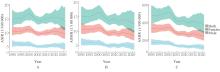
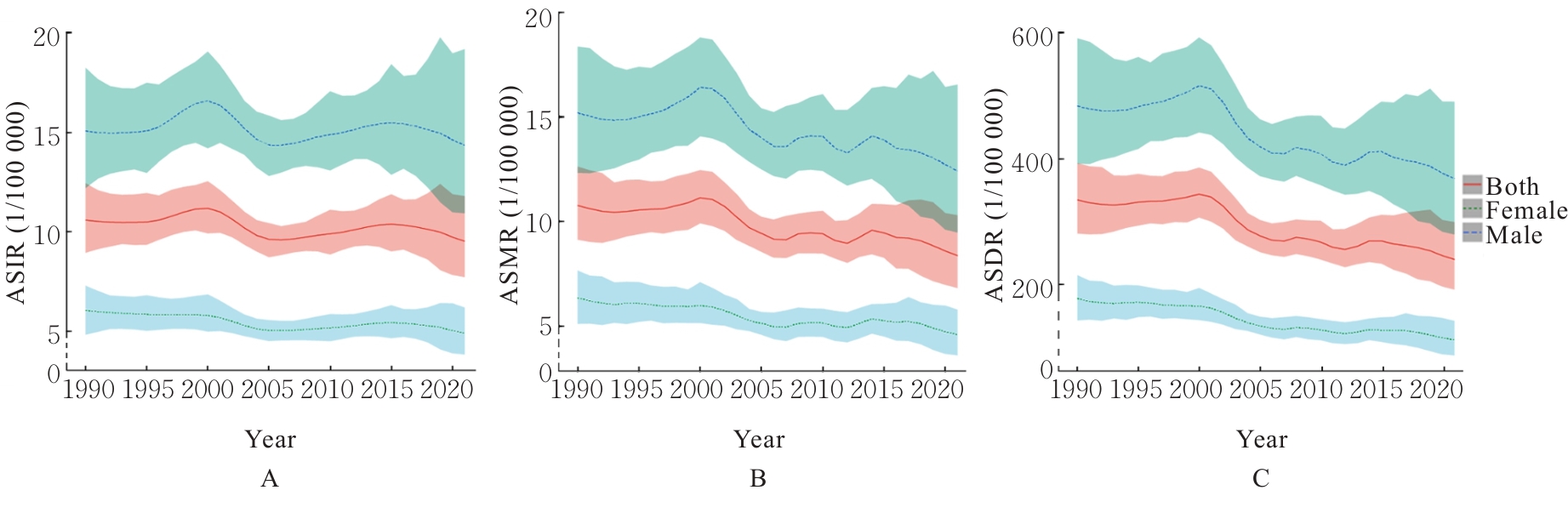
Fig. 1
Trends in burden of liver cancer in China divided by gender from 1990 to 2021"
Tab.1
Numbers of incidence, and death, and DALYs of liver cancer in China"
| Year | Average population | Male | Female |
|---|---|---|---|
| 1990 | |||
| Incident number (95%UI) | 96 434.35 (80 970.60,113 768.66) | 70 209.13 (56 752.31,85 768.18) | 26 225.22 (20 940.93,31 755.09) |
| Death number (95%UI) | 94 937.12 (79 884.26,111 526.73) | 68 304.01 (55 234.66,83 128.05) | 26 633.11 (21 349.83,32 258.36) |
| DALYs (95%UI) | 3 294 864.31 (2 763 028.96,3 879 589.00) | 2 462 152.37 (2 000 446.20,3 012 118.78) | 832 711.95(666 724.75,1 010 057.79) |
| ASIR (95%UI) | 10.58 (8.94,12.43) | 15.06 (12.20,18.24) | 6.04 (4.82,7.28) |
| ASMR (95%UI) | 10.75 (9.12,12.61) | 15.19 (12.32,18.36) | 6.33 (5.08,7.64) |
| ASDR (95%UI) | 334.52 (281.08,393.14) | 483.97 (392.36,591.53) | 177.47 (142.84,214.58) |
| 2021 | |||
| Incident number (95%UI) | 196 636.59 (158 273.06,243 557.68) | 143 788.16(108 926.76,193 830.93) | 52 848.43(41 045.47,67 025.70) |
| Death number (95%UI) | 172 068.40 (139 621.29,212 495.94) | 122 462.95 (93 115.19,164 815.76) | 49 605.44 (38 616.99,62 668.34) |
| DALYs (95%UI) | 4 890 023.03 (3 905 088.56,6 124 599.16) | 3 702 092.84 (2 805 346.91,4 985 653.81) | 1 187 930.19 (924 052.88,1 513 173.25) |
| ASIR (95%UI) | 9.52 (7.72,11.78) | 14.34 (10.93,19.18) | 4.89 (3.82,6.18) |
| ASMR (95%UI) | 8.35 (6.80,10.29) | 12.40 (9.46,16.55) | 4.57 (3.57,5.76) |
| ASDR (95%UI) | 239.91 (191.98,299.37) | 368.19 (279.67,490.95) | 111.91 (87.16,141.96) |
| 1990-2021 | |||
| Percentage Change in Incident Cases (%) | 103.91 (52.37,168.23) | 104.80 (43.93,183.39) | 101.52 (48.49,181.03) |
| Percentage Change in Death Cases (%) | 81.24 (36.07,137.11) | 79.29 (26.19,149.31) | 86.25 (37.23,159.58) |
| Percentage Change in DALYs (%) | 48.41 (10.75,96.81) | 50.36 (5.05,108.19) | 42.66 (3.96,99.91) |
| EAPC in ASIR (95%CI) | -0.28 (-0.42,-0.13) | -0.10 (-0.25,0.05) | -0.55 (-0.70,-0.39) |
| EAPC in ASMR (95%CI) | -0.76 (-0.92,-0.61) | -0.63 (-0.80,-0.46) | -0.89 (-1.05,-0.73) |
| EAPC in ASDR (95%CI) | -1.16 (-1.34,-0.98) | -0.98 (-1.17,-0.79) | -1.51 (-1.68,-1.34) |
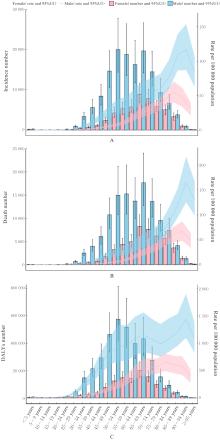
Fig. 2
Burden of liver cancer in China in 2021 divided by gender and age"
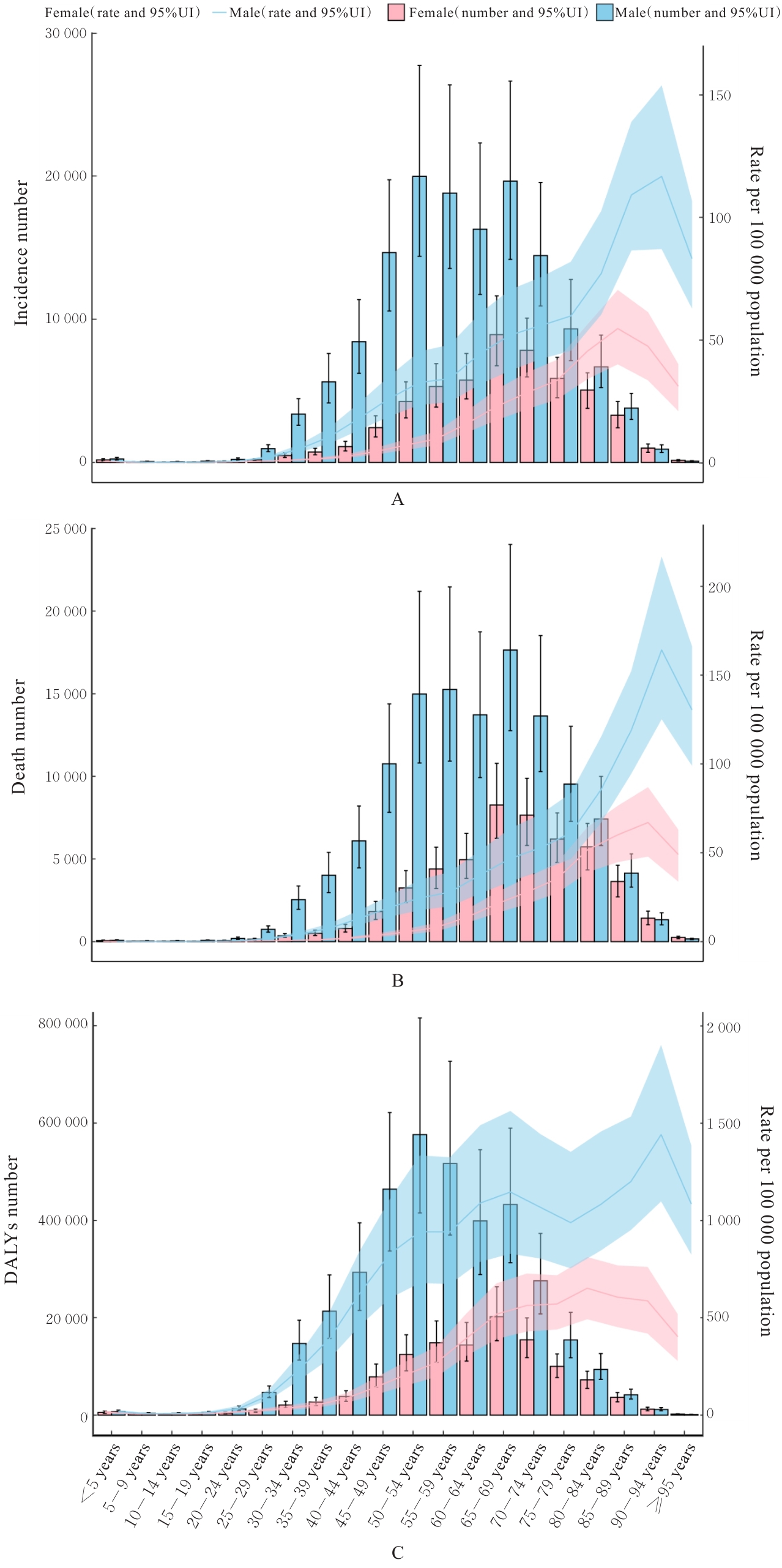
Fig. 3
Proportions of liver cancer deaths divided by etiology in China in 2021 among various ages"
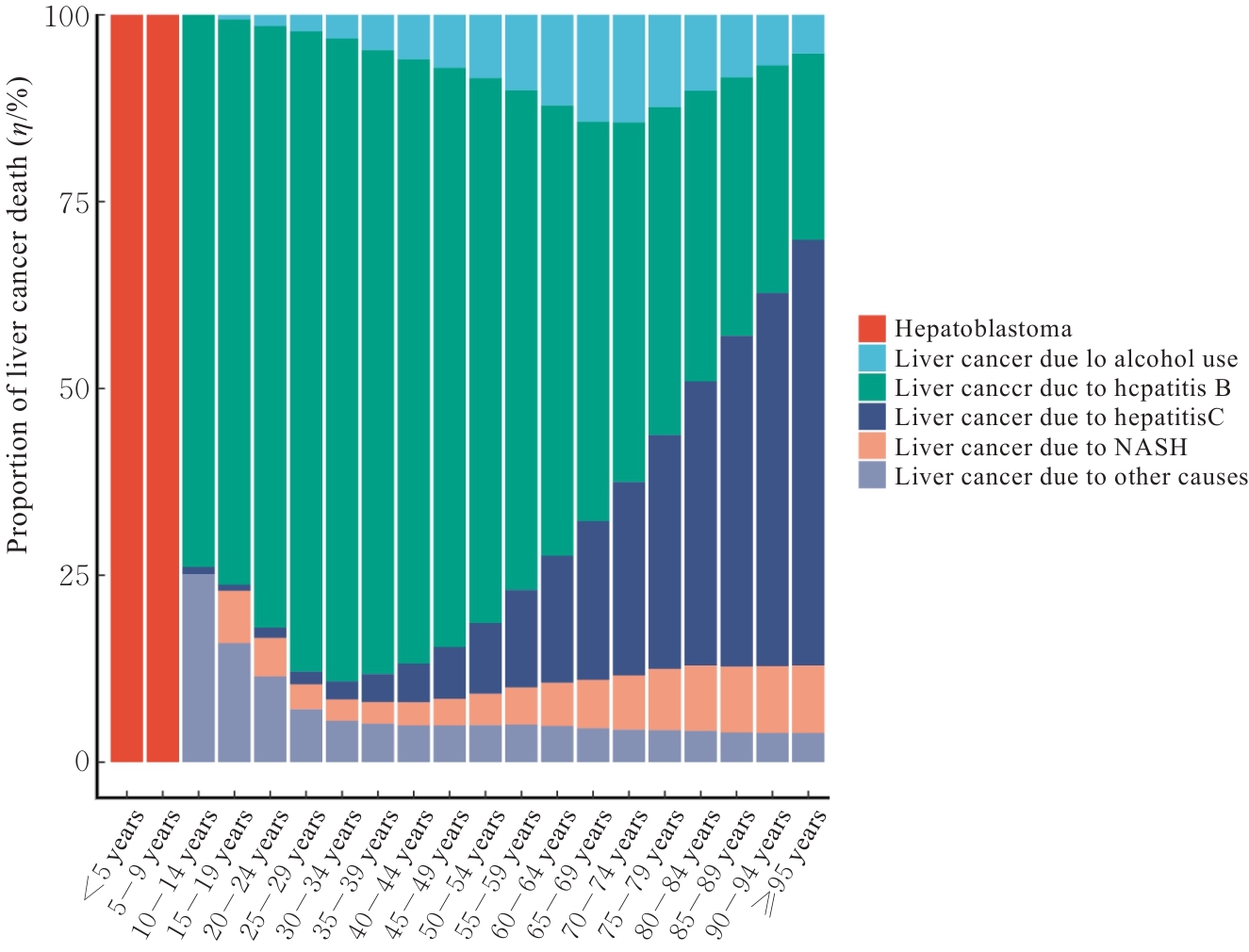
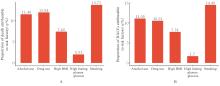
Fig. 4
Proportions of attributable risk factors for liver cancer death and DALYs in China in 2021"
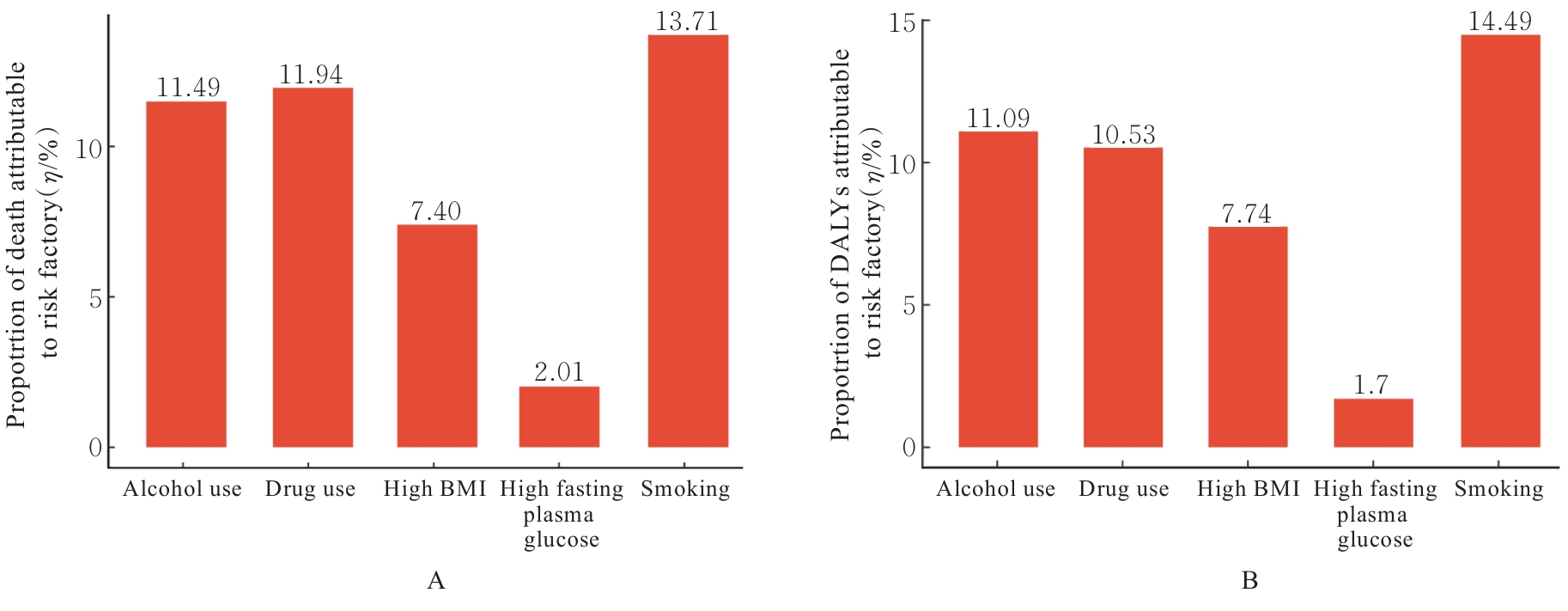
Fig. 5
Percentages of contribution of major risk factors to liver cancer dealth in China in 2021 among different age groups"
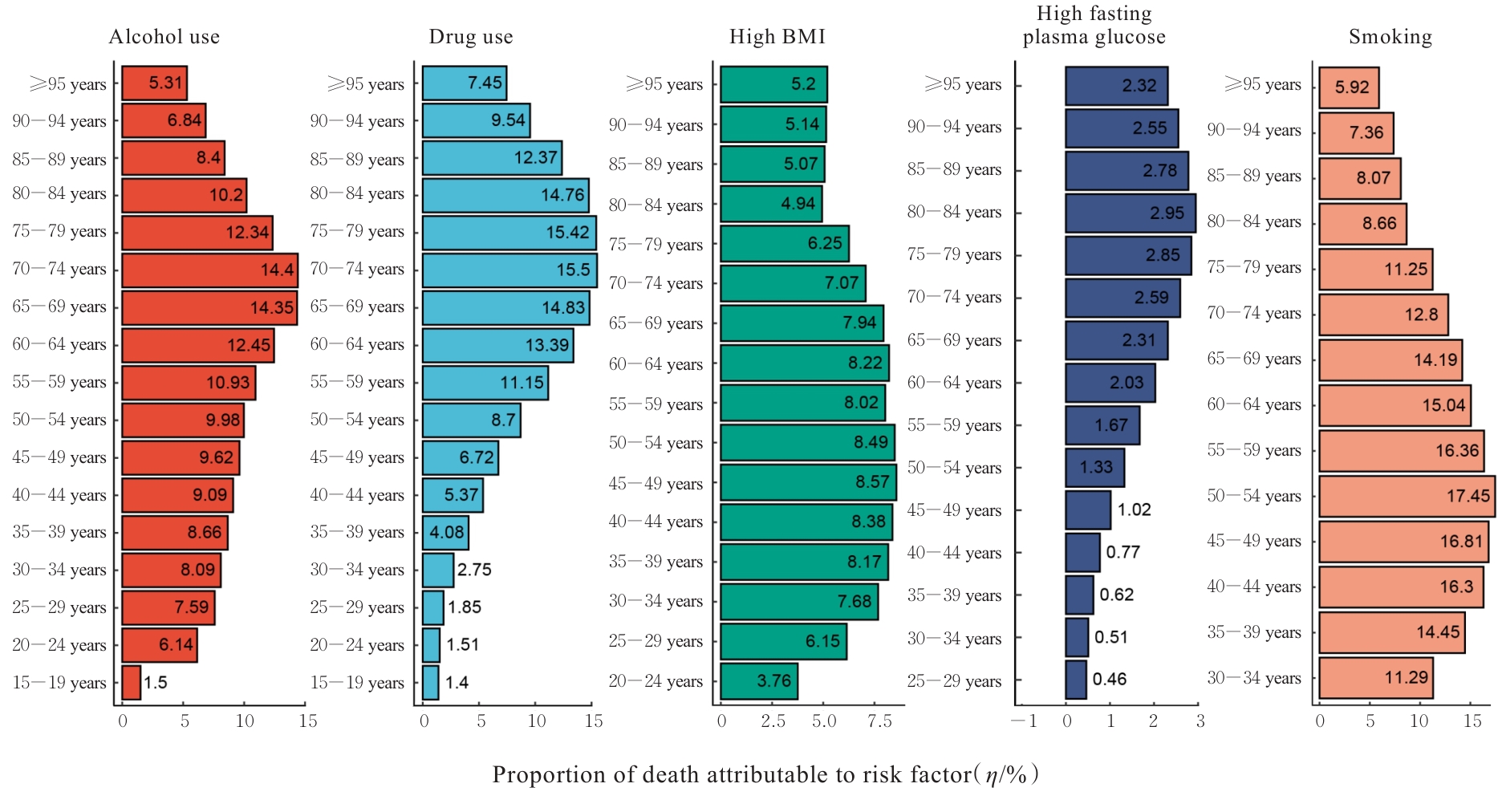
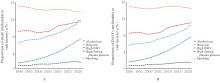
Fig. 6
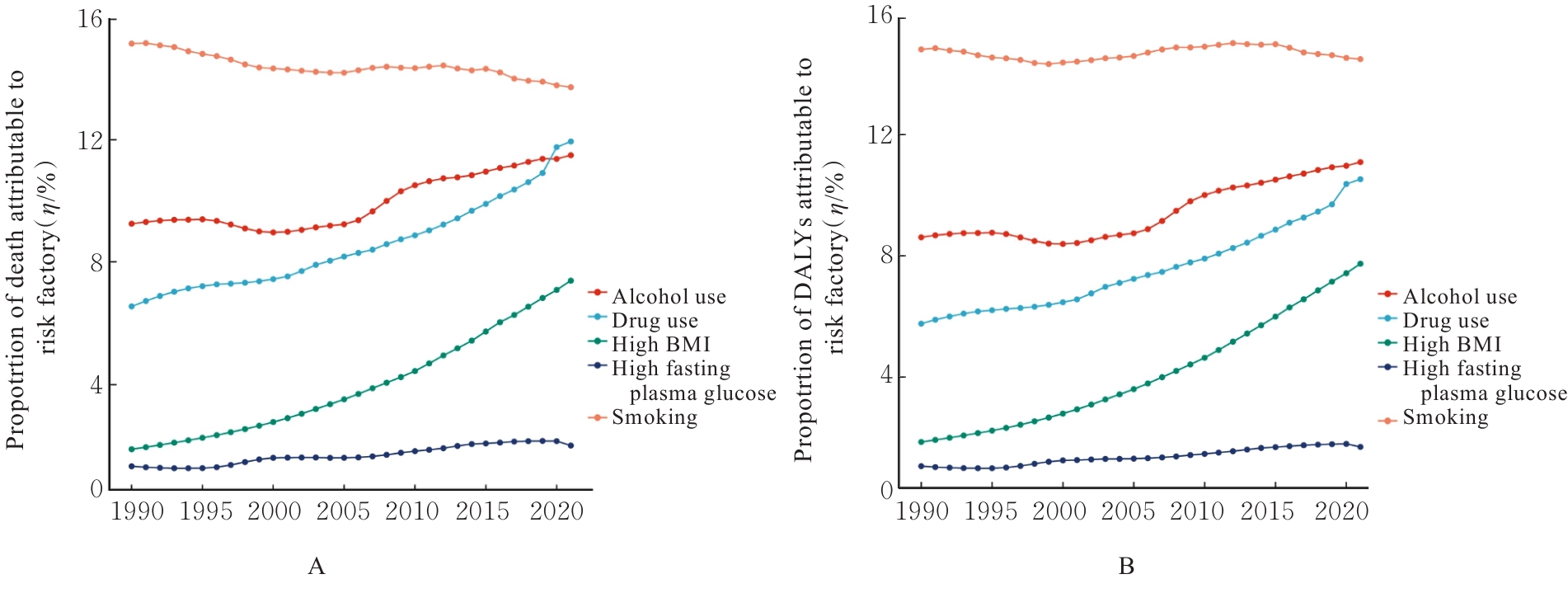
Trends in percentages of contribution of attributable risk factors to liver cancer in China from 1990 to 2021"
Tab.2
Percentages of contribution of major risk factors to liver cancer dealth and DALYs in China in 2021"
| Indicator | Smoking | Alcohol use | Drug use | BMI | High fasting plasma glucos |
|---|---|---|---|---|---|
| Deaths | |||||
| Total (95%UI) | 13.71(4.78,21.75) | 11.49(9.39,14.18) | 11.94(8.62,15.75) | 7.40(2.97,12.48) | 2.01(0.22,4.06) |
| Male (95%UI) | 18.29(6.64,29.42) | 11.15(8.84,14.23) | 10.14(7.76,12.62) | 6.65(2.68,11.13) | 1.50(0.17,3.06) |
| Female (95%UI) | 2.52(0.77,4.55) | 12.32(10.35,14.62) | 16.36(10.11,24.08) | 9.21(3.69,15.68) | 3.28(0.36,6.58) |
| DALYs | |||||
| Total (95%UI) | 14.49(5.06,23.18) | 11.09(8.76,14.02) | 10.53(7.81,13.58) | 7.74(3.11,13.18) | 1.70(0.18,3.44) |
| Male (95%UI) | 18.42(6.67,29.56) | 10.62(7.95,14.13) | 8.54(6.72,10.47) | 7.09(2.86,12.00) | 1.26(0.14,2.60) |
| Female (95%UI) | 2.36(0.71,4.24) | 12.56(10.59,15.02) | 16.66(10.43,24.03) | 9.75(3.90,16.90) | 3.05(0.34,6.22) |
Fig. 7
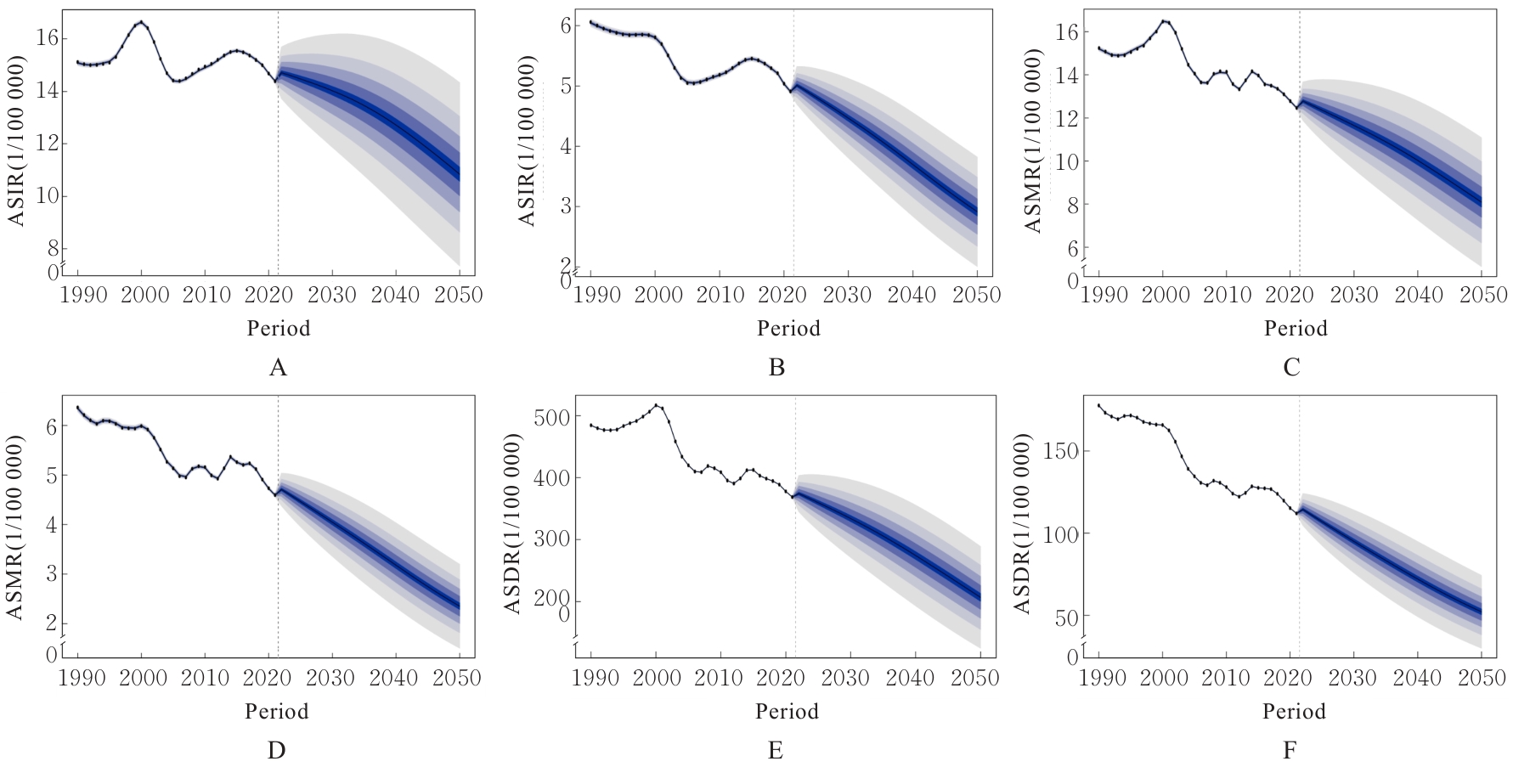
Trends in burden of liver cancer divided by gender in China from 1990 to 2050"
| [1] | WU Z H, XIA F N, LIN R. Global burden of cancer and associated risk factors in 204 countries and territories, 1980–2021: a systematic analysis for the GBD 2021[J]. J Hematol Oncol, 2024, 17(1): 119. |
| [2] | SUNG H, FERLAY J, SIEGEL R L, et al. Global cancer statistics 2020: GLOBOCAN estimates of incidence and mortality worldwide for 36 cancers in 185 countries[J]. CA Cancer J Clin, 2021, 71(3): 209-249. |
| [3] | 文天夫, 李 川, 张晓赟, 等. “健康中国2030”肝癌5年生存率提高15%的关键[J]. 中国普外基础与临床杂志,2023, 30(11): 1281-1283. |
| [4] | DIAO X Y, GUO C, JIN Y K, et al. Cancer situation in China: an analysis based on the global epidemiological data released in 2024[J]. Cancer Commun (Lond), 2025, 45(2): 178-197. |
| [5] | ZHENG R S, CHEN R, HAN B F, et al. Cancer incidence and mortality in China, 2022[J]. Zhonghua Zhong Liu Za Zhi, 2024, 46(3): 221-231. |
| [6] | IOANNOU G N. Epidemiology and risk-stratification of NAFLD-associated HCC[J]. J Hepatol, 2021, 75(6): 1476-1484. |
| [7] | CHOI J, LIM Y S. Genetic-based risk assessment for hepatocellular carcinoma in patients with hepatitis C: where do we stand?[J]. EBioMedicine, 2017, 15: 6-7. |
| [8] | CHEN Y, ZHAO L G, JUNG S Y, et al. Diabetes risk reduction diet and risk of liver cancer and chronic liver disease mortality: a prospective cohort study[J]. J Intern Med, 2024, 296(5): 410-421. |
| [9] | 陈嘉慧, 王海博, 柯立鑫, 等. 1990年—2021年中国因非酒精性脂肪性肝炎所致肝癌的疾病负担分析与未来趋势预测研究[J]. 华西医学, 2025, 40(4): 546-553. |
| [10] | 贾士杰, 张 彬, 刘领弟, 等. 1990—2019年中国乙型肝炎病毒相关肝癌发病及死亡趋势分析[J]. 中华肿瘤防治杂志, 2024, 31(8): 486-491. |
| [11] | LIN Y S, ZHENG L Y, FANG K L, et al. Proportion of liver cancer cases and deaths attributable to potentially modifiable risk factors in China[J]. Int J Epidemiol, 2023, 52(6): 1805-1814. |
| [12] | GBD 2021 Diseases and Injuries Collaborators. Global incidence, prevalence, years lived with disability (YLDs), disability-adjusted life-years (DALYs), and healthy life expectancy (HALE) for 371 diseases and injuries in 204 countries and territories and 811 subnational locations, 1990-2021: a systematic analysis for the Global Burden of Disease Study 2021[J]. Lancet, 2024, 403(10440): 2133-2161. |
| [13] | LV B, LAN J X, SI Y F, et al. Epidemiological trends of subarachnoid hemorrhage at global, regional, and national level: a trend analysis study from 1990 to 2021[J]. Mil Med Res, 2024, 11(1): 46. |
| [14] | KUANG Z Y, WANG J X, LIU K X, et al. Global, regional, and national burden of tracheal, bronchus, and lung cancer and its risk factors from 1990 to 2021: findings from the global burden of disease study 2021[J]. EClinicalMedicine, 2024, 75: 102804. |
| [15] | CAO G Y, LIU J, LIU M. Global, regional, and national trends in incidence and mortality of primary liver cancer and its underlying etiologies from 1990 to 2019: results from the global burden of disease study 2019[J]. J Epidemiol Glob Health, 2023, 13(2): 344-360. |
| [16] | CUI F Q, ZHUANG H. Progress in prevention and control of viral hepatitis since the establishing of the People’s Republic of China[J]. Zhonghua Gan Zang Bing Za Zhi, 2021, 29(8): 725-731. |
| [17] | NING H B, LI K, SHANG J. Immunotherapy the road of hope for patients with advanced liver cancer in the new era[J]. Zhonghua Gan Zang Bing Za Zhi, 2021, 29(4): 301-303. |
| [18] | LI M, WANG Z Q, ZHANG L, et al. Burden of cirrhosis and other chronic liver diseases caused by specific etiologies in China, 1990-2016: findings from the global burden of disease study 2016[J]. Biomed Environ Sci, 2020, 33(1): 1-10. |
| [19] | ZHU S, CHEN S T, JIN Y Y, et al. Analysis and prediction of disease burden of cirrhosis and other chronic liver diseases due to alcohol use in China from 1990 to 2030[J]. Zhonghua Liu Xing Bing Xue Za Zhi, 2024, 45(2): 185-191. |
| [20] | YU S X, WANG H W, HU T Y, et al. Disease burden of liver cancer attributable to specific etiologies in China from 1990 to 2019: an age-period-cohort analysis[J]. Sci Prog, 2021, 104(2): 368504211018081. |
| [21] | YUE T T, XU M, CAI T, et al. Gender disparity and temporal trend of liver cancer in China from 1990 to 2019 and predictions in a 25-year period[J]. Front Public Health, 2022, 10: 956712. |
| [22] | CAO M M, DING C, XIA C F, et al. Attributable deaths of liver cancer in China[J]. Chin J Cancer Res, 2021, 33(4): 480-489. |
| [23] | 刘芷希, 汪业胜, 王伟炳. 中国1990—2017年乙型肝炎疫情的变化趋势研究[J]. 中华流行病学杂志, 2021, 42(4): 613-619. |
| [24] | SUN L C, YANG Y, LI Y, et al. The past, present, and future of liver cancer research in China[J]. Cancer Lett, 2023, 574: 216334. |
| [25] | PANG Q, QU K, ZHANG J Y, et al. Cigarette smoking increases the risk of mortality from liver cancer: a clinical-based cohort and meta-analysis[J]. J Gastroenterol Hepatol, 2015, 30(10): 1450-1460. |
| [26] | 赫 捷, 陈万青, 沈洪兵, 等. 中国人群肝癌筛查指南(2022, 北京)[J]. 中国肿瘤, 2022, 31(8): 587-631. |
| [1] | Shanshan SUN,Mei LU,Xinfu GAO,LYu Guangyao,Baolei Zhao,LYu Wenwen. Inhibitory effect of Bradykinin 1 receptor antagonist ELN441958 on proliferation of HepG2 cells by regulating Akt/FoxO3a signaling pathway [J]. Journal of Jilin University(Medicine Edition), 2026, 52(1): 70-80. |
| [2] | Xinyi YU,Zhifang JIA,Yuzheng ZHANG,Yuchen PAN,Yangyu ZHANG,Yanhua WU,Donghui CAO,Jing JIANG. Analysis on distribution and trend of malignant tumor incidence and mortality in Dehui City and Yanji City in Jilin Province from 2009 to 2016 [J]. Journal of Jilin University(Medicine Edition), 2025, 51(3): 797-806. |
| [3] | Jing LOU,Lei ZHAO,Yanjie ZHU,Shuaiqiang YUAN,Fei WANG,Hangzhou ZHANG,Jiaojiao XU,Xiaoke YU,Liufa HOU. Effect of Fuzheng Ruanjian Anticancer Formula on malignant biological behaviors of hepatocellulars carcinoma HepG2 cells by regulating Akt/MDM2/P53 signaling pathway [J]. Journal of Jilin University(Medicine Edition), 2024, 50(6): 1654-1663. |
| [4] | Huaqing LIU,Qingkai CHEN,Yongxin CHEN,Runhao QIU,Xupeng DING,Fengjing SONG,Yan WANG,Baolin WANG,Hong CAO. Mendelian randomization study based on relationship between lifestyle and occurrence and development of hepatobiliary malignancies [J]. Journal of Jilin University(Medicine Edition), 2024, 50(3): 778-785. |
| [5] | Haiyao PANG,Jun MENG. Research progress in relationship between 14-3-3ɛ protein and occurrence and development of tumor [J]. Journal of Jilin University(Medicine Edition), 2024, 50(2): 572-578. |
| [6] | Huijuan SONG,Zhenhua XU,Dongning HE. Effect of apolipoprotein C1 expression on proliferation and apoptosis of human liver cancer HepG2 cells and its mechanism [J]. Journal of Jilin University(Medicine Edition), 2024, 50(1): 128-135. |
| [7] | Yan SUN,Xinhua DONG,Dongying LI,Qingfen ZHENG,Huiyu YANG,Bingrong LIU. Investigation and analysis on cognition of first-degree relatives of patients with colorectal cancer on colorectal cancer screening [J]. Journal of Jilin University(Medicine Edition), 2022, 48(4): 1065-1070. |
| [8] | Xingguo ZHANG,Chenguang LI,Zhili ZHANG,Yu SUN,Wei CUI,Qiu CHU,Fengjuan QIAO,Yubing WANG,Bingxin SUN. Epidemiological characteristics of patients with hand-foot-mouth disease in Changchun City of Jilin Province and genetic characteristics of enterovirus 71 VP1 [J]. Journal of Jilin University(Medicine Edition), 2022, 48(1): 234-240. |
| [9] | Dong CHEN,Na ZHOU,Xin ZHANG,Xiaoyu TAO,Wenyan TAN,Haicheng LIN,Shibin WANG,Liyuan PU,Wenhui GAO,Lina JIN,Yaqin YU. Survey of status of severe mental disorders and comparison of clinical and epidemiological characteristics between community and hospital patients in Guangdong Province [J]. Journal of Jilin University(Medicine Edition), 2021, 47(5): 1298-1305. |
| [10] | Jie YANG,Wubin HE,Ni AN,Wencong KONG,Rongjian SU,Xuezhe WANG. Regulatory effect of glucose-regulating protein 78 on radiotherapy sensitivity of liver cancer cells and its mechanism [J]. Journal of Jilin University(Medicine Edition), 2021, 47(4): 888-895. |
| [11] | Tianyi WANG,Yufeng ZHU,Miao SUN,Wei WANG. Application of three-dimensional reconstruction combined with indocyanine green intraoperative navigation in diagnosis and treatment of liver cancer [J]. Journal of Jilin University(Medicine Edition), 2021, 47(4): 1014-1021. |
| [12] | Runhong MU, Xinzhu LIU, Rui LIN, Yupeng LI, Luyao WANG, Chunyu WANG, Xiao GUO. Effect of PRDX6 over-expression of proliferation, invasion and migration of liver cancer cells and its molecular mechanism [J]. Journal of Jilin University(Medicine Edition), 2021, 47(3): 559-565. |
| [13] | Haiying ZHANG,Wenxin ZHANG,Wenjing ZHAO,Wei LI. Induction effect of gallic acid on apoptosis of human hepatocellular carcinoma HepG-2 cells through regulating mitochondrial oxidative phosphorylation [J]. Journal of Jilin University(Medicine Edition), 2021, 47(1): 125-132. |
| [14] | CHEN Xi, BAI Lin, WANG Yingying, CAO Shuang, MU Hongping, WANG Yilin, SHI Hao, ZHANG Qian, GAO Xin, ZHANG Chengyi, ZHANG Ruowen. Inhibitory effect of tanshinone ⅡA on proliferation and migration of human liver cancer HepG2 cells and its apoptosis-promoting effect [J]. Journal of Jilin University(Medicine Edition), 2019, 45(03): 531-538. |
| [15] | YU Tao, JIAO Xue, FU Changfeng, LI Qin. Selective effects of cyclamin on proliferation and apoptosis of liver cancer cells and their mechanisms [J]. Journal of Jilin University(Medicine Edition), 2019, 45(02): 319-324. |
|
||