Journal of Jilin University(Medicine Edition) ›› 2026, Vol. 52 ›› Issue (2): 359-365.doi: 10.13481/j.1671-587X.20260207
• Research in basic medicine • Previous Articles Next Articles
Expression levels of miR-328-3p and miR-671-5p in serum exosomes of Kawasaki disease model mice and their significance
Di LI1,Yang SU1,Yong ZHANG2,Jiaoqi WANG3,Xiaofei ZHANG1( ),Xuebing ZHAO1
- 1.Department of Pediatrics,China-Japan Union Hospital,Jilin University,Changchun 130033,China
2.Department of Forensic,School of Basic Medical Science,Jilin University,Changchun 130021,China
3.Department of Neurology,China-Japan Union Hospital,Jilin University,Changchun 130033,China
-
Received:2025-05-06Accepted:2025-07-06Online:2026-03-28Published:2026-04-15 -
Contact:Xiaofei ZHANG E-mail:xiaofei@jlu.edu.cn

CLC Number:
- R725.4
Cite this article
Di LI,Yang SU,Yong ZHANG,Jiaoqi WANG,Xiaofei ZHANG,Xuebing ZHAO. Expression levels of miR-328-3p and miR-671-5p in serum exosomes of Kawasaki disease model mice and their significance[J].Journal of Jilin University(Medicine Edition), 2026, 52(2): 359-365.
share this article

Fig. 1
Pathomorphology of cardiac tissue of mice in various groups (HE, ×400)"
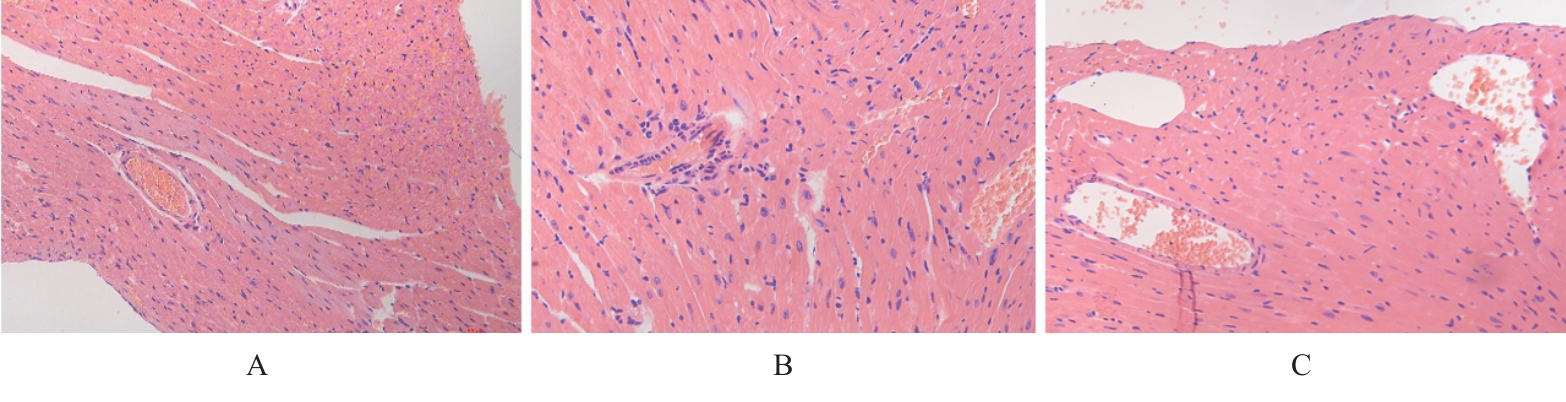
Fig. 2
Morphology, particle size, and marker expressions of serum exosomes"
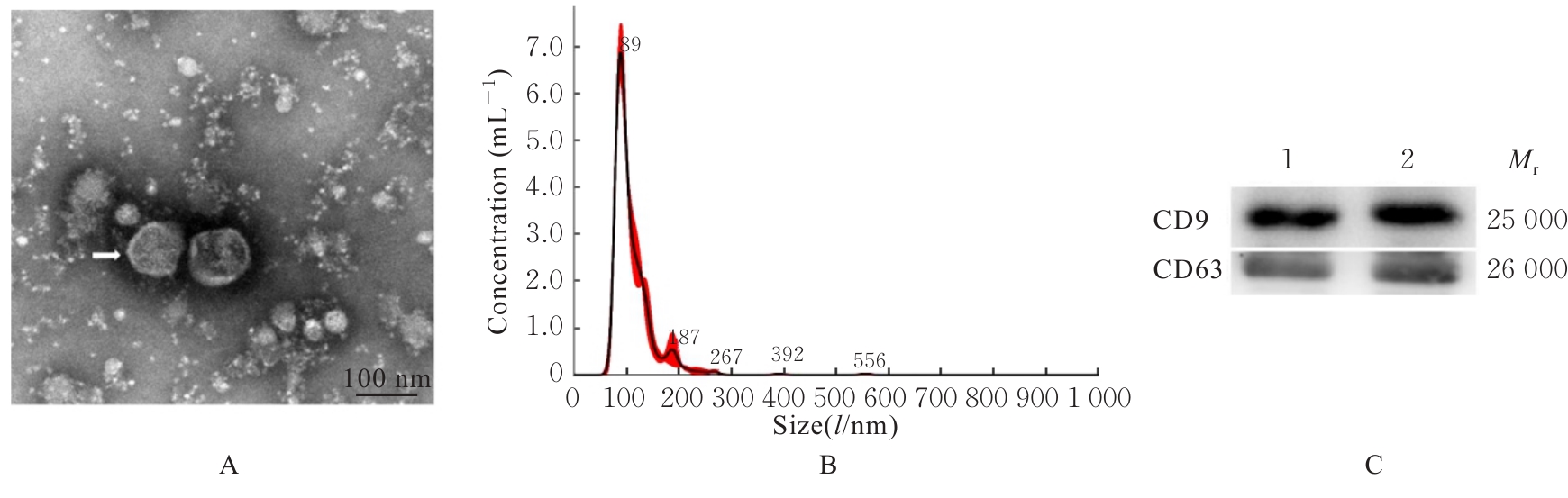
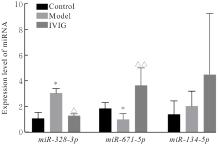
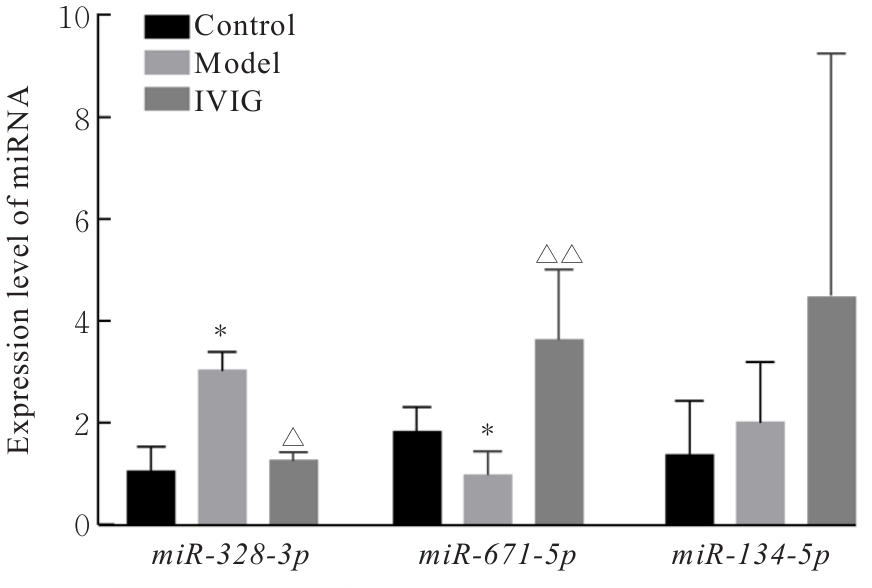
Fig. 3
Expression levels of miRNA in serum exosomes of mice in various groups"
| [1] | NEWBURGER J W, TAKAHASHI M, GERBER M A, et al. Diagnosis, treatment, and long-term management of Kawasaki disease: a statement for health professionals from the Committee on Rheumatic Fever, Endocarditis and Kawasaki Disease, Council on Cardiovascular Disease in the Young, American Heart Association[J]. Circulation, 2004, 110(17): 2747-2771. |
| [2] | HARTOPO A B, SETIANTO B Y. Coronary artery sequel of Kawasaki disease in adulthood, a concern for internists and cardiologists[J]. Acta Med Indones, 2013, 45(1): 69-75. |
| [3] | RIFE E, GEDALIA A. Kawasaki disease: an update[J]. Curr Rheumatol Rep, 2020, 22(10): 75. |
| [4] | CAPITTINI C, EMMI G, MANNARINO S, et al. An immune-molecular hypothesis supporting infectious aetiopathogenesis of Kawasaki disease in children[J]. Eur J Immunol, 2018, 48(3): 543-545. |
| [5] | HARA T, NAKASHIMA Y, SAKAI Y, et al. Kawasaki disease: a matter of innate immunity[J]. Clin Exp Immunol, 2016, 186(2): 134-143. |
| [6] | HU P, JIANG G M, WU Y, et al. TNF-α is superior to conventional inflammatory mediators in forecasting IVIG nonresponse and coronary arteritis in Chinese children with Kawasaki disease[J]. Clin Chim Acta, 2017, 471: 76-80. |
| [7] | 韦铭菲, 史俊展, 姚泽伟, 等. 川崎病性冠状动脉瘤破裂出血致急性心包压塞死亡一例[J]. 郑州大学学报(医学版), 2024, 59(1): 144-147. |
| [8] | ZHANG X F, XIN G D, SUN D J. Serum exosomal miR-328, miR-575, miR-134 and miR-671-5p as potential biomarkers for the diagnosis of Kawasaki disease and the prediction of therapeutic outcomes of intravenous immunoglobulin therapy[J]. Exp Ther Med, 2018, 16(3): 2420-2432. |
| [9] | SUN F Y, YUAN W F, WU H, et al. LncRNA KCNQ1OT1 attenuates sepsis-induced myocardial injury via regulating miR-192-5p/XIAP axis[J]. Exp Biol Med, 2020, 245(7): 620-630. |
| [10] | WANG Z S, ZHANG J Y, ZHANG S L, et al. miR-30e and miR-92a are related to atherosclerosis by targeting ABCA1[J]. Mol Med Rep, 2019, 19(4): 3298-3304. |
| [11] | LEHMAN T J, WALKER S M, MAHNOVSKI V, et al. Coronary arteritis in mice following the systemic injection of group B Lactobacillus casei cell walls in aqueous suspension[J]. Arthritis Rheum, 1985, 28(6): 652-659. |
| [12] | ABE M, RASTELLI D D, GOMEZ A C, et al. IL-1-dependent electrophysiological changes and cardiac neural remodeling in a mouse model of Kawasaki disease vasculitis[J]. Clin Exp Immunol, 2020, 199(3): 303-313. |
| [13] | CHENG Y R, QU X Y, DONG Z N, et al. Comparison of serum exosome isolation methods on co-precipitated free microRNAs[J]. Peer J, 2020, 8: e9434. |
| [14] | ZHANG Q, HUA W, WANG Y, et al. Clinical features of Kawasaki disease in children with an atypical age of onset [J]. Hong Kong J Paediatr, 2021, 26(4): 204-210. |
| [15] | FUKAZAWA R, KOBAYASHI T, MIKAMI M, et al. Nationwide survey of patients with giant coronary aneurysm secondary to Kawasaki disease 1999-2010 in Japan[J]. Circ J, 2017, 82(1): 239-246. |
| [16] | GORDON J B, DANIELS L B, KAHN A M, et al. The spectrum of cardiovascular lesions requiring intervention in adults after Kawasaki disease[J]. JACC Cardiovasc Interv, 2016, 9(7): 687-696. |
| [17] | NAKAMURA Y, ASO E, YASHIRO M, et al. Mortality among Japanese with a history of Kawasaki disease: results at the end of 2009[J]. J Epidemiol, 2013, 23(6): 429-434. |
| [18] | GORDON J B, KAHN A M, BURNS J C. When children with Kawasaki disease grow up: Myocardial and vascular complications in adulthood[J]. J Am Coll Cardiol, 2009, 54(21): 1911-1920. |
| [19] | STANGEL M, PUL R. Basic principles of intravenous immunoglobulin (IVIg) treatment[J]. J Neurol, 2006, 253(): V18-V24. |
| [20] | TAKAHASHI K, OHARASEKI T, YOKOUCHI Y. Pathogenesis of Kawasaki disease[J]. Clin Exp Immunol, 2011, 164(): 20-22. |
| [21] | KELLER S, SANDERSON M P, STOECK A, et al. Exosomes: from biogenesis and secretion to biological function[J]. Immunol Lett, 2006, 107(2): 102-108. |
| [22] | 周孙欣, 霍 娜, 李红坤, 等. 人滑膜间充质干细胞外泌体中miR-429修复骨关节炎软骨损伤的作用初探[J]. 解放军医学杂志, 2025, 50(7): 882-889. |
| [23] | LU M M, YUAN S F, LI S C, et al. The exosome-derived biomarker in atherosclerosis and its clinical application[J]. J Cardiovasc Transl Res, 2019, 12(1): 68-74. |
| [24] | 张向前, 韩 笑, 张 坤. 血清外泌体LncRNA GAS5在胃癌患者中的表达水平及其临床意义[J]. 临床检验杂志, 2025, 43(5): 336-340. |
| [25] | LI C, LI X L, GAO X, et al. microRNA-328 as a regulator of cardiac hypertrophy[J]. Int J Cardiol, 2014, 173(2): 268-276. |
| [26] | LU Y J, ZHANG Y, WANG N, et al. microRNA-328 contributes to adverse electrical remodeling in atrial fibrillation[J]. Circulation, 2010, 122(23): 2378-2387. |
| [27] | NTOUMOU E, TZETIS M, BRAOUDAKI M, et al. Serum microRNA array analysis identifies miR-140-3p, miR-33b-3p and miR-671-3p as potential osteoarthritis biomarkers involved in metabolic processes[J]. Clin Epigenetics, 2017, 9: 127. |
| [28] | ZHANG B X, SUN M Q, WANG J Z, et al. miR-671 ameliorates the progression of osteoarthritis in vitro and in vivo [J]. Pathol Res Pract, 2019, 215(7): 152423. |
| [29] | JIA H L, LIU C W, ZHANG L, et al. Sets of serum exosomal microRNAs as candidate diagnostic biomarkers for Kawasaki disease[J]. Sci Rep, 2017, 7: 44706. |
| [1] | Tian LI,Jiafeng WANG,Zhimin ZHANG. Research progress in application of exosomes in diagnosis and treatment of oral diseases [J]. Journal of Jilin University(Medicine Edition), 2026, 52(2): 543-550. |
| [2] | Yuqing PAN,Jiayan TAN,Suqin WANG,Ya LI. Research progress in biological function of BCL6B gene and its role in occurrence and development of tumor [J]. Journal of Jilin University(Medicine Edition), 2026, 52(2): 551-560. |
| [3] | Jiaxin WANG,Junwen MAO,Xuan ZHANG. Expression of natural autoantibodies against apoptosis inhibitory genes in plasma of patients with hepatocellular carcinoma and its clinical significance [J]. Journal of Jilin University(Medicine Edition), 2026, 52(1): 228-235. |
| [4] | Huiying YANG,Weihong LIANG,Xinru XU,Haodan SUN,Xin JIAO,Haiping WANG. Research progress in effect of bone marrow mesenchymal stem cells on differentiation induction of cardiomyocyte-like cells, protection of cardiomyocytes, and myocardial-related diseases [J]. Journal of Jilin University(Medicine Edition), 2026, 52(1): 281-289. |
| [5] | Jing LIU,Yan WANG,Xu HUANG. Promoting effect of overexpressed circRNAs-modified dental pulp stem cell-derived exosomes on angiogenesis of human umbilical vein endothelial cells [J]. Journal of Jilin University(Medicine Edition), 2025, 51(6): 1561-1570. |
| [6] | Xianwei JIANG,Minghang WANG,Huiru LI,Xiaosheng DONG,Yuanyuan LIU. Mendelian randomization and GEO database identification analysis based on potential therapeutic targets for chronic obstructive pulmonary disease [J]. Journal of Jilin University(Medicine Edition), 2025, 51(4): 1072-1083. |
| [7] | Xiaoshuang HE,Lina XU,Mei CUI,Yu ZHAO,Bei WANG,Zheng HUANG,Yuchao WANG,Wenyan XIN,Chao WU. Effects of lncRNA DUXAP8 in lung cancer A549 cells-derived exosomes on lung cancer cell growth and its mechnism [J]. Journal of Jilin University(Medicine Edition), 2025, 51(4): 958-967. |
| [8] | DILIXIATI·Dilidaer,Lin JIA. Improvement effect of exosomes derived from human adipose-derived stem cells and human dermal fibroblasts on ultraviolet-induced photoaging skin wrinkles in nude mice [J]. Journal of Jilin University(Medicine Edition), 2025, 51(3): 621-631. |
| [9] | Jiaxin YI,Yangyu ZHANG,Yingli FU,Yuchen PAN,Yongjie HAN,Jing JIANG,Yanhua WU. Effect of MEIS1 expression on survival in patients after radical gastrectomy and its value in prognostic evaluation [J]. Journal of Jilin University(Medicine Edition), 2024, 50(5): 1358-1364. |
| [10] | Honghong LI,Na YU,Minghao SHI,Ying SUN,Yao LI,Zhongjun SHEN,Xiaoyi LIU,Liyan ZHAO. Predictive value of new thrombotic risk assessment model for venous thromboembolism in patients with malignant tumors [J]. Journal of Jilin University(Medicine Edition), 2024, 50(5): 1390-1399. |
| [11] | Jinlian LI,Lanzhen HUANG,Xishi HUANG,Kangzhi LI,Jiali JIANG,Miaomiao ZHANG,Qunying WU. Bioinformatics analysis on key genes related to prognosis, diagnosis, and immune cell infiltration of hepatocellular carcinoma and their potential therapeutic drugs [J]. Journal of Jilin University(Medicine Edition), 2024, 50(4): 1062-1075. |
| [12] | Yufei FENG,Shan JIN,Yubing WANG,Yinfei LU,Lijuan PANG,Kejian LIU. Bioinformatics analysis based on immune-related genes and immune cell infiltration of in-stent restenosis after percutaneous coronary intervention [J]. Journal of Jilin University(Medicine Edition), 2024, 50(3): 749-758. |
| [13] | Bo YUAN,Jiayi XIE,Siyu JIANG,Yajun MENG,Qinghua ZHU,Xiaofei LI,Xiumei FU,Lide XIE. Effect of adipose-derived stem cell-derived exosomes on migration ability of macrophages in vitro [J]. Journal of Jilin University(Medicine Edition), 2024, 50(3): 718-727. |
| [14] | Xiaolei XUE,Baomei XU. Expression of Klotho protein in placenta exosomes in patients with pre-eclampsia and its effect on oxidative stress in vascular endothelial cells [J]. Journal of Jilin University(Medicine Edition), 2023, 49(6): 1528-1538. |
| [15] | Jiao ZHAGN,Baolian MA,Yonglan ZHANG. Antioxidant capacities of edible plant-exosomes-like nanoparticles in vitro and their protective effects on oxidative damage of PC12 cells induced by hydrogen peroxide [J]. Journal of Jilin University(Medicine Edition), 2023, 49(5): 1117-1124. |
|