Journal of Jilin University(Medicine Edition) ›› 2026, Vol. 52 ›› Issue (2): 483-490.doi: 10.13481/j.1671-587X.20260220
• Research in clinical medicine • Previous Articles Next Articles
Relationship between serum PI3K and Akt levels and thrombocytopenia in patients with Sjögren’s syndrome and its clinical significance
Xiao LIU,Fei FEI,Tao LIU,Lan QIN( )
)
- Department of Hematology,Fourth Affiliated Hospital,Xinjiang Medical University,Urumqi 830000,China
-
Received:2025-03-13Accepted:2025-07-18Online:2026-03-28Published:2026-04-15 -
Contact:Lan QIN E-mail:fgh22p@qq.com

CLC Number:
- R593.2
Cite this article
Xiao LIU,Fei FEI,Tao LIU,Lan QIN. Relationship between serum PI3K and Akt levels and thrombocytopenia in patients with Sjögren’s syndrome and its clinical significance[J].Journal of Jilin University(Medicine Edition), 2026, 52(2): 483-490.
share this article
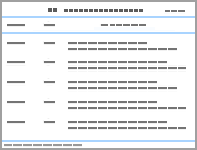
Tab.1
Levels of PI3K and Akt in serum of patients in two groups [x±s, ρB/(pg·L-1)]"
| Group | n | PI3K | Akt |
|---|---|---|---|
| SS-NTP | 147 | 8.30±1.98 | 9.19±2.12 |
| SS-TP | 51 | 6.23±2.01 | 7.03±2.08 |
| t | 6.408 | 6.300 | |
| P | <0.001 | <0.001 |
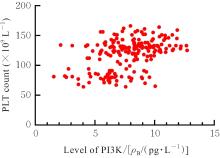
Fig. 1
Correlation between PI3K level and PLT count in SS patients"
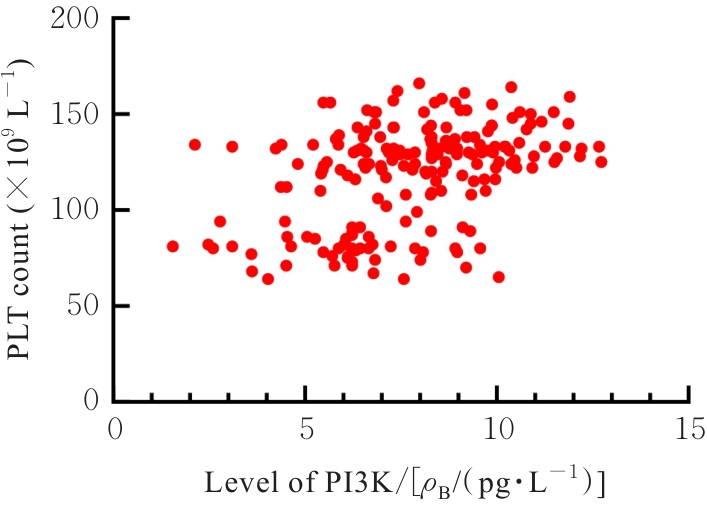
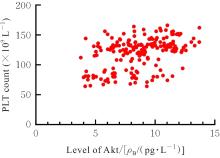
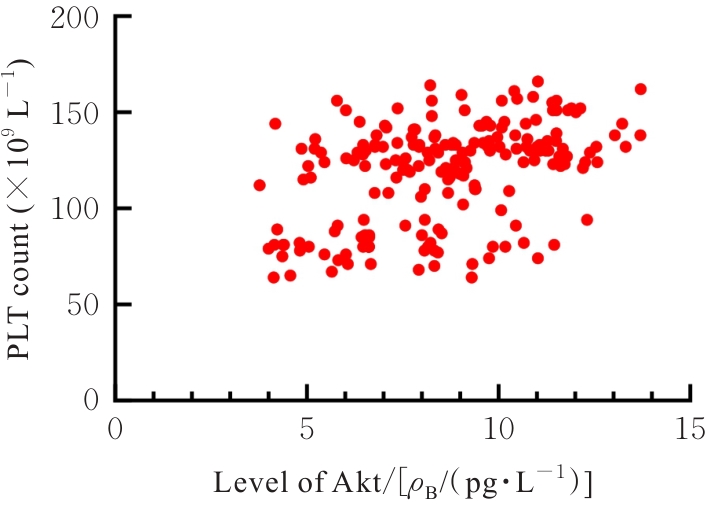
Fig. 2
Correlation between Akt level and PLT count in SS patients"
Tab.2
Baseline characteristics of patients in two groups"
| Characteristic | SS-NTP (n=147) | SS-TP (n=51) | χ2/t | P |
|---|---|---|---|---|
| Gender [n(%)] | 0.006 | 0.939 | ||
| Male | 13(8.84) | 5(9.80) | ||
| Female | 134(91.16) | 46(90.20) | ||
| Age (x±s, year) | 48.89±4.07 | 49.26±4.14 | 0.557 | 0.578 |
| BMI (x±s, kg·m-2) | 23.12±2.44 | 22.86±2.38 | 0.660 | 0.510 |
| Duration of disease (x±s, month) | 40.31±10.02 | 38.95±9.69 | 0.842 | 0.401 |
| Family history of rheumatic diseases [n(%)] | 22(14.97) | 8(15.69) | 0.015 | 0.902 |
| SS activity index (x±s) | 9.44±1.95 | 10.06±2.01 | 1.941 | 0.054 |
| Clinical manifestations [n(%)] | ||||
| Dry eyes | 60(40.82) | 21(41.18) | 0.002 | 0.964 |
| Dry mouth | 90(61.22) | 33(64.71) | 0.195 | 0.659 |
| Parotid gland enlargement | 92(62.59) | 31(60.78) | 0.052 | 0.819 |
| Fatigue | 48(32.65) | 17(33.33) | 0.008 | 0.929 |
| Arthralgia | 79(53.74) | 25(49.02) | 0.339 | 0.561 |
| “Rampant” caries | 21(14.29) | 8(15.69) | 0.059 | 0.807 |
| Raynaud’s phenomenon | 12(8.16) | 5(9.80) | 0.005 | 0.944 |
| Peripheral neuropathy | 28(19.05) | 10(19.61) | 0.008 | 0.930 |
| Dysphagia | 12(8.16) | 4(7.84) | 0.051 | 0.821 |
| Lymphadenopathy | 14(9.52) | 12(23.53) | 6.511 | 0.011 |
| Blood routine indicators (x±s) | ||||
| White blood cell count (×109 L-1) | 4.07±0.41 | 3.97±0.36 | 1.547 | 0.124 |
| Neutrophil count (×109 L-1) | 2.50±0.46 | 2.45±0.42 | 0.684 | 0.495 |
| Lymphocyte count (×109 L-1) | 1.40±0.32 | 1.12±0.29 | 5.511 | <0.001 |
| Hemoglobin (g·L-1) | 128.81±22.04 | 109.65±24.49 | 5.196 | <0.001 |
| Immune-related indicator | ||||
| Complement C3 (x±s, g·L-1) | 0.86±0.07 | 0.84±0.06 | 1.821 | 0.070 |
| Complement C4 (x±s, g·L-1) | 0.22±0.04 | 0.21±0.03 | 1.632 | 0.104 |
| IgM (x±s, g·L-1) | 1.17±0.23 | 1.20±0.25 | 0.785 | 0.434 |
| IgA (x±s, g·L-1) | 2.61±0.79 | 2.78±0.81 | 1.316 | 0.190 |
| IgG (x±s, g·L-1) | 13.97±3.92 | 14.28±3.86 | 0.489 | 0.626 |
| CD4+/CD8+ T lymphocyte ratio (x±s) | 1.71±0.38 | 1.62±0.35 | 1.486 | 0.139 |
| Percentage of NK cell (x±s, %) | 11.20±2.51 | 10.59±2.35 | 1.520 | 0.130 |
| ANA (+) [n(%)] | 125(85.03) | 41(80.39) | 0.602 | 0.438 |
| Anti-SSA (+) [n(%)] | 80(54.42) | 27(52.94) | 0.033 | 0.855 |
| Anti-SSB (+) [n(%)] | 30(20.41) | 11(21.57) | 0.031 | 0.860 |
| RF (+) [n(%)] | 33(22.45) | 10(19.61) | 0.180 | 0.672 |
Tab.3
Assignments of variables for SS patients complicated with TP"
| Variable | Type | Assignment |
|---|---|---|
| Dependent variable | ||
| Incidence of TP | Dichotomous variable | No=0, Yes=1 |
| Independent variables | ||
| Lymphadenopathy | Dichotomous variable | No=0, Yes=1 |
| Lymphocyte count | Continuous variable | Specific value |
| Hemoglobin level | Continuous variable | Specific value |
| PI3K level | Continuous variable | Specific value |
| Akt level | Continuous variable | Specific value |
Tab.4
Influencing factors of SS patients complicated with TP"
| Variable | β | SE | Wald χ2 | P | OR | 95%CI |
|---|---|---|---|---|---|---|
| Lymphadenopathy | 1.037 | 0.699 | 2.200 | 0.138 | 2.820 | 0.717-11.099 |
| Lymphocyte count | -3.938 | 0.867 | 20.609 | <0.001 | 0.019 | 0.004-0.107 |
| Hemoglobin level | -0.479 | 0.120 | 16.082 | <0.001 | 0.619 | 0.490-0.783 |
| PI3K level | -0.519 | 0.125 | 17.195 | <0.001 | 0.595 | 0.466-0.761 |
| Akt level | -0.618 | 0.141 | 19.101 | <0.001 | 0.539 | 0.408-0.711 |
Tab. 5
Predictive values of serum PI3K and Akt levels in SS patients complicated with TP"
| Variable | AUC | 95%CI | Z | P | Cut-off [ρB/(pg·L-1)] | Youden index | Sensitivity (η/%) | Specificity (η/%) |
|---|---|---|---|---|---|---|---|---|
| PI3K | 0.770 | 0.705—0.827 | 7.129 | <0.001 | ≤6.83 | 0.468 | 70.59 | 76.19 |
| Akt | 0.763 | 0.698—0.821 | 6.813 | <0.001 | ≤8.52 | 0.449 | 82.35 | 62.59 |
| Combined | 0.853 | 0.796—0.899 | 12.195 | <0.001 | 0.573 | 80.39 | 76.87 |
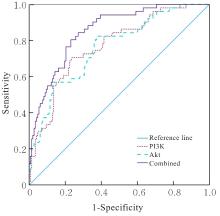
Fig. 3
ROC curves predicted by serum PI3K and Akt levels of SS patients complicated with TP"
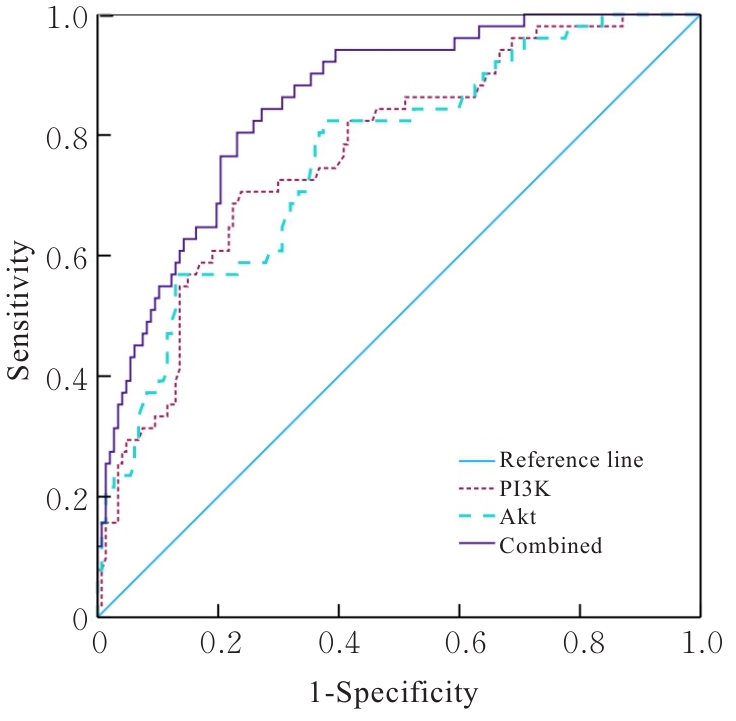
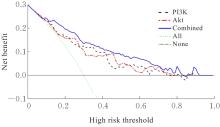
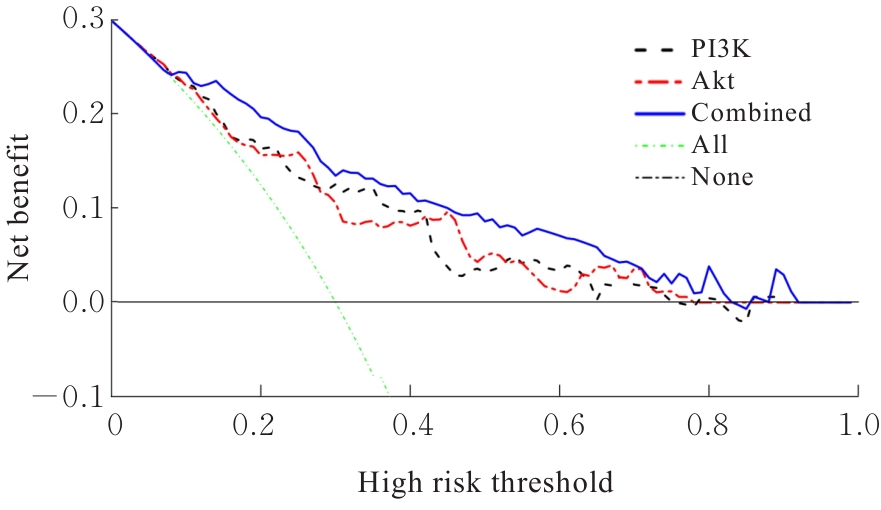
Fig. 4
Decision curves predicted by serum PI3K and Akt levels of SS patients complicated with TP"
| [1] | HAMMITT K M, NAEGELI A N, VAN DEN BROEK R W M, et al. Patient burden of Sjögren’s: a comprehensive literature review revealing the range and heterogeneity of measures used in assessments of severity[J]. RMD Open, 2017, 3(2): e000443. |
| [2] | 张 文, 陈 竹, 厉小梅, 等. 原发性干燥综合征诊疗规范[J]. 中华内科杂志, 2023, 62(9): 1059-1067. |
| [3] | MALLADI A S, SACK K E, SHIBOSKI S C, et al. Primary Sjögren’s syndrome as a systemic disease: a study of participants enrolled in an international Sjögren’s syndrome registry[J]. Arthritis Care Res, 2012, 64(6): 911-918. |
| [4] | QIAN J Y, HE C M, LI Y, et al. Ten-year survival analysis of patients with primary Sjögren’s syndrome in China: a national prospective cohort study[J]. Ther Adv Musculoskelet Dis, 2021, 13: 1759720X211020179. |
| [5] | ZENG P, JIANG Z, HUANG Z W, et al. PI3K/AKT/mTOR signaling pathway is downregulated by runzaoling (RZL) in Sjögren’s syndrome[J]. Mediators Inflamm, 2022, 2022: 7236118. |
| [6] | YANG H X, LI Y J, HE Y L, et al. Hydrogen sulfide promotes platelet autophagy via PDGFR-α/PI3K/Akt signaling in cirrhotic thrombocytopenia[J]. J Clin Transl Hepatol, 2024, 12(7): 625-633. |
| [7] | SHIBOSKI C H, SHIBOSKI S C, SEROR R, et al. 2016 American college of rheumatology/European league against rheumatism classification criteria for primary Sjögren’s syndrome: a consensus and data-driven methodology involving three international patient cohorts[J]. Arthritis Rheumatol, 2017, 69(1): 35-45. |
| [8] | 中国成人血小板减少症急诊管理共识专家组. 中国成人血小板减少症急诊管理专家共识[J]. 中华急诊医学杂志, 2022, 31(2): 161-168. |
| [9] | 孙 佳. 原发性干燥综合征并发血小板减少临床特征研究[D]. 石家庄: 河北医科大学, 2020. |
| [10] | 杨 柳. 原发性干燥综合征继发血小板减少患者临床特征及危险因素分析[D]. 石家庄: 河北医科大学, 2022. |
| [11] | 王丽丽, 黄鸿影, 王 信, 等. 原发性干燥综合征继发免疫性血小板减少症的临床特点及危险因素分析[J]. 蚌埠医学院学报, 2024, 49(2): 167-171. |
| [12] | DAI F, YANG G M, RAO P S, et al. Clinical characteristics of secondary immune thrombocytopenia associated with primary Sjögren’s syndrome[J]. Front Med, 2020, 7: 138. |
| [13] | 王红权, 苏锦锋, 彭春晓, 等. 原发性干燥综合征继发血小板减少患者的临床特征及相关因素分析[J]. 风湿病与关节炎, 2024, 13(10): 9-14. |
| [14] | WANG Q R, ZHANG W L, HU J, et al. Lithium prevents glucocorticoid-induced chondrocyte autophagy: an in vitro study[J]. Mol Med Rep, 2023, 28(4): 183. |
| [15] | 罗雅琴, 黄 伟. 芪黄益气摄血方调控PI3K/AKT/mTOR信号通路和自噬治疗免疫性血小板减少症的作用机制[J]. 中华中医药杂志, 2022, 37(10): 5627-5633. |
| [16] | 刘珈言, 梅 蓉, 杨礼凤, 等. 雷公藤多苷减轻干燥综合征模型小鼠炎性反应[J]. 基础医学与临床, 2022,42(9): 1362-1366. |
| [17] | 张春梅, 黄新惠, 胡锦秋, 等. 莱菔硫烷下调PI3K/Akt信号通路对高糖诱导人血小板凋亡的保护作用[J]. 实用医学杂志, 2024, 40(18): 2530-2536. |
| [18] | BALDINI C, BERARDICURTI O, GIACOMELLI R, et al. Is minor salivary gland biopsy still mandatory in Sjogren’s syndrome? Does seronegative Sjogren’s syndrome exist?[J]. Autoimmun Rev, 2024, 23(1): 103425. |
| [19] | DING Y H, XIANG Q, ZHU P Y, et al. Qihuang Zhuyu formula alleviates coronary microthrombosis by inhibiting PI3K/Akt/αIIbβ3-mediated platelet activation[J]. Phytomedicine, 2024, 125: 155276. |
| [20] | 宋维海, 李 琴, 茅建春. 一贯煎对干燥综合征模型大鼠及颌下腺PI3K/Akt/eNOS通路的影响[J]. 中药材, 2020, 43(7): 1721-1725. |
| [21] | SUN Y Y, WANG T, LV Y, et al. MALAT1 promotes platelet activity and thrombus formation through PI3k/Akt/GSK-3β signalling pathway[J]. Stroke Vasc Neurol, 2023, 8(3): 181-192. |
| [22] | SONG H D, YANG Y J, LI B. Tripeptide Hyp-Asp-Gly from collagen peptides inhibited platelet activation via regulation of PI3K/Akt-MAPK/ERK1/2 signaling pathway[J]. J Food Sci, 2022, 87(7): 3279-3293. |
| [23] | SUN Y Y, YANG M N, LI S J, et al. Alantolactone induces platelet apoptosis by activating the Akt pathway[J]. Platelets, 2023, 34(1): 2173505. |
| [24] | ZHAO H Y, ZHANG Y Y, XING T, et al. Correction: M2 macrophages, but not M1 macrophages, support megakaryopoiesis by upregulating PI3K-AKT pathway activity[J]. Signal Transduct Target Ther, 2024, 9(1): 240. |
| [25] | SCHWERTZ H, MIDDLETON E A. Autophagy and its consequences for platelet biology[J]. Thromb Res, 2023, 231: 170-181. |
| [26] | KAPSOGEORGOU E K, STERGIOU I E, CHATZIS L, et al. The role of the Akt signaling pathway in Sjögren’s syndrome[J]. Mediterr J Rheumatol, 2023, 34(1): 113-116. |
| [27] | XIN Z L, XU R Y, DONG Y, et al. Impaired autophagy-mediated macrophage polarization contributes to age-related hyposalivation[J]. Cell Prolif, 2024, 57(12): e13714. |
| [28] | QI W X, TIAN J X, WANG G, et al. Advances in cellular and molecular pathways of salivary gland damage in Sjögren’s syndrome[J]. Front Immunol, 2024, 15: 1405126. |
| [1] | Shanshan SUN,Mei LU,Xinfu GAO,LYu Guangyao,Baolei Zhao,LYu Wenwen. Inhibitory effect of Bradykinin 1 receptor antagonist ELN441958 on proliferation of HepG2 cells by regulating Akt/FoxO3a signaling pathway [J]. Journal of Jilin University(Medicine Edition), 2026, 52(1): 70-80. |
| [2] | Bing BAI,Qian ZHANG,Tao PU,Yu NI,Tingting HU,Linhong HU,Yibin YANG. Effect of angiopoietin 1 and tyrosine kinase receptor 2 inhibitor on glucose transportation in endothelial cells and its mechanism [J]. Journal of Jilin University(Medicine Edition), 2025, 51(6): 1487-1497. |
| [3] | Kun XU,Jing TIAN. Changes of early memory T lymphocytes in mice infected with influenza A virus PR8 and its significance [J]. Journal of Jilin University(Medicine Edition), 2025, 51(6): 1584-1594. |
| [4] | Haidong ZHU,Changkun LYU,Wei SHI. Effect of berberine hydrochloride on autophagy of HeLa cells infected with herpes simplex virus type 1 by regulating PI3K/AKT/mTOR signaling pathway [J]. Journal of Jilin University(Medicine Edition), 2025, 51(6): 1607-1617. |
| [5] | Wei AN, MAIMAITITUXUN·Tuerdi,Zhitao YAO. Regulatory effect of lutein on PI3K/AKT signaling pathway and chondrocyte autophagy in mandibular joint cartilage tissue of rabbits and its mechanism [J]. Journal of Jilin University(Medicine Edition), 2025, 51(4): 976-983. |
| [6] | Cheng CHEN,Jingyao LI,Wanxiang HU,Donghui LIU,Zhihong CHEN. Protective effect of sericin on streptozotocin-induced INS-1 cell damage by regulating PI3K/Akt/NF-κB signaling pathway through Akt1 and its mechanism [J]. Journal of Jilin University(Medicine Edition), 2025, 51(3): 590-598. |
| [7] | Yuling GU,Cui ZHENG,Yunxian TANG. Inhibitory effect of silencing of circadian rhythm gene TIMELESS on immune escape of ovarian cancer SK-OV-3 cells and its mechanism [J]. Journal of Jilin University(Medicine Edition), 2025, 51(3): 653-662. |
| [8] | Yihui WANG,Qing ZHANG,Yingnan LI,Liping YE. Effect of KIAA1522 on proliferation, migration, and invasion of lung cancer cells and its mechanism [J]. Journal of Jilin University(Medicine Edition), 2025, 51(3): 727-739. |
| [9] | Mengyun LU,Yucheng HAN,Yihong HU,Minhui HE,Yanqun ZHANG,Xianqiong ZOU. Effects of glycolipid transfer protein on proliferation, migration,and invasion of pancreatic cancer PANC-1 cells and their mechanisms [J]. Journal of Jilin University(Medicine Edition), 2025, 51(2): 284-295. |
| [10] | Ying YANG,Liang ZHAO,Yong YOU,Qian XU,Zhenjun YANG. Influence of 17β-estradiol in proliferation and differentiation of hippocampal neural stem cells and its mechanism [J]. Journal of Jilin University(Medicine Edition), 2025, 51(2): 317-324. |
| [11] | Chaohe ZHANG,Xinwei ZHANG,Xiangfeng WANG. Protective effect of Pien-Tze-Huang on acetaminophen-induced liver injury and its mechanism [J]. Journal of Jilin University(Medicine Edition), 2025, 51(1): 105-114. |
| [12] | Min CHEN,Huiyan ZHU,Jing TAO,Yipeng XU. Ameliorating effect of betaine on oxygen-glucose deprivation injury in rat brain microvascular endothelial cells and its influence in PI3K/AKT pathway [J]. Journal of Jilin University(Medicine Edition), 2025, 51(1): 96-104. |
| [13] | Gao SUN,Jing HE,Qi ZHAO,Jianhong SHI,Zhiling LIAO,Yuanye TIAN,Guomin WU. Therapeutic effect of resveratrol on osteoarthritis of temporomandibular joint and its mechanism [J]. Journal of Jilin University(Medicine Edition), 2024, 50(6): 1547-1556. |
| [14] | Jing LOU,Lei ZHAO,Yanjie ZHU,Shuaiqiang YUAN,Fei WANG,Hangzhou ZHANG,Jiaojiao XU,Xiaoke YU,Liufa HOU. Effect of Fuzheng Ruanjian Anticancer Formula on malignant biological behaviors of hepatocellulars carcinoma HepG2 cells by regulating Akt/MDM2/P53 signaling pathway [J]. Journal of Jilin University(Medicine Edition), 2024, 50(6): 1654-1663. |
| [15] | Like LUO,Ziwen CHENG,Kuo CHENG,Yonggang LI,Dawei WANG,Baoling YANG. Expression and localization of fever with thrombocytopenia syndrome virus nonstructural protein and screening and analysis of host-interacting proteins [J]. Journal of Jilin University(Medicine Edition), 2024, 50(5): 1286-1296. |
|