Journal of Jilin University(Medicine Edition) ›› 2026, Vol. 52 ›› Issue (2): 460-468.doi: 10.13481/j.1671-587X.20260218
• Research in basic medicine • Previous Articles Next Articles
Targeting relationship between miR-214-3p and EZH2 and its effects on proliferation, invasion, and apoptosis of ovarian cancer SKOV3 cells
Li ZHAI1,Meng CHEN2,Jianbo LUO1,Aili ZHANG1,Liangxiao WANG1,Ying WEI1( ),Xi ZHANG1()
- 1.Department of Medical Laboratory,Third Affiliated Hospital of Kunming Medical University,Yunnan Cancer Hospital,Peking University Cancer Hospital Yunnan,Kunming 650118,China
2.Department of Laboratory,Maternal and Child Health Service Center,Guandu District,Kunming City,Yunnan Province,Kunming 650200,China
-
Received:2025-03-26Accepted:2025-06-16Online:2026-03-28Published:2026-04-15 -
Contact:Ying WEI,Xi ZHANG E-mail:weiying@kmmu.edu.cn;zhangxi@kmmu.edu.cn

CLC Number:
- R737.31
Cite this article
Li ZHAI,Meng CHEN,Jianbo LUO,Aili ZHANG,Liangxiao WANG,Ying WEI,Xi ZHANG. Targeting relationship between miR-214-3p and EZH2 and its effects on proliferation, invasion, and apoptosis of ovarian cancer SKOV3 cells[J].Journal of Jilin University(Medicine Edition), 2026, 52(2): 460-468.
share this article
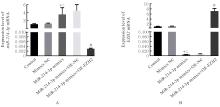
Fig. 1
Expression levels of miR-214-3p and EZH2 mRNA in SKOV3 cells in various groups"
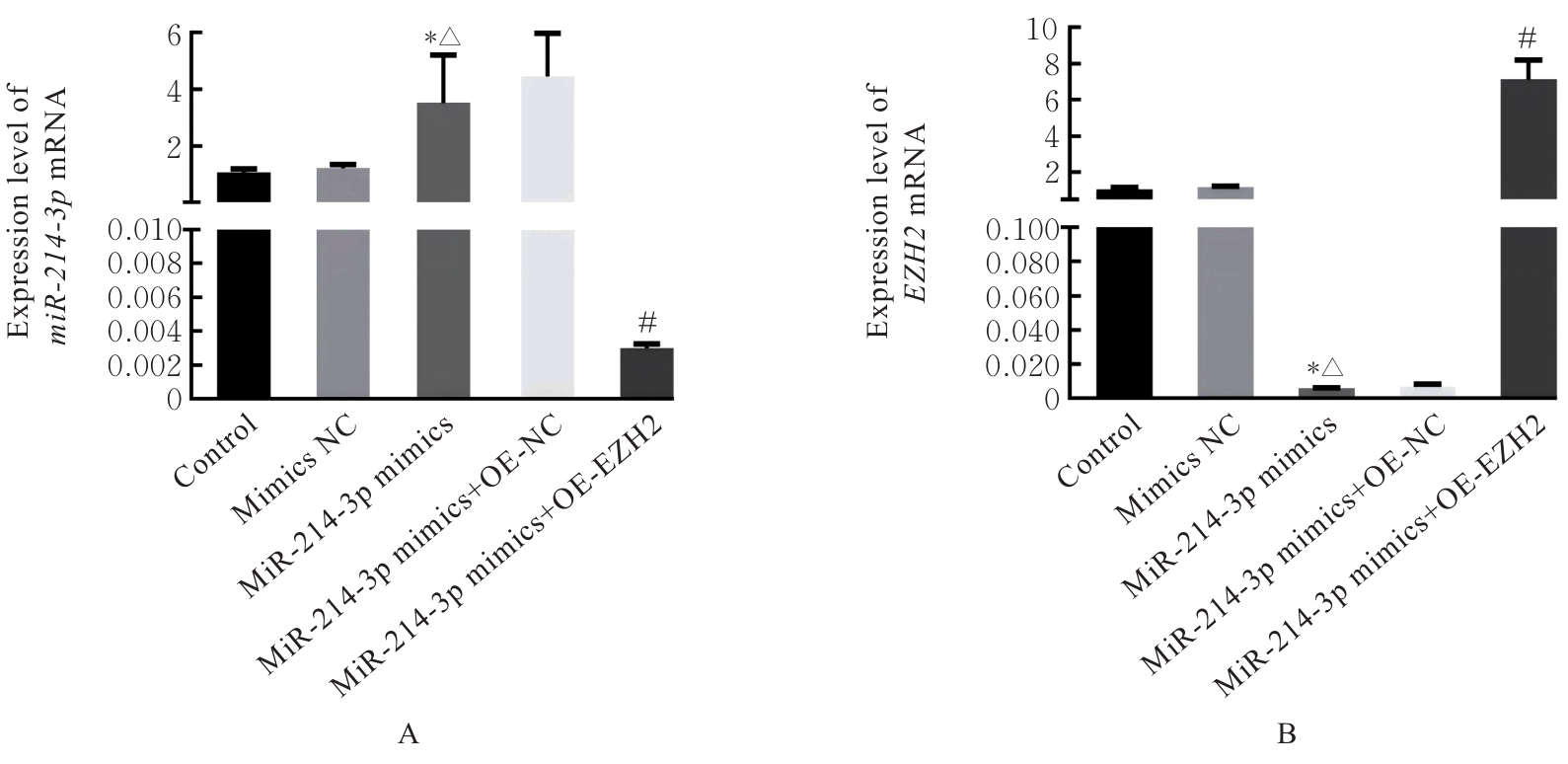
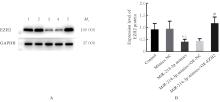
Fig. 2
Electrophoregram(A) and histogram(B) of expressions of EZH2 protein in SKOV3 cells in various groups"
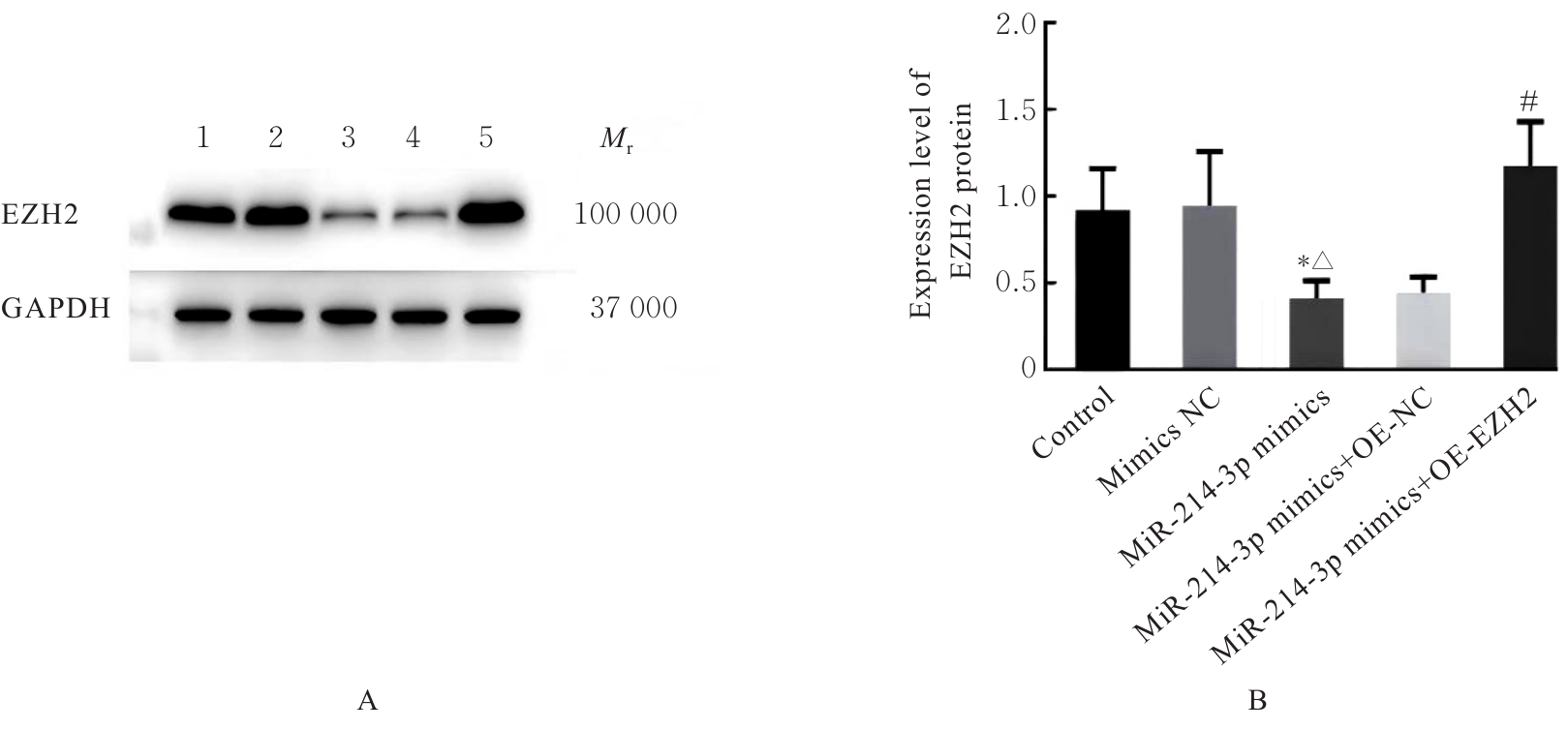

Fig. 3
Predicted binding site of miR-214-3p and EZH2"

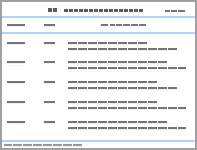
Tab.1
Activities of SKOV3 cells in various groups"
| Group | Activity |
|---|---|
| Control | 98.16±4.27 |
| Mimics NC | 97.78±1.70 |
| MiR-214-3p mimics | 66.97±2.05*△ |
| MiR-214-3p mimics+OE-NC | 65.94±5.92 |
| MiR-214-3p mimics+OE-EZH2 | 107.56±2.58# |

Fig. 4
Invasion of SKOV3 cells in various groups (Crystal violet,×100)"

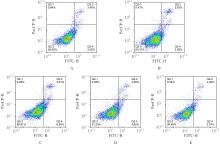
Fig. 5
Apoptosis of SKOV3 cells in various groups detected by flow cytometry"
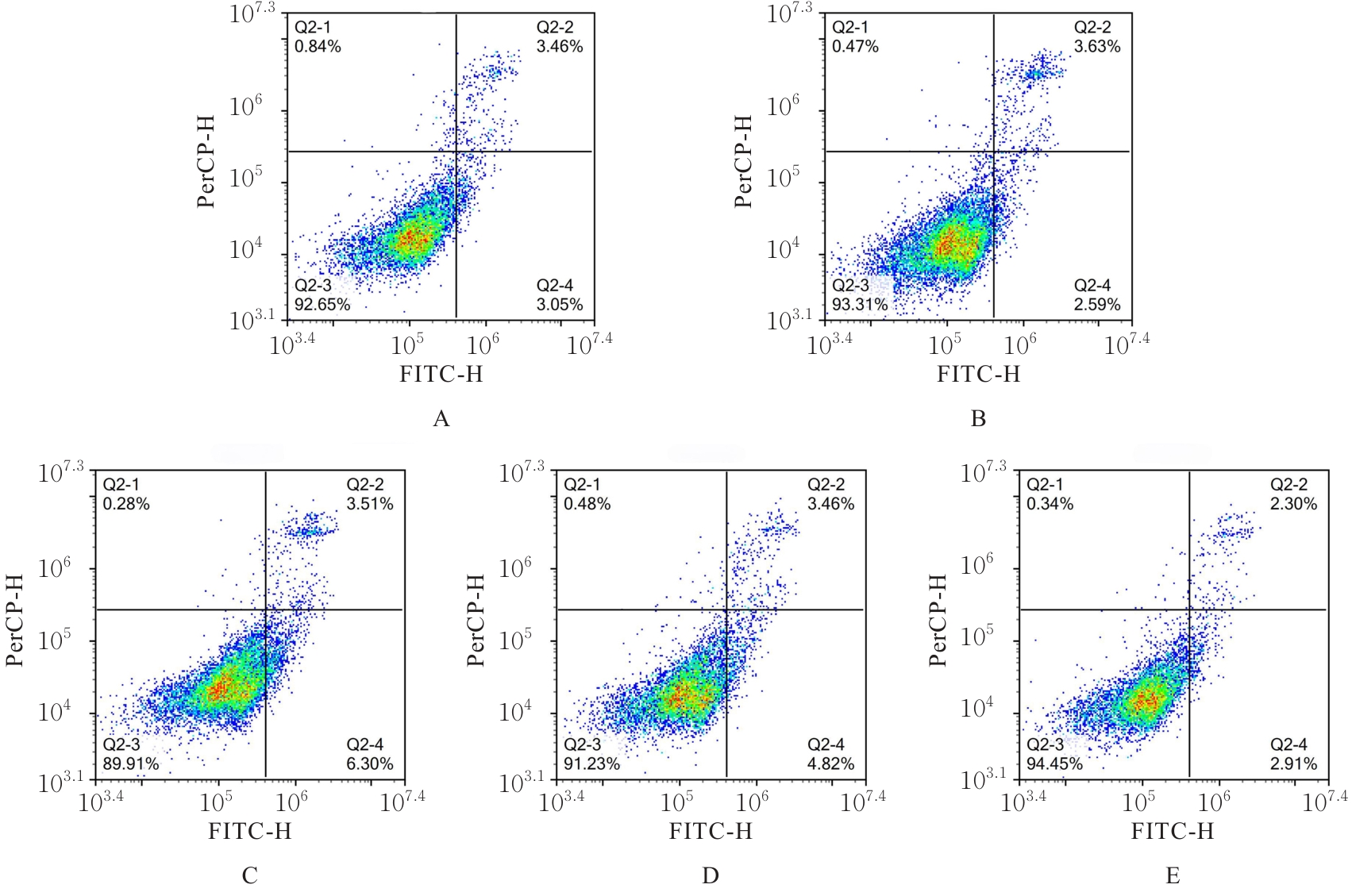
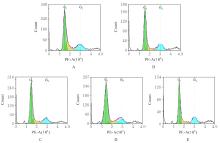
Fig. 6
Cycle distribution of SKOV3 cells in various groups"
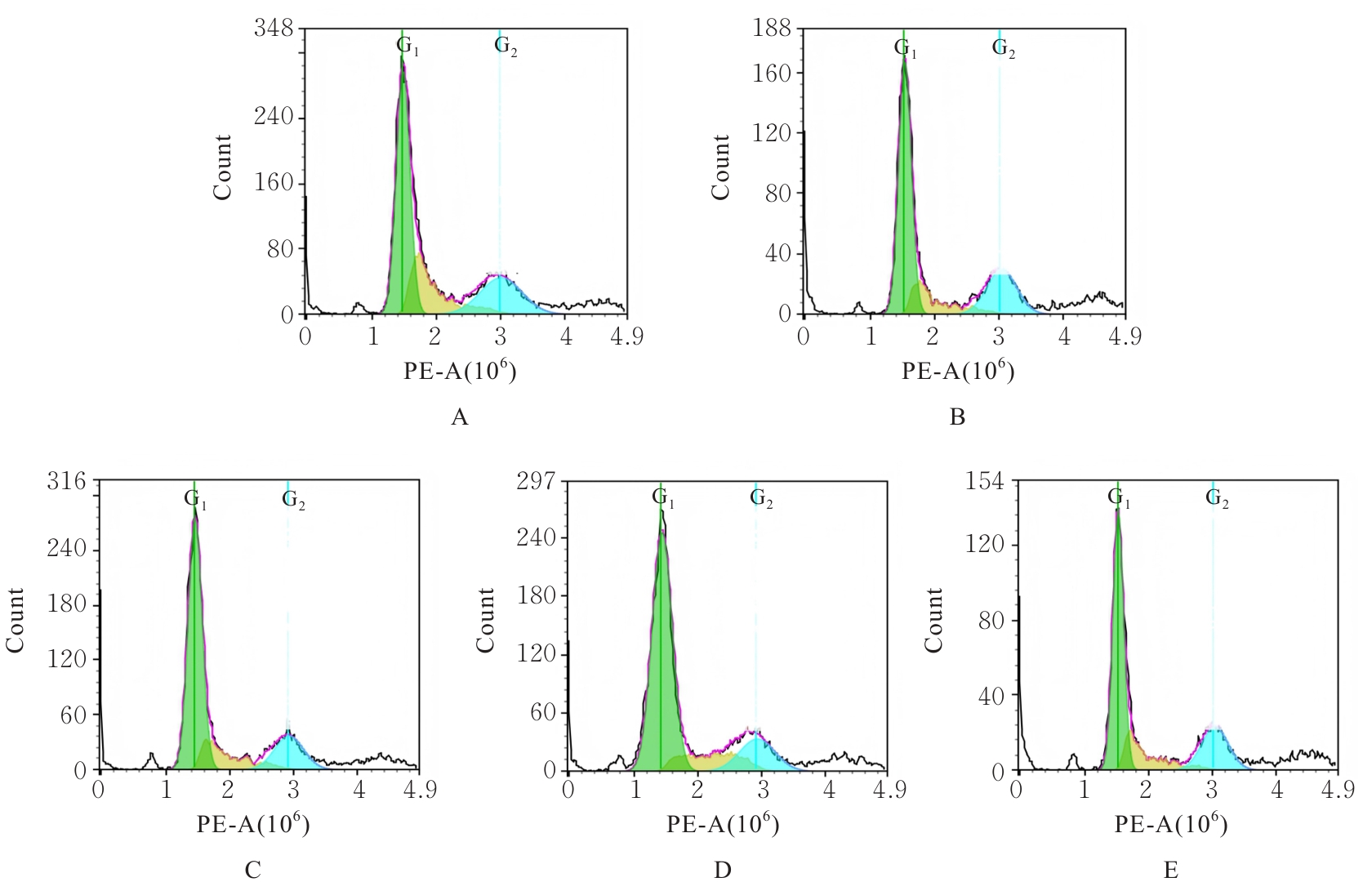
Tab.2
Percentages of SKOV3 cells at different cell cycles in various groups"
| Group | G1 phase | S phase | G2 phase |
|---|---|---|---|
| Control | 46.79±0.98 | 18.35±5.18 | 20.32±1.38 |
| Mimics NC | 47.93±0.70 | 17.26±5.33 | 18.01±3.64 |
| MiR-214-3p mimics | 54.88±0.53*△ | 14.22±0.45 | 17.28±2.05 |
| MiR-214-3p mimics+OE-NC | 56.90±4.36 | 13.85±0.32 | 16.93±3.53 |
| MiR-214-3p mimics+OE-EZH2 | 41.76±5.27 | 19.21±5.91 | 19.30±0.30 |
| [1] | FERLAY J, COLOMBET M, SOERJOMATARAM I, et al. Cancer statistics for the year 2020: an overview[J]. Int J Cancer, 2021, 149(4): 778-789. |
| [2] | 姜丹凤, 朱孟秀, 赵清娟, 等. 中国女性生殖系统肿瘤发病率和死亡率分析[J]. 现代肿瘤医学, 2023, 31(23): 4426-4431. |
| [3] | DONG X, MEN X, ZHANG W, et al. Advances in tumor markers of ovarian cancer for early diagnosis[J]. Indian J Cancer, 2014, 51(): e72-e76. |
| [4] | LIU Y K, YANG Q. The roles of EZH2 in cancer and its inhibitors[J]. Med Oncol, 2023, 40(6): 167. |
| [5] | KAUR P, SHANKAR E, GUPTA S. EZH2-mediated development of therapeutic resistance in cancer[J]. Cancer Lett, 2024, 586: 216706. |
| [6] | LIU Y, ZHOU H L, MA L, et al. MiR-214 suppressed ovarian cancer and negatively regulated semaphorin 4D[J]. Tumour Biol, 2016, 37(6): 8239-8248. |
| [7] | 孙伟涛, 石彦科, 封俊连, 等. lncRNA MIR17HG调节miR-214-3p/RNF38信号轴对肝癌细胞恶性生物学行为的影响[J]. 现代消化及介入诊疗, 2024, 29(5): 565-571. |
| [8] | LIN M Y, LIU X L, GUO M P. The effect of regulating miR-214 on the biological behaviors of cervical cancer[J]. Chin J Biomed Eng, 2024, 33(04): 163-171. |
| [9] | 严 涵, 郭绍兰, 戴学敏, 等. 红花苷联合miR-214对肺癌细胞增殖及凋亡的作用[J]. 河北医学, 2024, 30(12): 1937-1945. |
| [10] | 尹艳辉, 吴爱军, 周玲芝. 鼻咽癌患者miR-214-3p表达意义及与预后的关系分析[J]. 现代医学, 2022, 50(8): 974-979. |
| [11] | 周大新, 谢方利, 刘海科, 等. miR-214-3p通过靶向调节p53增强胃癌细胞的转移能力[J]. 安徽医科大学学报, 2021, 56(5): 769-773. |
| [12] | 郭剑锋. EZH2调节P57的表达促进卵巢癌进展的体内外实验研究[D]. 武汉: 华中科技大学, 2011. |
| [13] | 王俊杰, 蔡 晶, 高艳萍, 等. 人卵巢癌细胞EZH2基因下调对E-钙粘蛋白表达的影响[J]. 华中科技大学学报(医学版), 2013, 42(4): 382-385, 390. |
| [14] | 杨 丹, 李 凤, 杨斐斐, 等. BTK抑制剂联合基础化疗治疗初诊双表达弥漫性大B细胞淋巴瘤5例临床分析[J]. 中国实用内科杂志, 2024, 44(1): 42-48. |
| [15] | ZHAI L, TAI W L, PAN Y Q, et al. Expression of EZH2 and P53 and their correlation in ovarian cancer tissues[J]. Int J Clin Exp Pathol, 2020, 13(3): 456-464. |
| [16] | AMIN M M J, TREVELYAN C J, TURNER N A. MicroRNA-214 in health and disease[J]. Cells, 2021, 10(12): 3274. |
| [17] | 胡双洁, 章 勇, 薄维波, 等. miR-214-3p在乳腺癌中的表达模式对铁死亡的影响及其与临床病理特征的关联性研究[J]. 中国优生与遗传杂志, 2024, 32(9): 1833-1840. |
| [18] | 孙海力, 李绍霄, 叶纪拓. circRNA001263-miR-214信号轴调控鼻咽癌干细胞信号通路的机制研究[J]. 健康研究, 2024, 44(6): 675-682. |
| [19] | 黎康玲. miR-214-3p调控IKBKB基因抑制宫颈癌细胞的迁移及增殖[D]. 衡阳: 南华大学, 2024. |
| [20] | LIN T Y, DAI Y, GUO X L, et al. Silencing of hsa_circ_0008450 represses hepatocellular carcinoma progression through regulation of microRNA-214-3p/EZH2 axis[J]. Cancer Manag Res, 2019, 11: 9133-9143. |
| [21] | DERFOUL A, JUAN A H, DIFILIPPANTONIO M J, et al. Decreased microRNA-214 levels in breast cancer cells coincides with increased cell proliferation, invasion and accumulation of the Polycomb Ezh2 methyltransferase[J]. Carcinogenesis, 2011, 32(11): 1607-1614. |
| [1] | Yao ZHENG,Mingxia FU,Weichen WANG,Weiwei CHEN,Yuchen HAN,Yu BAI,Jiajia AN. Effect of sodium selenite on biological behaviors of breast cancer doxorubicin-resistant MCF-7/ADR cells [J]. Journal of Jilin University(Medicine Edition), 2026, 52(2): 410-417. |
| [2] | Hong LI,Panpan YU,Zouyu ZHAO,Chongfeng SUN,Hui QIAO,Ping YANG. Expression of GSTO1 in ovarian cancer tissue and effect of N-glycosylation site mutations on biological behaviors of epithelial ovarian cancer cells [J]. Journal of Jilin University(Medicine Edition), 2026, 52(2): 469-482. |
| [3] | Yunshan DING,Haitao DAI,Min CHEN,Xiaohui HAO,Xiao ZHOU,Nan WU. Effect of silencing TRPV2 gene and cannabidiol on biological behaviors of oral squamous cell carcinoma CAL-27 cells [J]. Journal of Jilin University(Medicine Edition), 2026, 52(1): 143-151. |
| [4] | Yan ZHAO,Huawei WU. Inhibitory effect of inhibition of miR-17-5p on proliferation of spinal cord astrocytes of rats induced by scratch injury through targeting Mfn2 expression [J]. Journal of Jilin University(Medicine Edition), 2026, 52(1): 81-92. |
| [5] | Xiaohan YAO,Mingchen YAO,Zhiqing WANG,Heyang LI,Yan YAN,Ningjing LEI. Effect of silencing GPR139 gene on proliferation, apoptosis and autophagy of breast cancer cells and its mechanism [J]. Journal of Jilin University(Medicine Edition), 2026, 52(1): 1-9. |
| [6] | Sifan FENG,Yunfeng LI,Jiaying WANG,Fubin MA,Yan WANG. Effects of heme-binding protein 1 gene knockdown on proliferation, migration, and inflammatory response of microglia BV2 and their mechanisms [J]. Journal of Jilin University(Medicine Edition), 2025, 51(6): 1532-1541. |
| [7] | Qiuyuan SU,Ling ZHAO,Jiajia TAN,Shien MO,Haiqin ZHOU,Fangfang LU,Yi WEI,Yang ZHOU,Yan KUANG. Construction of SPHK1 overexpression lentiviral vectors and establishment of stable transfected SKOV3 cell lines [J]. Journal of Jilin University(Medicine Edition), 2025, 51(6): 1709-1716. |
| [8] | Lulu FU,Yinggang ZOU,Xiaoyu ZHENG,Xueying ZHANG,Jingshun ZHANG,Min WANG,Qiang ZHANG,Lianwen ZHENG. Expression of placenta expressed transcription factor 1 in ovarian tissue of polycystic ovary syndrome rats and its effect on proliferation of rat ovarian granulosa cells [J]. Journal of Jilin University(Medicine Edition), 2025, 51(5): 1177-1184. |
| [9] | Pingsheng ZHU,Sitang GE,Lugen ZUO,Deli CHEN,Yangyang ZHANG. Effect of miR-325-3p targeting PRELID1 gene in regulation of EMT pathway on invasion and migration of colon cancer cells and their mechanisms [J]. Journal of Jilin University(Medicine Edition), 2025, 51(5): 1185-1193. |
| [10] | Wenxuan LI,Minru ZONG. Research progress in role of migration of Schwann cells in repairment of peripheral nerve injury [J]. Journal of Jilin University(Medicine Edition), 2025, 51(4): 1137-1144. |
| [11] | Zhongjun SHEN,Yao ZHAO,Mingbo JIA,Liyan ZHAO. Research progress in effects of hypoxia-inducible factors on cell migration and invasion during epithelial-mesenchymal transition in glioma cells [J]. Journal of Jilin University(Medicine Edition), 2025, 51(4): 1145-1154. |
| [12] | Yunxiu XIA,Shuo ZHANG,Huanhai ZHANG,Fei WANG,Hongliang DONG,Jing DU. Long non-coding RNA LINC00973 promotes migration, invasion and distal metastasis of epithelial ovarian cancer and its molecular mechanism [J]. Journal of Jilin University(Medicine Edition), 2025, 51(4): 866-878. |
| [13] | Yixuan GAO,Peng WANG,Silong ZHANG,Ruijuan GAO,Yingfang MA,Keke ZHANG,Dan FENG,Zongqi HUANG,Ketao MA,Li LI,Junqiang SI. Inhibitory effect of safranal on proliferation, migration and phenotypic transformation of vascular smooth muscle cells of rats induced by high glucose in vitro [J]. Journal of Jilin University(Medicine Edition), 2025, 51(4): 948-957. |
| [14] | Xiaoshuang HE,Lina XU,Mei CUI,Yu ZHAO,Bei WANG,Zheng HUANG,Yuchao WANG,Wenyan XIN,Chao WU. Effects of lncRNA DUXAP8 in lung cancer A549 cells-derived exosomes on lung cancer cell growth and its mechnism [J]. Journal of Jilin University(Medicine Edition), 2025, 51(4): 958-967. |
| [15] | Hongli LI,Mengyao WANG,Yangyang LIU,Hui ZHANG,Li LI. Effect of KHSRP on biological behavior of colorectal cancer cells through activation of JAK/STAT signaling pathway [J]. Journal of Jilin University(Medicine Edition), 2025, 51(4): 996-1006. |