吉林大学学报(工学版) ›› 2025, Vol. 55 ›› Issue (7): 2223-2232.doi: 10.13229/j.cnki.jdxbgxb.20231172
• 交通运输工程·土木工程 • 上一篇
半地下枢纽互通匝道隧道出口与二次分流点间安全距离
葛洪成1( ),郭忠印1,宋灿灿2(),王世伟3
- 1.同济大学 道路与交通工程教育部重点实验室,上海 201804
2.上海师范大学 建筑工程学院,上海 201418
3.中国铁路设计集团有限公司,天津 300308
Safety distance between semi-underground hub interchange ramp tunnel exit and secondary diversion points
Hong-cheng GE1(),Zhong-yin GUO1,Can-can SONG2(),Shi-wei WANG3
- 1.Key Laboratory of Road and Traffic Engineering,Ministry of Education,Tongji University,Shanghai 201804,China
2.School of Civil Engineering,Shanghai Normal University,Shanghai 201418,China
3.China Railway Design Corporation,Tianjin 300308,China
摘要:
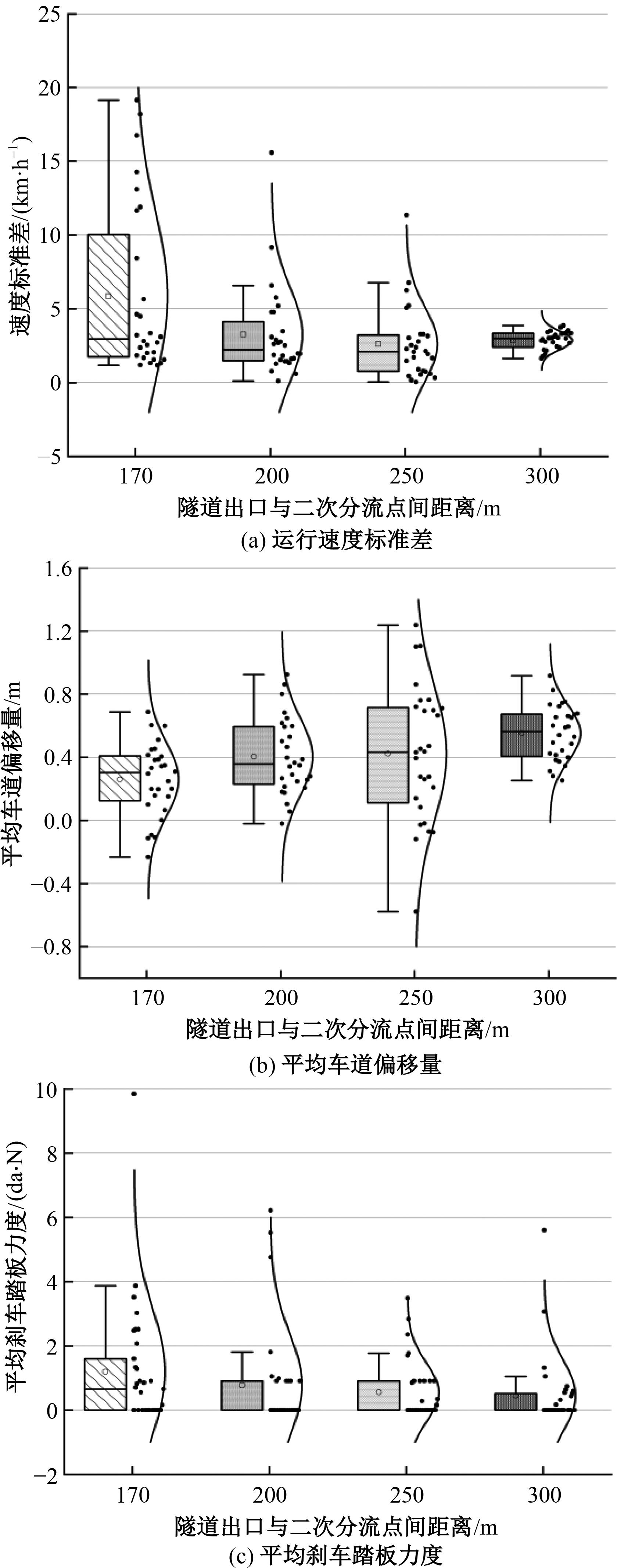
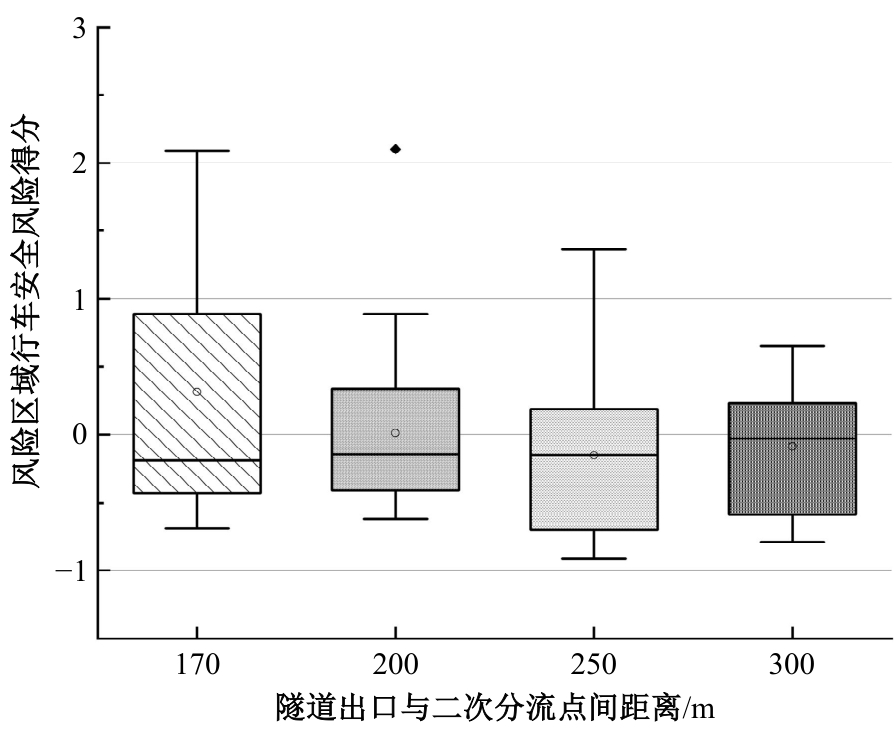
为了确定半地下枢纽互通匝道隧道出口与二次分流点间的安全距离,以优化线形设计并节约用地,研究了基于驾驶行为分解与运动学方程计算了理论安全距离,通过驾驶模拟实验收集了39名驾驶人在4种距离下的实验数据,采用Mann-Whitney U (MWU)检验选择了速度标准差、刹车踏板力度、车道偏移量3个指标,进而基于因子分析法构建了行车安全风险计算模型,并量化了不同距离下的风险分值。研究结果显示,理论安全距离为164.8 m,行车安全风险最低的距离为250 m。
中图分类号:
- U491



| [1] | 刘斌, 李刚, 黄春富, 等. 基于可靠度的地下互通立交匝道坡度指标研究 [J]. 公路, 2022, 67(10): 9-17. |
| Liu Bin, Li Gang, Huang Chun-fu, et al. Research on the slope index of underground interchange ramps based on reliability[J]. Highway, 2022, 67(10): 9-17. | |
| [2] | 袁胜强, 景啸, 史程祥. 城市地下互通立交通行能力计算 [J]. 同济大学学报:自然科学版, 2021, 49(2): 236-442. |
| Yuan Sheng-qiang, Jing Xiao, Shi Cheng-xiang. Calculation of traffic capacity of urban underground interchanges[J]. Journal of Tongji University(Natural Science Edition), 2021, 49(2): 236-242. | |
| [3] | 李少刚. 地下互通立交隧道设计参数优化及施工技术研究[D]. 北京: 北京交通大学土木建筑工程学院, 2011. |
| Li Shao-gang. Optimization of design parameters and construction technology for underground interchange tunnels[D]. Beijing: School of Civil Engineering, Beijing Jiaotong University, 2011. | |
| [4] | 史科. 高速公路互通立交二次分离出口匝道通行能力分析[D]. 南京: 东南大学交通学院, 2021. |
| Shi Ke. Analysis of the traffic capacity of the secondary separation exit ramp of the highway interchange[D]. Nanjing: School of Transportation, Southeast University, 2021. | |
| [5] | Lyu N C, Wu C Z, Fu Q. Analysis traffic safety for highway off-rampbased on visual reaction time on traffic signs[C]∥International Conference on Transportation Information and Safety(ICTIS), Piscataway, USA, 2015: 25-28. |
| [6] | 冯志成, 雷桂荣, 蒋若曦, 等. 苜蓿叶分离式互通立交二次定向分流匝道合理长度研究 [J]. 公路与汽运, 2017, 182(5): 28-32, 37. |
| Feng Zhi-cheng, Lei Gui-rong, Jiang Ruo-xi, et al. Study on the reasonable length of the secondary directional diversion ramp of the alfalfa leaf-separated interchange[J]. Highways and Automotive Applications, 2017, 182(5): 28-32, 37. | |
| [7] | Shang T, Wu P, Lian G, et al. Influences of exit advance guide signs on the trajectory and speed of passenger cars in highway tunnels[J]. Journal of Advanced Transportation, 2021(9): No.8453439. |
| [8] | 孙明玲, 赵源, 葛书芳. 双车道高速公路隧道与互通式立交出口最小间距分析[J]. 公路, 2014, 59(7): 274-278. |
| Sun Ming-ling, Zhao Yuan, Ge Shu-fang. Analysis of the minimum spacing between the double-lane highway tunnel and the interchange exit[J]. Highway, 2014, 59(7): 274-278. | |
| [9] | 牛敏强, 蒲华乔, 符锌砂, 等. 基于稳定流态下隧道与主线出入口最小净距研究 [J]. 中外公路, 2021, 41(4): 261-267. |
| Niu Min-qiang, Pu Hua-qiao, Fu Xin-sha, et al. Study on the minimum net distance between tunnels and main line entrances and exits under stable flow conditions[J]. Journal of China and Foreign Highway, 2021, 41(4): 261-267. | |
| [10] | 邵阳, 潘兵宏, 王云泽. 高速公路互通式立交连续出口和入口间距研究 [J]. 铁道科学与工程学报, 2016, 13(8): 1642-1651. |
| Shao Yang, Pan Bing-hong, Wang Yun-ze. Study on the spacing between continuous exits and entrances of highway interchanges[J]. Journal of Railway Science and Engineering, 2016, 13(8): 1642-1651. | |
| [11] | 程传乐. 基于变异型集散道模型的高速公路互通式立交最小间距研究[D]. 西安: 长安大学公路学院, 2019. |
| Cheng Chuan-le. Study on the minimum spacing of highway interchanges based on the variant-type collection and distribution road model[D]. Xi'an: School of Highways, Chang'an University, 2019. | |
| [12] | 吴文静, 战勇斌, 杨丽丽, 等. 考虑安全间距的合流区可变限速协调控制方法 [J]. 吉林大学学报: 工学版, 2022, 52(6): 1315-1323. |
| Wu Wen-jing, Zhan Yong-bin, Yang Li-li, et al. Coordinated control method of variable speed limit in on⁃ramp area considering safety distance[J]. Journal of Jilin University(Engineering and Technology Edition), 2022, 52(6): 1315-1323. | |
| [13] | .公路立体交叉设计细则 [S]. |
| [14] | .公路路线设计规范 [S]. |
| [15] | .公路隧道设计规范 [S]. |
| [16] | .城市地下道路工程设计规范 [S]. |
| [17] | 潘兵宏, 周锡浈, 周廷文, 等. 高速公路互通式立交出口识别视距计算模型 [J]. 同济大学学报: 自然科学版, 2020, 48(9): 1312-1318. |
| Pan Bing-hong, Zhou Xi-zhen, Zhou Ting-wen, et al. Calculation model of recognition sight distance for highway interchange exits[J]. Journal of Tongji University(Natural Science Edition), 2020, 48(9): 1312-1318. | |
| [18] | 赵一飞, 陈敏, 潘兵宏. 隧道与互通式立交出口最小间距需求分析 [J]. 长安大学学报:自然科学版, 2011, 31(3): 68-71. |
| Zhao Yi-fei, Chen Min, Pan Bing-hong. Analysis of the minimum spacing requirements between tunnels and interchange exits[J]. Journal of Chang'an University(Natural Science Edition), 2011, 31(3): 67-71. | |
| [19] | 陈湘. 公路交通标志优化设计研究 [J]. 科学技术创新, 2023(6): 177-180. |
| Chen Xiang. Study on optimal design of highway traffic signs[J]. Scientific and Technological Innovation, 2023(6): 177-180. | |
| [20] | 徐进, 曾粤. 高速条件下隧道出入口行驶速度特性 [J]. 交通运输工程学报, 2021, 21(4): 197-209. |
| Xu Jin, Zeng Yue. Characteristics of driving speed at tunnel entrances and exits at high speed[J]. Journal of Traffic and Transportation Engineering, 2021, 21(4): 197-209. |
| [1] | 闫晟煜,温福华,武瑾,郑毅,郝时杰,尤文博. 基于公路通行数据的节假日山地景区运力适配方法[J]. 吉林大学学报(工学版), 2025, 55(5): 1576-1587. |
| [2] | 方华珍,刘立,顾青,肖小凤,孟宇. 基于轨迹预测和极限梯度提升的驾驶意图识别[J]. 吉林大学学报(工学版), 2025, 55(2): 623-630. |
| [3] | 李怀鑫,晏长根,林斌,石玉玲. 黏土-混凝土组合体强度及全过程统计损伤模型[J]. 吉林大学学报(工学版), 2025, 55(1): 245-255. |
| [4] | 姚荣涵,祁文彦,胡宏宇,杜筱婧,乔延峰,王立冰. 考虑公交-合乘车道的多车道元胞自动机模型[J]. 吉林大学学报(工学版), 2025, 55(1): 162-174. |
| [5] | 严利鑫,曾涛,贺宜,郭军华,胡鑫辉. 共驾型智能车辆人机接管行为序列编码与解析[J]. 吉林大学学报(工学版), 2024, 54(9): 2547-2556. |
| [6] | 周荣贵,高沛,李雨璇,周建. 基于轨迹数据的高速公路小客车异常驾驶行为[J]. 吉林大学学报(工学版), 2024, 54(9): 2581-2587. |
| [7] | 许清津,付锐,郭应时,吴付威. 载货汽车弯道侧翻路侧预测方法[J]. 吉林大学学报(工学版), 2024, 54(5): 1302-1310. |
| [8] | 蒲云,徐银,刘海旭,谭一帆. 考虑多车影响的智能网联车跟驰模型[J]. 吉林大学学报(工学版), 2024, 54(5): 1285-1292. |
| [9] | 马庆禄,闫浩,聂振宇,李杨梅. 匝道合流区智能网联车辆协同控制方法[J]. 吉林大学学报(工学版), 2024, 54(5): 1332-1346. |
| [10] | 曹倩,李志慧,陶鹏飞,李海涛,马永建. 面向交通事故检测及预防的异质传感器布设方法[J]. 吉林大学学报(工学版), 2024, 54(4): 969-978. |
| [11] | 陈仁祥,胡超超,胡小林,杨黎霞,张军,何家乐. 基于改进YOLOv5的驾驶员分心驾驶检测[J]. 吉林大学学报(工学版), 2024, 54(4): 959-968. |
| [12] | 赵晓华,刘畅,亓航,欧居尚,姚莹,郭淼,杨海益. 高速公路交通事故影响因素及异质性分析[J]. 吉林大学学报(工学版), 2024, 54(4): 987-995. |
| [13] | 张鑫,胡启洲,何君,吴啸宇. 考虑交通梗塞的合流区交通状况诊断[J]. 吉林大学学报(工学版), 2024, 54(2): 478-484. |
| [14] | 张卫华,刘嘉茗,解立鹏,丁恒. 网联混合环境快速路交织区自动驾驶车辆换道模型[J]. 吉林大学学报(工学版), 2024, 54(2): 469-477. |
| [15] | 牛世峰,于士杰,刘彦君,马冲. 基于手环数据的愤怒驾驶行为实时检测方法[J]. 吉林大学学报(工学版), 2024, 54(12): 3505-3512. |
|
||