吉林大学学报(工学版) ›› 2025, Vol. 55 ›› Issue (12): 4024-4033.doi: 10.13229/j.cnki.jdxbgxb.20240437
• 计算机科学与技术 • 上一篇
基于预处理层增强和注意力机制的空域图像隐写分析
罗维薇( ),刘长龙,雷琴()
- 兰州交通大学 电子与信息工程学院,兰州 730070
Spatial image steganography based on preprocessing layer enhancement and attention mechanism
Wei-wei LUO(),Chang-long LIU,Qin LEI()
- School of Electronic and Information Engineering,Lanzhou Jiaotong University,Lanzhou 730070,China
摘要:
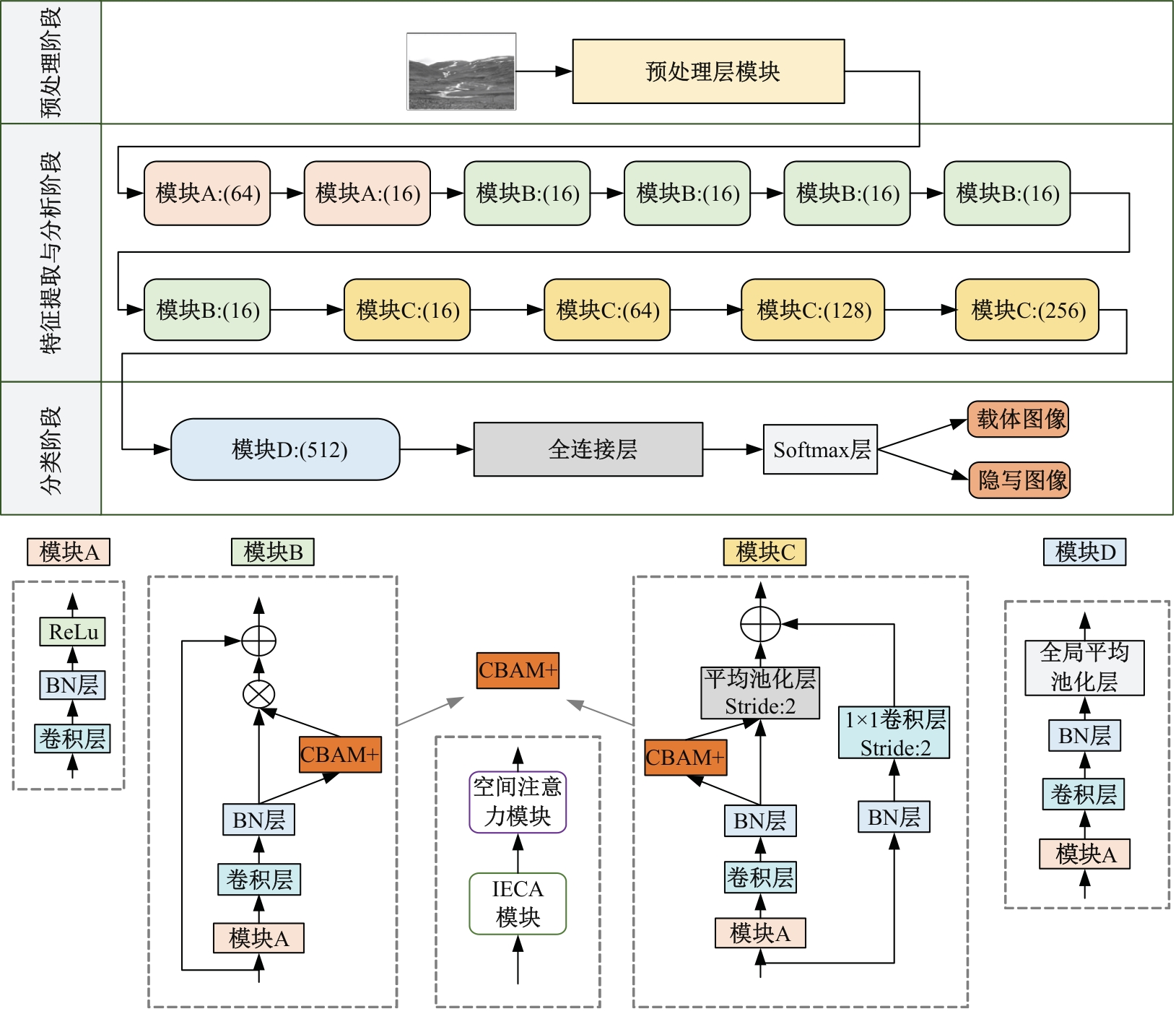
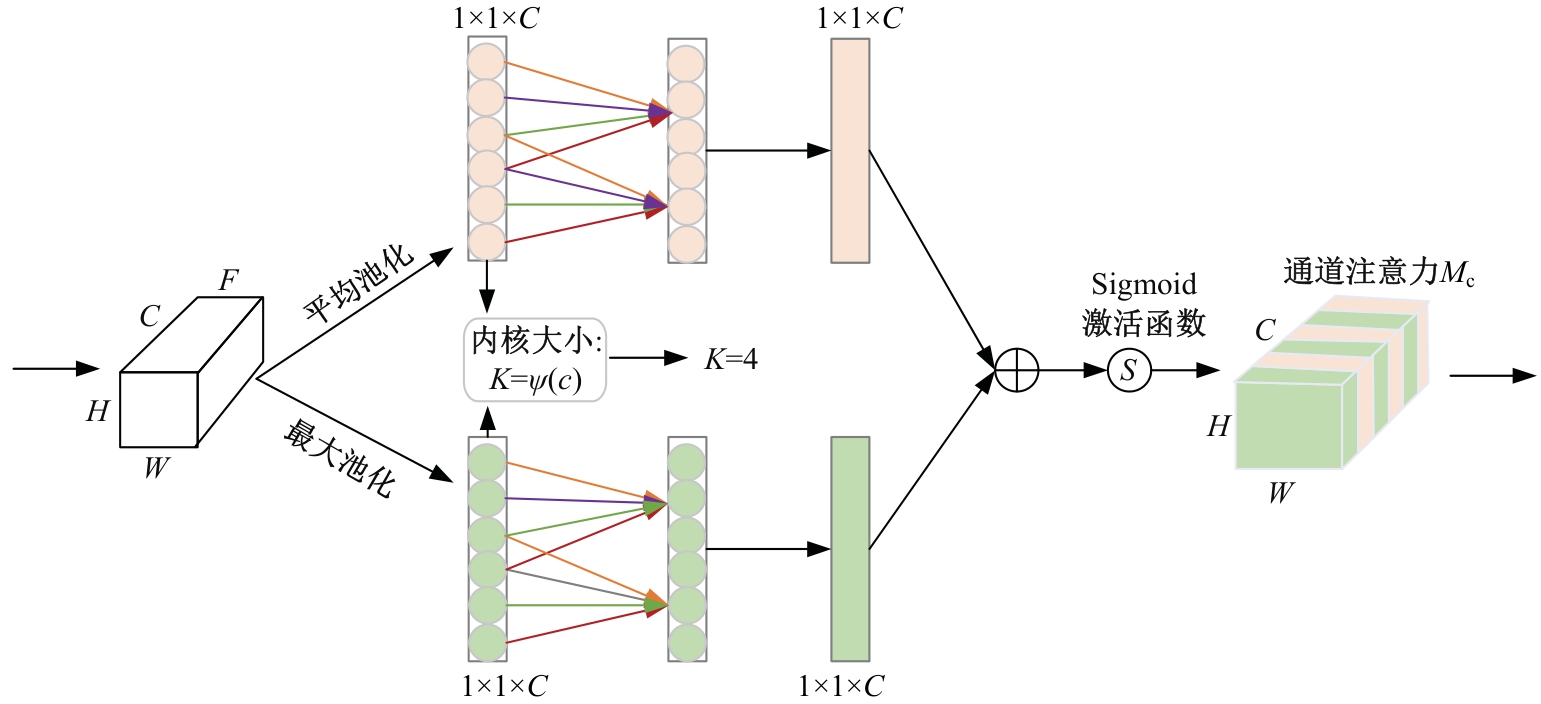
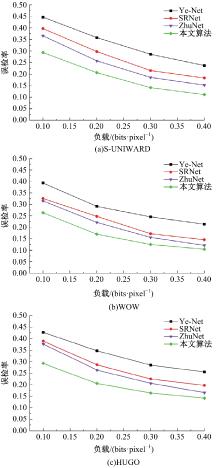
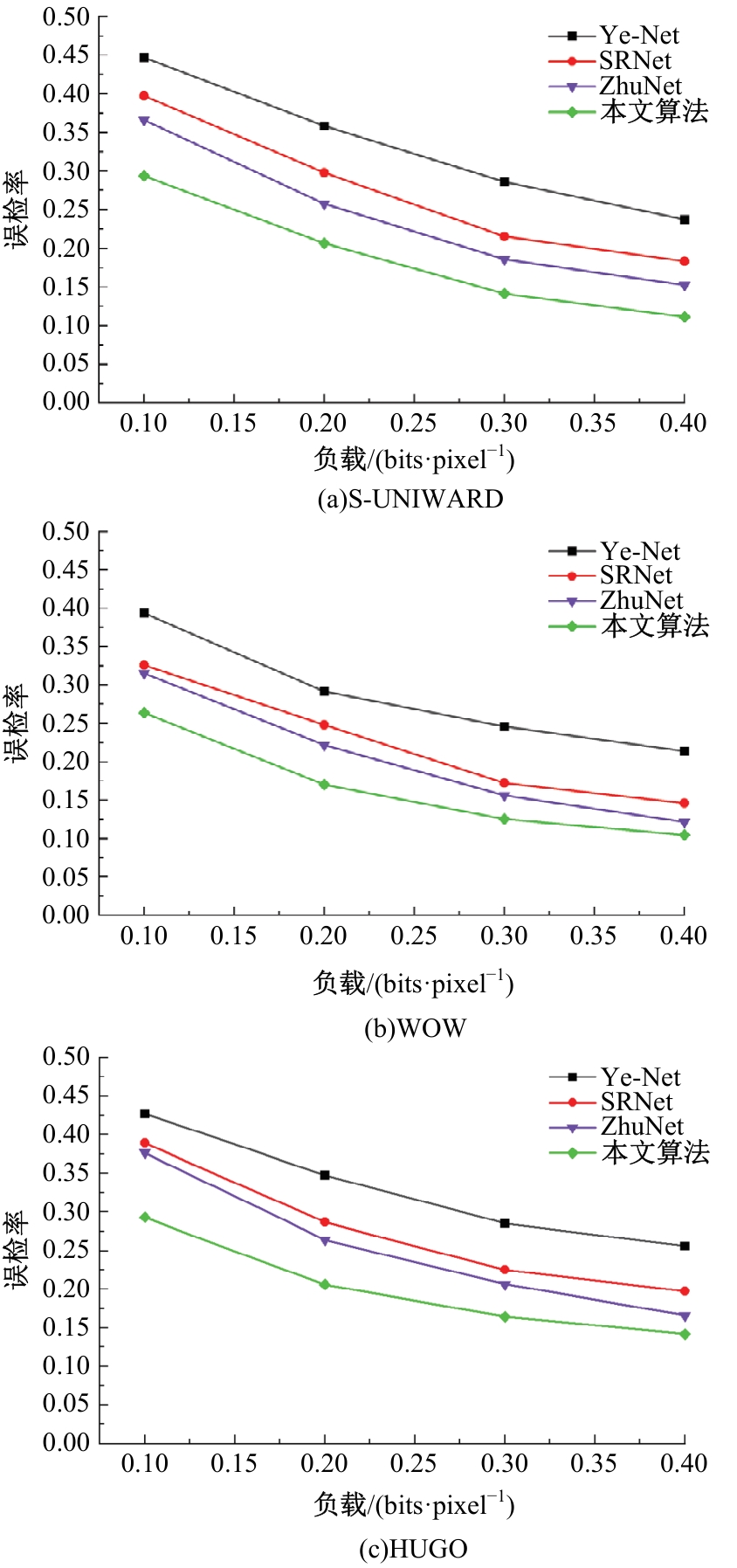
为了更全面地捕获隐写操作对图像统计特征的改变,提高空域隐写分析的检测精度,本文结合隐写算法的嵌入特点,采用导数和Gabor双重滤波器对图像进行预处理,并对滤波器提取进行增强,产生多种残差图像,有效增加隐写分析特征的多样性。将优化的CBAM模块嵌入残差块中,引导网络有效聚焦于具有丰富隐写信号的区域,从而提高网络的判别学习能力和训练效果。将本模型与经典模型在BOSSbase v1.01和BOWS2两个公开数据集上进行比较,实验结果表明:该方法的检测精度优于现有主流模型Ye-Net、SRNet和ZhuNet。
中图分类号:
- TP309

| [1] | Xiang S J, Luo X R. Reversible data hiding in encry pted image based on homomorphic public key crypt osystem[J]. Journal of Software, 2016, 27(6): 1592- 1601. |
| [2] | 陈君夫, 付章杰, 张卫明, 等. 基于深度学习的图像隐写分析综述[J]. 软件学报,2021, 32(2): 551-578. |
| Chen Jun-fu, Fu Zhang-jie, Zhang Wei-ming, et al. A review of image steganography based on deep learning [J]. Journal of Software, 2021, 32(2): 551-578. | |
| [3] | Fridrich J, Kodovsky J. Rich models for steganalysis of digital images[J]. IEEE Transactions on Information Forensics and Security, 2012, 7(3): 868-882. |
| [4] | Holub V, Fridrich J. Low-complexity features for JPEG steganalysis using undecimated DCT[J]. IEEE Transactions on Information Forensics and Security, 2014, 10(2): 219-228. |
| [5] | Holub V, Fridrich J. Phase-aware projection model for steganalysis of JPEG images[C]∥Media Watermarking, Security, and Forensics,Philadelphia, USA,2015:75-84. |
| [6] | Khan A, Sohail A, Zahoora U,et al. A survey of the recent architectures of deep convolutional neural networks[J]. Artificial Intelligence Review, 2020, 53: 5455-5516. |
| [7] | Chollet F. Xception: deep learning with depthwise separable convolutions[C]∥Proc IEEE Conf Comput Vis Pattern Recognit (CVPR),Honolulu, USA, 2017: 1800-1807. |
| [8] | He K, Zhang X, Ren S, et al. Deep residual learning for image recognition[C]∥Proc IEEE Conf Comput Vis Pattern Recognit (CVPR), Las Vegas,USA, 2016: 770-778. |
| [9] | Szegedy C, Ioffe S, Vanhoucke V, et al. Inception-v4, inception-ResNet and he impact of residual connections on learning[C]∥AAAI Conf Artif Intell,San Francisco,USA, 2017: 4278-4284. |
| [10] | Qian Y, Dong J, Wang W, et al. Learning and transferring representations for image steganalysis using convolutional neural network[C]∥IEEE International Conference on Image Processing(ICIP), Phoenix, USA, 2016: 2752-2756. |
| [11] | Jian Y, Ni J, Yang Y.Deep learning hierarchical representations for image steganalysis[J].IEEE Trans. Inf Forensic Secur,2017,12 (11): 2545-2557. |
| [12] | Zhang X B, Zhang X P, Feng G. Image steganalysis network based on dual-attention mechanism[J]. IEEE Signal Processing Letters, 2023, 30: 1287-1291. |
| [13] | Qian Y, Dong J, Wang W, et al. Deep learning for steganalysis via convolutional neural networks[C]∥Media Watermarking, Security, and Forensics, San Francisco, USA, 2015: 171-180. |
| [14] | Xu G, Wu H Z, Shi Y Q. Structural design of convolutional neural networks for steganalysis[J]. IEEE Signal Processing Letters, 2016, 23(5): 708-712. |
| [15] | Ye J, Ni J, Yi Y. Deep learning hierarchical representations for image steganalysis[J]. IEEE Transactions on Information Forensics and Security, 2017, 12(11): 2545-2557. |
| [16] | Zhang R, Zhu F, Liu J, et al. Depth-wise separable convolutions and multi-level pooling for an efficient spatial CNN-based steganalysis[J]. IEEE Transactions on Information Forensics and Security, 2019, 15: 1138-1150. |
| [17] | Han X, Zhang T. Spatial steganalysis based on non-local block and multi-channel convolutional networks[J]. IEEE Access, 2022, 10: 87241-87253. |
| [18] | Li B, Li Z, Zhou S, et al. New steganalytic features for spatial image steganography based on derivative filters and threshold LBP operator[J]. IEEE Transactions on Information Forensics and Security, 2017, 13(5): 1242-1257. |
| [19] | 史晓裕, 李斌, 谭舜泉. 深度学习空域隐写分析的预处理层[J]. 应用科学学报,2018, 36(2): 309-320. |
| Shi Xiao-yu, Li Bin, Tan Shun-quan. Preprocessing layer for deep learning spatial steganography [J]. Chinese Journal of Applied Sciences, 2018, 36(2): 309-320. | |
| [20] | Li B, Wei W, Ferreira A, et al. ReST-Net: diverse activation modules and parallel subnets-based CNN for spatial image steganalysis[J]. IEEE Signal Processing Letters, 2018, 25(5): 650-654. |
| [21] | Hu J, Shen L, Sun G. Squeeze-and-excitation networks[C]∥Proceedings of the IEEE Conference on Computer Vision and Pattern Recognition, Salt Lake City, USA, 2018: 7132-7141. |
| [22] | Woo S, Park J, Lee J Y, et al. Cbam: convolutional block attention module[C]∥Proceedings of the European Conference on Computer Vision (ECCV), Munich, Germany, 2018: 3-19. |
| [23] | Wang Q, Wu B, Zhu P, et al. ECA-Net: efficient channel attention for deep convolutional neural networks[C]∥Proceedings of the IEEE/CVF Conference on Computer Vision and Pattern Recognition, Seattle, USA, 2020:11531-11539. |
| [24] | Bas P, Filler T, Pevný T. Break our steganographic system: the ins and outs of organizing BOSS[C]∥International Workshop on Information Hiding, Prague, Czech Republic, 2011: 59-70. |
| [25] | Bas P, Furon T. BOWS-2. [DB/OL]. [2024-04-12]. . |
| [26] | He T, Zhang Z, Zhang H, et al. Bag of tricks for image classification with convolutional neural networks[C]∥Proceedings of the IEEE/CVF Conference on Computer Vision and Pattern Recognition, Long Beach, USA, 2019: 558-567. |
| [27] | Boroumand M, Chen M, Fridrich J. Deep residual network for steganalysis of digital images[J]. IEEE Transactions on Information Forensics and Security, 2018, 14(5): 1181-1193. |
| [1] | 朴燕,康继元. RAUGAN:基于循环生成对抗网络的红外图像彩色化方法[J]. 吉林大学学报(工学版), 2025, 55(8): 2722-2731. |
| [2] | 田婧,马社强,宋现敏,赵丹,陈发城. 稀疏数据下的交通状态估计自适应卷积网络[J]. 吉林大学学报(工学版), 2025, 55(8): 2579-2587. |
| [3] | 肖红,刘显德. 基于混合智能的学习状态实时采集与动态分析方法[J]. 吉林大学学报(工学版), 2025, 55(7): 2402-2408. |
| [4] | 冯志刚,王首起,于明月. 基于变分模态提取及轻量级网络的滚动轴承故障诊断[J]. 吉林大学学报(工学版), 2025, 55(6): 1883-1891. |
| [5] | 杜睿山,王紫珊. 基于时空注意力的多视角人脸表情识别算法[J]. 吉林大学学报(工学版), 2025, 55(6): 2097-2102. |
| [6] | 胡宏宇,张争光,曲优,蔡沐雨,高菲,高镇海. 基于双分支和可变形卷积网络的驾驶员行为识别方法[J]. 吉林大学学报(工学版), 2025, 55(1): 93-104. |
| [7] | 汪豪,赵彬,刘国华. 基于时间和运动增强的视频动作识别[J]. 吉林大学学报(工学版), 2025, 55(1): 339-346. |
| [8] | 张锦洲,姬世青,谭创. 融合卷积神经网络和双边滤波的相贯线焊缝提取算法[J]. 吉林大学学报(工学版), 2024, 54(8): 2313-2318. |
| [9] | 朱圣杰,王宣,徐芳,彭佳琦,王远超. 机载广域遥感图像的尺度归一化目标检测方法[J]. 吉林大学学报(工学版), 2024, 54(8): 2329-2337. |
| [10] | 赵宏伟,武鸿,马克,李海. 基于知识蒸馏的图像分类框架[J]. 吉林大学学报(工学版), 2024, 54(8): 2307-2312. |
| [11] | 特木尔朝鲁朝鲁,张亚萍. 基于卷积神经网络的无线传感器网络链路异常检测算法[J]. 吉林大学学报(工学版), 2024, 54(8): 2295-2300. |
| [12] | 孙铭会,薛浩,金玉波,曲卫东,秦贵和. 联合时空注意力的视频显著性预测[J]. 吉林大学学报(工学版), 2024, 54(6): 1767-1776. |
| [13] | 魏晓辉,王晨洋,吴旗,郑新阳,于洪梅,岳恒山. 面向脉动阵列神经网络加速器的软错误近似容错设计[J]. 吉林大学学报(工学版), 2024, 54(6): 1746-1755. |
| [14] | 夏超,王梦佳,朱剑月,杨志刚. 基于分层卷积自编码器的钝体湍流流场降阶分析[J]. 吉林大学学报(工学版), 2024, 54(4): 874-882. |
| [15] | 梁礼明,周珑颂,尹江,盛校棋. 融合多尺度Transformer的皮肤病变分割算法[J]. 吉林大学学报(工学版), 2024, 54(4): 1086-1098. |
|
||