Journal of Jilin University(Medicine Edition) ›› 2026, Vol. 52 ›› Issue (1): 135-142.doi: 10.13481/j.1671-587X.20260114
• Research in basic medicine • Previous Articles Next Articles
Protective effect of miR-378 on myocardial cell injury induced by hypoxia/reoxygenation and its mechanism
Liang ZHAO,Yun CHEN,Wei XIE( )
)
- Heart Center,Xinjiang Production and Construction Corps Hospital,Urumqi 830002,China
-
Received:2025-03-03Accepted:2025-04-14Online:2026-01-28Published:2026-02-24 -
Contact:Wei XIE E-mail:xieweixinyu@sina.com

CLC Number:
- R543
Cite this article
Liang ZHAO,Yun CHEN,Wei XIE. Protective effect of miR-378 on myocardial cell injury induced by hypoxia/reoxygenation and its mechanism[J].Journal of Jilin University(Medicine Edition), 2026, 52(1): 135-142.
share this article
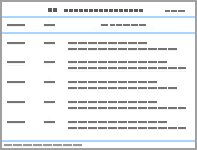
Tab.1
Primer sequences of RT-qPCR"
| Gene | Forword 5'-3' | Reverse 5'-3' |
|---|---|---|
| MiR-378 | CTGAGACTGGACTTGGAGTC | GTGCAGGGTCCGAGGT |
| U6 | TGCGGGTGCTCGCTTCGGCAGC | CCAGTGCAGGGTCCGAGGT |
| iNOS | GGACTAGCACAGACACACGGA | CTTCAGAGGAGCAGCACCAGA |
| TNF-α | GAGGCCAAGCCCTGGTATG | CGGGCCGATTGATCTCAGC |
| IL-1β | TGCCACCTTTTGACAGTGATG | TGATGTGCTGCAGATT |
| IL-6 | ATCTGGATTCAATGAGGAGA | TCTGGCTTGTTCCTCACTAC |
| Arg-1 | TCATCTGGGTGGATGCTCACAC | GAGAATCCTGGCACATCGGGAA |
| TGF-β1 | ATGGACCAGTATAAGGCAAGC | GCTCTGGATGAGCCTATATTG |
| IL-4 | AAAACTTTGAACAGCCTACAG | GGTTTCCTTCTCAGTTGTGTTC |
| IL-10 | GTTGTTAAAGGAGTCCTTGCTG | TTCACAGGGAAGAAATCGATGA |
| GAPDH | CCACTCCTCCACCTTTGAC | ACCCTGTTGCTGTAGCCA |
Tab.2
Expression levels of iNOS,TNF-α,IL-1β, and IL-6 mRNA secreted by M1 macrophages and Arg-1,TGF-β1,IL-4 and IL-10 mRNA secreted by M2 macrophages in THP-1 cells in various groups"
| Group | iNOS | TNF-α | IL-1β | IL-6 | Arg-1 | TGF-β1 | IL-4 | IL-10 |
|---|---|---|---|---|---|---|---|---|
| Control | 1.00±0.07 | 1.00±0.05 | 1.00±0.06 | 1.00±0.08 | 1.00±0.05 | 1.00±0.07 | 1.00±0.08 | 1.00±0.10 |
| MiR-NC | 1.02±0.09 | 0.98±0.08 | 0.99±0.10 | 1.01±0.11 | 1.01±0.09 | 1.02±0.11 | 1.01±0.10 | 0.99±0.11 |
| MiR-378 mimics | 0.34±0.04*△ | 0.45±0.05*△ | 0.41±0.05*△ | 0.52±0.05*△ | 2.46±0.26*△ | 3.03±0.32*△ | 3.48±0.41*△ | 2.32±0.25*△ |
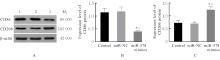
Fig.1
Electrophoregram(A) and histograms (B, C) of expressions of CD86 and CD206 proteins in THP-1 cells after transfected with miR-378"
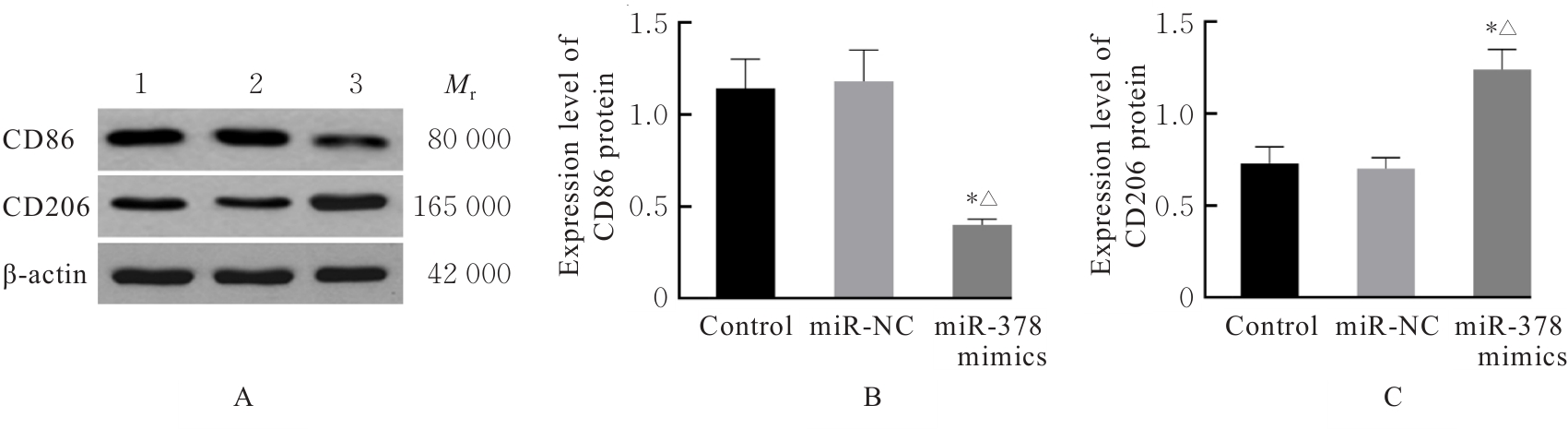
Tab.3
Levels of MDA and ROS and activities of SOD in AC16 cells in various groups"
| Group | MDA[mB/(μmol·g-1)] | ROS(η/%) | SOD[λB/(U·mg-1)] |
|---|---|---|---|
| Control | 7.65±0.77 | 8.45±0.86 | 180.34±19.46 |
| H/R | 16.67±1.53* | 36.73±3.69* | 114.56±12.36* |
| MiR-NC+H/R | 17.05±1.86 | 35.86±3.87 | 116.83±13.62 |
| MiR-378 mimics +H/R | 10.86±1.13△ | 22.59±2.38△ | 143.80±15.29△ |
| [1] | RIOS-NAVARRO C, DAGHBOUCHE-RUBIO N, GAVARA J, et al. Ischemia-reperfusion injury to coronary arteries: Comprehensive microscopic study after reperfused myocardial infarction[J]. Ann Anat Anat Anz, 2021, 238:151785. |
| [2] | XIANG Q, YI X, ZHU X H, et al. Regulated cell death in myocardial ischemia-reperfusion injury[J]. Trends Endocrinol Metab, 2024, 35(3):219-234. |
| [3] | HEUSCH G. Myocardial ischemia/reperfusion: Translational pathophysiology of ischemic heart disease[J]. Med, 2024, 5(1):10-31. |
| [4] | GE T, NING B, WU Y Q, et al. microRNA-specific therapeutic targets and biomarkers of apoptosis following myocardial ischemia-reperfusion injury[J]. Mol Cell Biochem, 2024, 479(10):2499-2521. |
| [5] | XU C R, JIA Z W, CAO X F, et al. Hsa_circ_0007059 promotes apoptosis and inflammation in cardiomyocytes during ischemia by targeting microRNA-378 and microRNA-383[J]. Cell Cycle, 2022, 21(10):1003-1019. |
| [6] | ZHOU R, JIA Y P, WANG Y, et al. Elevating miR-378 strengthens the isoflurane-mediated effects on myocardial ischemia-reperfusion injury in mice via suppression of MAPK1[J]. Am J Transl Res, 2021, 13(4):2350-2364. |
| [7] | 徐佩尔, 颜雪芸, 周 乐, 等. 血塞通(三七皂苷)对缺氧/复氧诱导的H9c2心肌细胞氧化损伤的抑制作用[J]. 中国临床药理学杂志, 2022, 38(2): 113-117. |
| [8] | ALGOET M, JANSSENS S, HIMMELREICH U, et al. Myocardial ischemia-reperfusion injury and the influence of inflammation[J]. Trends Cardiovasc Med, 2023, 33(6):357-366. |
| [9] | SUN F, ZHUANG Y T, ZHU H X, et al. LncRNA PCFL promotes cardiac fibrosis via miR-378/GRB2 pathway following myocardial infarction[J]. J Mol Cell Cardiol, 2019, 133:188-198. |
| [10] | WANG H, SHI J J, WANG J C, et al. microRNA‑378: an important player in cardiovascular diseases (Review) [J]. Mol Med Rep, 2023, 28(3):172. |
| [11] | WANG G L, FENG L L, LIU C X, et al. miR-378 inhibits angiotensin II-induced cardiomyocyte hypertrophy by targeting AKT2[J]. Int Heart J, 2024, 65(3):528-536. |
| [12] | 熊霞军, 胡思远, 钟森杰, 等. 基于miR-378探讨丹红注射液干预压力超负荷心力衰竭大鼠心肌纤维化机制[J].湖南中医药大学学报, 2023, 43(3): 383-390. |
| [13] | CHEN H, HOU Y X, ZHAI Y L, et al. Peli1 deletion in macrophages attenuates myocardial ischemia/reperfusion injury by suppressing M1 polarization[J]. J Leukoc Biol, 2023, 113(2):95-108. |
| [14] | ZUO W J, SUN R H, JI Z J, et al. Macrophage-driven cardiac inflammation and healing: insights from homeostasis and myocardial infarction[J]. Cell Mol Biol Lett, 2023, 28(1):81. |
| [15] | YU W, WANG S, WANG Y Y, et al. microRNA: role in macrophage polarization and the pathogenesis of the liver fibrosis[J]. Front Immunol, 2023, 14:1147710. |
| [16] | KISHORE A, PETREK M. Roles of macrophage polarization and macrophage-derived miRNAs in pulmonary fibrosis[J]. Front Immunol, 2021, 12:678457. |
| [17] | 杨 泉, 何惠宇, 王思凡, 等. 过表达miR-378a促进巨噬细胞向M2极化且抑制巨噬细胞向M1极化[J]. 中国组织工程研究, 2024, 28(13): 2036-2041. |
| [18] | ZHANG S, YAN F, LUAN F, et al. The pathological mechanisms and potential therapeutic drugs for myocardial ischemia reperfusion injury[J]. Phytomedicine, 2024, 129:155649. |
| [19] | ZHOU M L, YU Y F, LUO X X, et al. Myocardial ischemia-reperfusion injury: therapeutics from a mitochondria-centric perspective[J]. Cardiology, 2021, 146(6):781-792. |
| [20] | GONG G, WAN W H, ZHANG X H, et al. Management of ROS and regulatory cell death in myocardial ischemia-reperfusion injury[J]. Mol Biotechnol, 2025, 67(5):1765-1783. |
| [21] | KHAN A A, ALLEMAILEM K S, ALHUMAYDHI F A, et al. The biochemical and clinical perspectives of lactate dehydrogenase: an enzyme of active metabolism[J]. Endocr Metab Immune Disord Drug Targets, 2020, 20(6): 855-868. |
| [1] | Guobin HE,Huan WANG. Effect of knockdown of RIP3 on autophagy, pyroptosis, and ferroptosis of hypoxia/reoxygenation-induced human renal tubular epithelial HK2 cells [J]. Journal of Jilin University(Medicine Edition), 2024, 50(6): 1644-1653. |
| [2] | Lianzhi CUI,Xiaowei ZHANG,Hua ZHU,Yue PAN,Xiuyan YU. Promotion effect of chemokine CCL19-induced macrophage M1 polarization on chronic pancreatitis in mice and its mechanism [J]. Journal of Jilin University(Medicine Edition), 2024, 50(6): 1587-1596. |
| [3] | Bo YUAN,Jiayi XIE,Siyu JIANG,Yajun MENG,Qinghua ZHU,Xiaofei LI,Xiumei FU,Lide XIE. Effect of adipose-derived stem cell-derived exosomes on migration ability of macrophages in vitro [J]. Journal of Jilin University(Medicine Edition), 2024, 50(3): 718-727. |
| [4] | Xuebing ZHOU,Qianqian LIN,Yanchun LI. Effect of polysaccharides from porphyra on inflammatory factors secreted by macrophages in mice and its mechanism [J]. Journal of Jilin University(Medicine Edition), 2023, 49(6): 1452-1456. |
| [5] | Yong DONG,Lingyao XU,Jing HUA,Han LIANG,Dongya LIU,Junbo ZHAO,Zhenglu SUN,Cheng CHENG,Shutang WEI. Effect of macrophage exosomal lncRNA HULC on migration, invasion,and metastasis of hepatocellular carcinoma cells and its mechanism [J]. Journal of Jilin University(Medicine Edition), 2023, 49(5): 1217-1226. |
| [6] | Hongying LI,Chenyan WANG,Shichao GUO,Youwei ZHAO,Yanbo DONG,Jiancheng HUANG. Effect of down-regulation of miR-320a expression on proliferation and apoptosis of cardiomyocytes induced by hypoxia/reoxygenation [J]. Journal of Jilin University(Medicine Edition), 2023, 49(4): 958-967. |
| [7] | Chuanlong SONG,Hongjie JIAO, HAILIQIGULI·Nuriding,Yingbin YUE,Mei YAN. Improvement effect of hydatid antigen B on immune thrombocytopenia in mice by regulating macrophage polarization through tumor necrosis factor receptor 2 [J]. Journal of Jilin University(Medicine Edition), 2023, 49(4): 858-866. |
| [8] | Wei CHEN,Nan SHEN,Wanna HAN,Yanli XI,Kuang REN,Lianhai JIN,Na XU. Effect of adapters of Toll-like receptor 4 on M2 polarization of macrophages induced by lactate and its mechanism [J]. Journal of Jilin University(Medicine Edition), 2022, 48(5): 1190-1199. |
| [9] | Xuechun DU,Baosheng LI,Shuwei QIAO,Yanzhen OU,Zhen LI,Weiyan MENG. Effect of Porphyromonas gingivalis-LPS on expression levels of ferroptosis-related factors in macrophages [J]. Journal of Jilin University(Medicine Edition), 2022, 48(5): 1148-1155. |
| [10] | Weibo LI,Juan CAO,Xiu GUO,Chunling DONG,Bo LI. Promotion effect of tumor associated macrophages-derived IL-6 on invasion and migration of oral squamous cell carcinoma Cal27 cells by upregulating LIF expression in tumor cells [J]. Journal of Jilin University(Medicine Edition), 2022, 48(4): 946-953. |
| [11] | Xin SHEN,Yang LIU,Hongyu CHEN,Jie ZHANG,Qingli CHENG,Guang YANG. Regulatory effect of high glucose on polarization of RAW264.7 macrophages via miR-125b in mice [J]. Journal of Jilin University(Medicine Edition), 2022, 48(4): 847-857. |
| [12] | Ming LI,Qiuting WANG,Shan CHEN,Huifang SHI. Improvement effect of p38 MAPK inhibitor on chronic obstructive pulmonary disease injury in mice through inhibiting cell pyrotosis mediated by NLRP3 pathway [J]. Journal of Jilin University(Medicine Edition), 2022, 48(3): 744-754. |
| [13] | Ye TIAN, ABUDU MIJITI·Abudu Kelimu,Peng WANG,Mo SHA,Qi CUI. Effects of polarization state of tumor-associated macrophages on self-renewal ability and vasculogenic mimicry of prostate cancer stem cells [J]. Journal of Jilin University(Medicine Edition), 2022, 48(2): 374-382. |
| [14] | Feilong REN,Huanyu LUO,Shize ZHENG,Xinyi FAN,Chunxia REN,Yuan MENG,Hong ZHAO,Ce SHI,Hongchen SUN. Effects of C3a-C3aR axis on inflammatory response and tissue damage in chronic periodontitis model mice by promoting M1-type polarization of macrophages [J]. Journal of Jilin University(Medicine Edition), 2022, 48(1): 1-8. |
| [15] | Hexin MAO,Linyuan WANG,Ning GUAN,Xiuqiu GAO. Effect of gallic acid on polarization of M1 macrophages [J]. Journal of Jilin University(Medicine Edition), 2021, 47(5): 1139-1145. |