Journal of Jilin University(Medicine Edition) ›› 2026, Vol. 52 ›› Issue (2): 491-498.doi: 10.13481/j.1671-587X.20260221
• Research in clinical medicine • Previous Articles Next Articles
Effect of carotid plaque composition and HDL-C levels on symptomatic carotid artery stenosis
Liyang BAI,Di MA,Shuo HUANG,Chuan WANG,Jiaxin LIANG,Tian WANG,Liuping CUI,Lingmin ZHAO,Meizhen XIE,Mengyue YAO,Ying CHEN( ),Lijuan WANG()
- Department of Neurology,First Hospital,Jilin University,Changchun 130021,China
-
Received:2025-06-16Accepted:2025-07-20Online:2026-03-28Published:2026-04-15 -
Contact:Ying CHEN,Lijuan WANG E-mail:cheny187080119@jlu.edu.cn;wanglj66@jlu.edu.cn

CLC Number:
- R743.1
Cite this article
Liyang BAI,Di MA,Shuo HUANG,Chuan WANG,Jiaxin LIANG,Tian WANG,Liuping CUI,Lingmin ZHAO,Meizhen XIE,Mengyue YAO,Ying CHEN,Lijuan WANG. Effect of carotid plaque composition and HDL-C levels on symptomatic carotid artery stenosis[J].Journal of Jilin University(Medicine Edition), 2026, 52(2): 491-498.
share this article
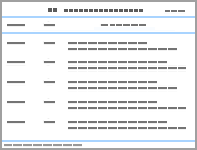
Tab.1
Baseline data of patients in two groups"
| Variable | Asymptomatic CAS group (n=70) | Symptomatic CAS group (n=60) | χ2/Z | P |
|---|---|---|---|---|
| Gender(n/%) | ||||
| Male | 52(74.3) | 52(86.7) | 3.095 | 0.079 |
| Female | 18(25.7) | 8(13.3) | ||
| Alcohol consumption (n/%) | 24(34.3) | 26(43.3) | 1.117 | 0.290 |
| Smoking (n/%) | 28(40.0) | 38(63.3) | 7.038 | 0.008 |
| Heart disease (n/%) | 14(20.0) | 6(10.0) | 2.482 | 0.115 |
| Stroke (n/%) | 20(28.6) | 14(23.3) | 0.459 | 0.498 |
| Hypertension (n/%) | 45(64.3) | 29(48.3) | 3.353 | 0.067 |
| Diabetes (n/%) | 20(28.6) | 22(36.7) | 0.968 | 0.325 |
| Age [M(P25,P75), year] | 68.0(64.0,70.0) | 66.5(62.0,69.0) | -0.853 | 0.394 |
| TC [M(P25,P75), mmol·L-1] | 3.60(3.09,4.27) | 3.49(3.14,3.82) | -1.635 | 0.102 |
| TG [M(P25,P75), mmol·L-1] | 1.22(0.87,1.68) | 1.34(0.91,1.65) | 0.308 | 0.758 |
| LDL-C [M(P25,P75), mmol·L-1] | 2.09(1.79,2.63) | 2.09(1.82,2.32) | -0.888 | 0.375 |
| HDL-C [M(P25,P75), mmol·L-1] | 0.98(0.84,1.15) | 0.87(0.77,1.03) | -2.495 | 0.013 |
| Homocysteine [M(P25,P75), μmol·L-1] | 12.44(9.46,16.48) | 11.48(10.40,15.41) | -0.112 | 0.911 |
| HbA1c [M(P25,P75), %] | 6.10(5.80,6.40) | 6.15(5.80,7.90) | 0.964 | 0.335 |
| Hs-CRP [M(P25,P75), ng?L-1] | 2.32(1.47,4.69) | 2.74(1.52,4.85) | -0.420 | 0.674 |
| Vitamin B12 [M(P25,P75), pmol·L-1] | 285(237,433) | 294(200,437) | -0.673 | 0.501 |
| Uric acid [M(P25,P75), μmol·L-1] | 324.0(275.0,398.0) | 342.5(283.0,393.0) | 0.738 | 0.461 |
| Fasting blood glucose [M(P25,P75), mmol·L-1] | 5.23(4.90,5.97) | 5.92(5.11,7.56) | 2.681 | 0.007 |
Tab.2
Internal components of plaques of patients in two groups"
| Variable | Asymptomatic CAS group (n=70) | Symptomatic CAS group (n=60) | χ2/Z | P |
|---|---|---|---|---|
| Incomplete fibrous cap integrity(n/%) | 36(51.4) | 54(90.0) | 22.564 | <0.001 |
| Hemorrhage (n/%) | 48(68.6) | 46(76.7) | 1.057 | 0.304 |
| Calcification (n/%) | 40(57.1) | 30(50.0) | 0.663 | 0.415 |
| White blood cell count [M(P25,P75)] | 45.00(20.00,84.67) | 93.84(54.13,131.37) | -4.467 | <0.001 |
| Neovascularization count [M(P25,P75)] | 0.40(0.20,1.20) | 0.80(0.40,1.65) | -2.936 | 0.003 |
| Collagen Ⅲ/collagen Ⅰ ratio [M(P25,P75)] | 2.47(1.02,4.83) | 5.50(3.36,11.63) | -4.189 | <0.001 |
Tab.3
Assignments of independent variables"
| Variable | Assignment |
|---|---|
| Fibrous cap integrity | Complete fibrous cap=0,Incomplete fibrous cap=1 |
| White blood cell count | <28.90=1,28.90-49.30=2,49.30-83.55=3,>83.55=4 |
| Collagen Ⅲ/collagen Ⅰ ratio | <1.83=1,1.83-3.80=2,3.80-8.28=3,>8.23=4 |
| HDL-C level | Continuous variable(0.63-1.92 mmol·L-1) |
Tab. 4
Multivariate Logistic regression analysis of independent influencing factors for symptomatic CAS"
| Factor | β | SE | Wald χ2 | OR | 95%CI | P | |
|---|---|---|---|---|---|---|---|
| Lower limit | Upper limit | ||||||
| Model 1 | |||||||
| Fibrous cap integrity | 1.699 | 0.577 | 8.681 | 5.467 | 1.766 | 16.926 | 0.003 |
| White blood cell count | 0.796 | 0.218 | 13.336 | 2.216 | 1.446 | 3.396 | <0.001 |
| Collagen Ⅲ/collagen Ⅰ ratio | 0.507 | 0.228 | 4.939 | 1.660 | 1.062 | 2.595 | 0.026 |
| HDL-C level | -1.894 | 0.829 | 5.223 | 0.150 | 0.030 | 0.764 | 0.022 |
| Model 2 | |||||||
| Fibrous cap integrity | 1.627 | 0.602 | 7.305 | 5.089 | 1.564 | 16.562 | 0.007 |
| White blood cell count | 0.890 | 0.252 | 12.505 | 2.435 | 1.487 | 3.987 | <0.001 |
| Collagen Ⅲ/collagen Ⅰ ratio | 0.593 | 0.244 | 5.878 | 1.809 | 1.120 | 2.920 | 0.015 |
| HDL-C level | -2.399 | 1.096 | 4.792 | 0.091 | 0.011 | 0.778 | 0.029 |
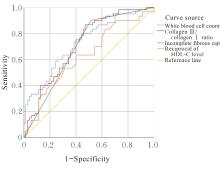
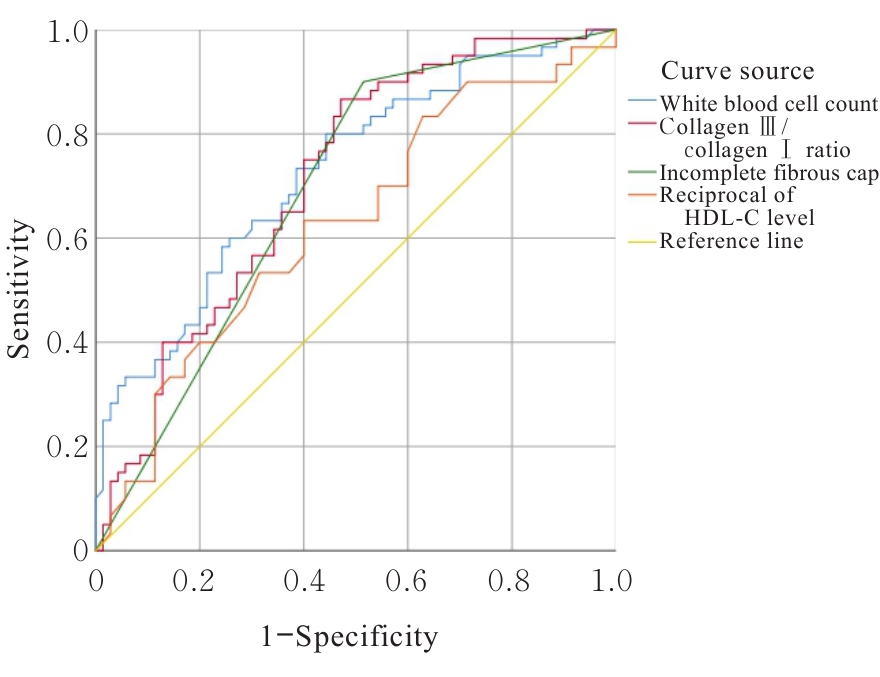
Fig. 1
ROC curves of four factors for prediction of symptomatic CAS"
| [1] | MURRAY C J L. Findings from the global burden of disease study 2021[J]. Lancet, 2024, 403(10440): 2259-2262. |
| [2] | RERKASEM A, ORRAPIN S, HOWARD D P, et al. Carotid endarterectomy for symptomatic carotid stenosis[J]. Cochrane Database Syst Rev, 2020, 9(9): CD001081. |
| [3] | IATAN I, GUAN M J, HUMPHRIES K H, et al. Atherosclerotic coronary plaque regression and risk of adverse cardiovascular events: a systematic review and updated meta-regression analysis[J]. JAMA Cardiol, 2023, 8(10): 937-945. |
| [4] | 蔡忻懿, 惠品晶, 颜燕红, 等. 基于颈动脉斑块的临床特征构建缺血性卒中患者预测模型的研究[J]. 中风与神经疾病杂志, 2024, 41(10): 875-881. |
| [5] | GABA P, GERSH B J, MULLER J, et al. Evolving concepts of the vulnerable atherosclerotic plaque and the vulnerable patient: implications for patient care and future research[J]. Nat Rev Cardiol, 2023, 20(3): 181-196. |
| [6] | NAKAHARA T, STRAUSS H W, NARULA J, et al. Vulnerable plaque imaging[J]. Semin Nucl Med, 2023, 53(2): 230-240. |
| [7] | FAN J L, WATANABE T. Atherosclerosis: known and unknown[J]. Pathol Int, 2022, 72(3): 151-160. |
| [8] | BONATI L H, JANSEN O, DE BORST G J, et al. Management of atherosclerotic extracranial carotid artery stenosis[J]. Lancet Neurol, 2022, 21(3): 273-283. |
| [9] | ZHAO J J, LU Y, CUI J Y, et al. Characteristics of symptomatic plaque on high-resolution magnetic resonance imaging and its relationship with the occurrence and recurrence of ischemic stroke[J]. Neurol Sci, 2021, 42(9): 3605-3613. |
| [10] | IHLE-HANSEN H, VIGEN T, BERGE T, et al. Carotid plaque score for stroke and cardiovascular risk prediction in a middle-aged cohort from the general population[J]. J Am Heart Assoc, 2023, 12(17): e030739. |
| [11] | UGUSMAN A, HISAM N S N, OTHMAN N S, et al. Pharmacological interventions for intraplaque neovascularization in atherosclerosis[J]. Pharmacol Ther, 2024, 261: 108685. |
| [12] | BALMOS I A, SLEVIN M, BRINZANIUC K, et al. Intraplaque neovascularization, CD68+ and iNOS2+ macrophage infiltrate intensity are associated with atherothrombosis and intraplaque hemorrhage in severe carotid atherosclerosis[J]. Biomedicines, 2023, 11(12): 3275. |
| [13] | ELIEH-ALI-KOMI D, BOT I, RODRÍGUEZ-GONZÁLEZ M, et al. Cellular and molecular mechanisms of mast cells in atherosclerotic plaque progression and destabilization[J]. Clin Rev Allergy Immunol, 2024, 66(1): 30-49. |
| [14] | MICELI G, BASSO M G, PINTUS C, et al. Molecular pathways of vulnerable carotid plaques at risk of ischemic stroke: a narrative review[J]. Int J Mol Sci, 2024, 25(8): 4351. |
| [15] | WANG J, KANG Z J, LIU Y D, et al. Identification of immune cell infiltration and diagnostic biomarkers in unstable atherosclerotic plaques by integrated bioinformatics analysis and machine learning[J]. Front Immunol, 2022, 13: 956078. |
| [16] | 黎小林, 张伟兰, 王建萍, 等. 2型糖尿病合并颈动脉粥样硬化与血清脂联素、 瘦素的相关性[J]. 同济大学学报(医学版), 2025, 46(4): 543-548. |
| [17] | FERNANDEZ D M, RAHMAN A H, FERNANDEZ N F, et al. Single-cell immune landscape of human atherosclerotic plaques[J]. Nat Med, 2019, 25(10): 1576-1588. |
| [18] | BENTZON J F, OTSUKA F, VIRMANI R, et al. Mechanisms of plaque formation and rupture[J]. Circ Res, 2014, 114(12): 1852-1866. |
| [19] | HENEIN M Y, VANCHERI S, LONGO G, et al. The role of inflammation in cardiovascular disease[J]. Int J Mol Sci, 2022, 23(21): 12906. |
| [20] | ZHANG S, LIU Y, CAO Y, et al. Targeting the microenvironment of vulnerable atherosclerotic plaques: an emerging diagnosis and therapy strategy for atherosclerosis[J]. Adv Mater, 2022, 34(29): e2110660. |
| [21] | PRATI F, ARBUSTINI E, ALFONSO F. Potential of an approach based on the identification and treatment of vulnerable coronary plaques[J]. JACC Cardiovasc Interv, 2021, 14(4): 468-473. |
| [22] | JANSEN I, CAHALANE R, HENGST R, et al. The interplay of collagen, macrophages, and microcalcification in atherosclerotic plaque cap rupture mechanics[J]. Basic Res Cardiol, 2024, 119(2): 193-213. |
| [23] | MIANO J M, FISHER E A, MAJESKY M W. Fate and state of vascular smooth muscle cells in atherosclerosis[J]. Circulation, 2021, 143(21): 2110-2116. |
| [24] | FANG L, MOORE X L, CHAN W, et al. Decreased fibrocyte number is associated with atherosclerotic plaque instability in man[J]. Cardiovasc Res, 2012, 95(1): 124-133. |
| [25] | SHAMI A, GONÇALVES I, HULTGÅRDH-NILSSON A. Collagen and related extracellular matrix proteins in atherosclerotic plaque development[J]. Curr Opin Lipidol, 2014, 25(5): 394-399. |
| [26] | WANG Q, DAI H J, HOU T, et al. Dissecting causal relationships between gut microbiota, blood metabolites, and stroke: a mendelian randomization study[J]. J Stroke, 2023, 25(3): 350-360. |
| [27] | MEIKLE P J, FORMOSA M F, MELLETT N A, et al. HDL phospholipids, but not cholesterol distinguish acute coronary syndrome from stable coronary artery disease[J]. J Am Heart Assoc, 2019, 8(11): e011792. |
| [28] | HU Y, SONG M, WU D M, et al. The association between HDL-C and stroke in the middle-aged and elderly: a cross-sectional study[J]. Brain Behav, 2023, 13(3): e2901. |
| [29] | ALI A, OBAID O, AKHTAR N, et al. Association between HDL levels and stroke outcomes in the Arab population[J]. Sci Rep, 2024, 14(1): 3071. |
| [1] | Jingyuan WANG,Fang CHEN,Yancun LIU,Shixin LI,Songtao SHOU. Protective effect of silencing coagulation factor V gene on septic rats by inhibiting JNK1/2 and p38 MAPK signaling pathways [J]. Journal of Jilin University(Medicine Edition), 2026, 52(2): 418-428. |
| [2] | Huiyan ZHU,Min CHEN,Jinxian LI,Chunli LI. Effect of enriched environment on neurofunctional damage in rats with ischemic stroke via transcription factor EB-mediated autophagy [J]. Journal of Jilin University(Medicine Edition), 2026, 52(1): 116-124. |
| [3] | Sitong CHEN,Dan YANG,Qingjie LI,Xiaolei TANG,Han WANG,Yangyang LIU,Tiejun LIU. Ameliorative effect of puerarin on non-alcoholic fatty liver disease induced by high-fat diet in mice and its mechanism [J]. Journal of Jilin University(Medicine Edition), 2026, 52(1): 44-55. |
| [4] | Sifan FENG,Yunfeng LI,Jiaying WANG,Fubin MA,Yan WANG. Effects of heme-binding protein 1 gene knockdown on proliferation, migration, and inflammatory response of microglia BV2 and their mechanisms [J]. Journal of Jilin University(Medicine Edition), 2025, 51(6): 1532-1541. |
| [5] | Tao SUN,Zhiyin DAI,Xuan LI,Chaopu ZHANG,Shu DING,Jianwei ZHAO. Predictive value of pan-immune-inflammation index for major adverse cardiovascular events within 1 year after PCI in elderly patients with coronary heart disease [J]. Journal of Jilin University(Medicine Edition), 2025, 51(6): 1655-1660. |
| [6] | Huanhuan TENG,Guang SUN,Rui JIANG,Liwei SUN,Jianzeng LIU. Promotive effect of Shengji Yuhong Ointment extract on skin wound healing of zebrafish and its mechanism [J]. Journal of Jilin University(Medicine Edition), 2025, 51(5): 1221-1229. |
| [7] | Ying HU,Yong HUANG. Improvement effect of short-chain fatty acids on inflammation-induced autophagic damage in ovarian granulosa cells in polycystic ovary syndrome and its mechanism [J]. Journal of Jilin University(Medicine Edition), 2025, 51(5): 1340-1348. |
| [8] | Guang YANG,Zhifang ZHENG,Xinhua ZHANG. Research progress in protective effect of miRNA on neonatal hypoxic-ischemic brain injury [J]. Journal of Jilin University(Medicine Edition), 2025, 51(5): 1423-1428. |
| [9] | Hanyue LI,Lian YANG,Jianfeng LIU,Shufei ZHANG,Li HONG. Effect of bone marrow mesenchymal stem cells of mice on proliferation and collagen expression levels of fibroblasts through JAK2/STAT3 signaling pathway [J]. Journal of Jilin University(Medicine Edition), 2025, 51(2): 325-332. |
| [10] | Junjie JIANG,Hao WU,Kang HE,Zhiqiang SAN,Qing YANG,Hui LI,Na LI. Repair effect of ginseng polypeptide thermosensitive hydrogel on heat-induced skin injury in rats and its mechanism [J]. Journal of Jilin University(Medicine Edition), 2025, 51(2): 360-369. |
| [11] | Xiaoxia HU,Yalong LI,Dongliang YANG,Bazeren LA,Xinyue LIU. Effect of high glucose on polarization of Raw264.7 macrophages in vitro [J]. Journal of Jilin University(Medicine Edition), 2025, 51(2): 403-411. |
| [12] | Xingqi SU,Lingmin ZHAO,Di MA,Jiulin YOU,Ying CHEN,Liangshu FENG,Jing WANG,Jiachun FENG,Chuan WANG. Analysis on correlation of cerebral infarct area with cytokines and immune status in patients with acute ischemic stroke [J]. Journal of Jilin University(Medicine Edition), 2025, 51(1): 124-132. |
| [13] | Yanyan BAI,Yutong ZHOU,Haijuan SUI,Zhuo LIU. Improvement effect of asiatic acid on damage of lipopolysaccharide-induced hippocampum neuron in rats through Nrf2/HO-1 signaling pathway [J]. Journal of Jilin University(Medicine Edition), 2025, 51(1): 85-95. |
| [14] | Haixia CHEN,Hongru LI,Jingyi LIU,Zhifang XU,Shuwen LIU,Yuan YANG,Yang CHEN,Yu LUO,Yinjie CUI. Research progress in changes of intestinal flora after spinal cord injury and their effects on spinal neuroinflammation [J]. Journal of Jilin University(Medicine Edition), 2024, 50(6): 1751-1756. |
| [15] | Wenhui LIU,Miao YU,Ying GUO,Yupeng LIU,Yang XING,Xinyu HONG,Jiale CUI. Research progress in effect of CXC chemokine receptor 3 on occurrence and development of nervous system diseases [J]. Journal of Jilin University(Medicine Edition), 2024, 50(5): 1474-1480. |
|
||