吉林大学学报(工学版) ›› 2026, Vol. 56 ›› Issue (1): 158-169.doi: 10.13229/j.cnki.jdxbgxb.20240661
公交换乘优惠政策下居民换乘意向的异质性分析
马壮林1( ),毕宇明2,周备1(),邓亚娟1,兆雪3
- 1.长安大学 运输工程学院,西安 710064
2.比亚迪汽车工业有限公司,广东 深圳 518118
3.西安石油大学 理学院,西安 710065
Heterogeneity analysis of residents’ transfer intentions under transit transfer preferential policy
Zhuang-lin MA1(),Yu-ming BI2,Bei ZHOU1(),Ya-juan DENG1,Xue ZHAO3
- 1.School of Transportation Engineering,Chang'an University,Xi'an 710064,China
2.BYD Automotive Industry Co. ,Ltd. ,Shenzhen 518118,China
3.School of Science,Xi'an Shiyou University,Xi'an 710065,China
摘要:
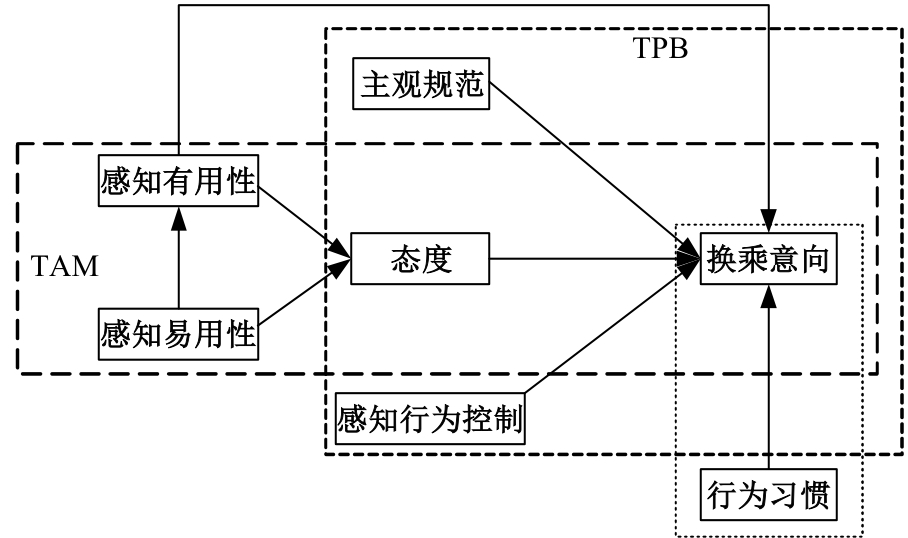
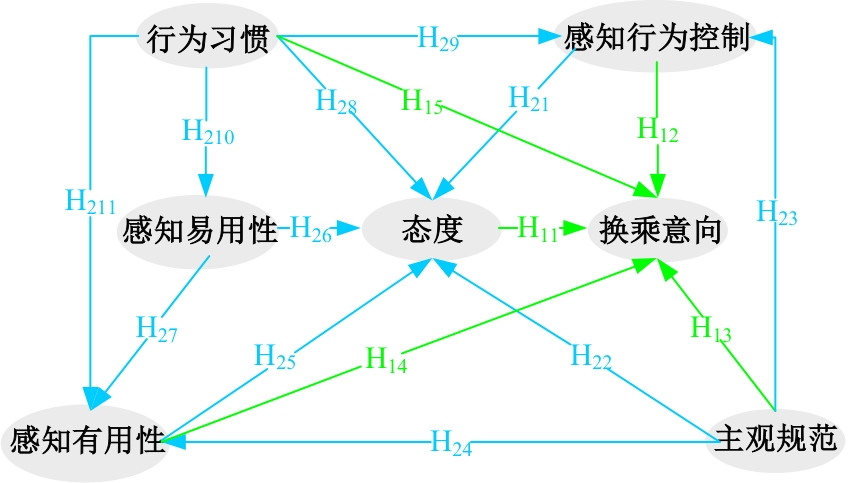
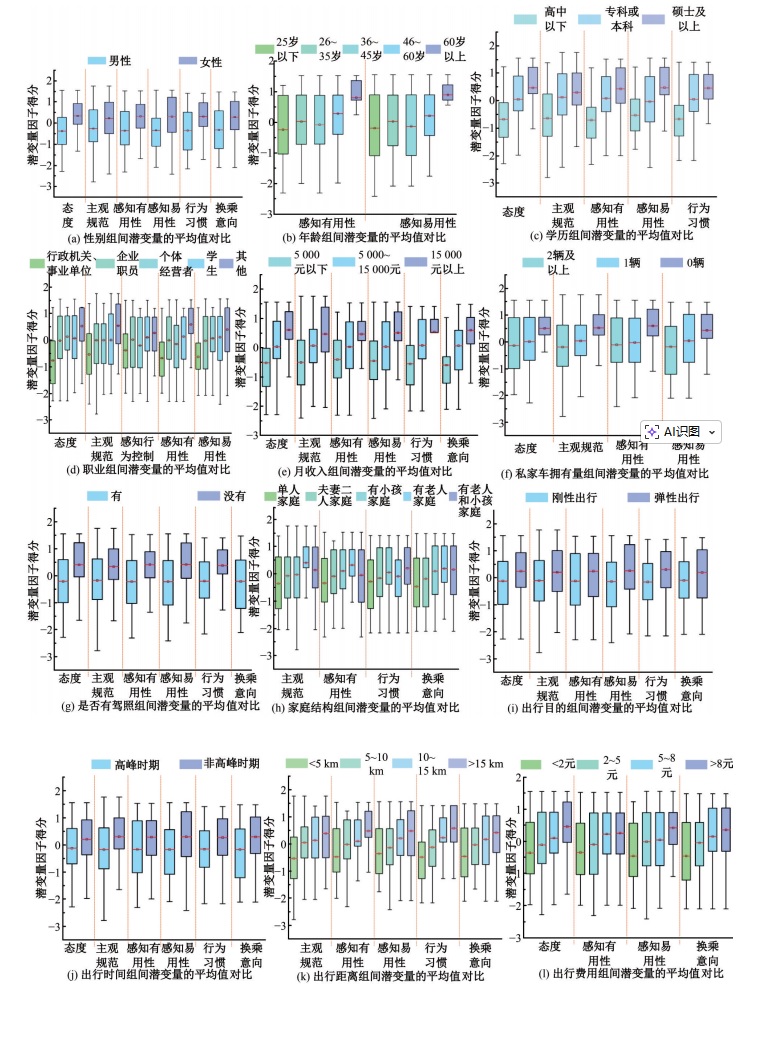
为探究公交换乘优惠政策下城市居民换乘意向的影响因素及其相互作用机理,本文在计划行为理论和技术接受模型的基础上融入行为习惯,采用结构方程模型(SEM)构建了公交换乘优惠政策下的居民换乘意向模型;采用显示性偏好(RP)方法设计调查问卷,通过网络调查获得365份有效样本,探究各心理潜变量之间的路径关系,并通过Bootstrap法检验模型的中介效应;采用单因素方差分析(ANOVA)探讨潜变量在不同群组中的异质性。结果表明:态度、主观规范、感知有用性和行为习惯对换乘意向有直接的显著影响;态度、感知有用性和感知易用性是中介变量,但并非在所有路径中都能发挥中介效应;潜变量对换乘意向影响的总效应值从大到小排序为:行为习惯(0.457)、感知有用性(0.366)、态度(0.326)、主观规范(0.312)、感知易用性(0.096);不同社会经济属性和出行特征的群组对潜变量的感知及影响存在显著差异。研究成果不仅有助于完善行为意向研究的理论体系,而且可为其他城市交通管理部门制定公交换乘优惠政策提供理论支撑。
中图分类号:
- U491

| [1] | 中国政府网. 中共中央 国务院印发《交通强国建设纲要》[EB/OL]. [2024-03-23]. . |
| [2] | Nayum A, Nordfjærn T. Predictors of public transport use among university students during the winter: A MIMIC modelling approach[J]. Travel Behaviour and Society, 2021, 22: 236-243. |
| [3] | 吴文静, 孙刃超, 宗芳, 等. 居民低碳通勤出行的主观态度识别及影响分析[J]. 重庆交通大学学报: 自然科学版, 2021, 40(5): 53-58. |
| Wu Wen-jing, Sun Ren-chao, Zong Fang, et al. Subjective attitude identification and impact analysis of residents' low-carbon commuting travel[J]. Journal of Chongqing Jiaotong University(Natural Science), 2021, 40(5): 53-58. | |
| [4] | Zhang X, Zhong S, Ling S, et al. How to promote the transition from solo driving to mobility services delivery? an empirical study focusing on ridesharing[J]. Transport Policy, 2022, 129: 176-187. |
| [5] | 胡含, 李昕光, 孙崇效, 等. 城市居民低碳出行意向异质性分析[J]. 交通运输工程与信息学报, 2024, 22(1): 128-138. |
| Hu Han, Li Xin-guang, Sun Chong-xiao, et al. Heterogeneity analysis of urban residents' low-carbon travel intention[J]. Journal of Transportation Engineering and Information, 2024, 22(1): 128-138. | |
| [6] | Kaye S, Lewis I, Buckley L, et al. To share or not to share: A theoretically guided investigation of factors predicting intentions to use fully automated shared passenger shuttles[J]. Transportation Research Part F: Traffic Psychology and Behaviour, 2020, 75: 203-213. |
| [7] | Rejali S, Aghabayk K, Mohammadi A, et al. Assessing a priori acceptance of shared dockless e-scooters in Iran[J]. Transportation Research Part D: Transport and Environment, 2021, 100: No.103042. |
| [8] | 马壮林, 崔姗姗, 胡大伟. 限行政策下城市居民低碳出行意向[J]. 吉林大学学报: 工学版, 2022, 52(11): 2607-2617. |
| Ma Zhuang-lin, Cui Sha-shan, Hu Da-wei. Urban residents' low-carbon travel intention after implementation of driving restriction policy[J]. Journal of Jilin University(Engineering and Technology Edition), 2022, 52(11): 2607-2617. | |
| [9] | Bollen K A. Structural Equation with Latent Variables[M]. New York: Wiley, 1989. |
| [10] | 王玉茹. 居民低碳出行意向模型及其影响因素研究[J]. 云南民族大学学报: 自然科学版, 2016, 25(3): 280-285. |
| Wang Yu-ru. A study of the factors influencing Tianjin residents' intention of low-carbon travel[J]. Journal of Yunnan Minzu University(Natural Science Edition), 2016, 25(3): 280-285. | |
| [11] | 乔婧, 孙立山, 刘小明, 等. 基于结构方程的公共交通换乘影响因素研究[J]. 科学技术与工程, 2017, 17(6): 296-300. |
| Qiao Jing, Sun Li-shan, Liu Xiao-ming, et al. Analysis on public transportation transfer influencing factors based on structural equation model[J]. Science Technology and Engineering, 2017, 17(6): 296-300. | |
| [12] | Li J, Shen J, Jia B. Exploring intention to use shared electric bicycles by the extended theory of planned behavior[J]. Sustainability, 2021, 13(8): 1-13. |
| [13] | Ajzen I. The theory of planned behavior[J]. Organizational Behavior & Human Decision Processes, 1991, 50(2): 179-211. |
| [14] | Davis F D, Bagozzi P R, Warshaw P. User acceptance of computer technology: a comparison of two theoretical models[J]. Management Science, 1989(35): 982-1003. |
| [15] | Neal D T, Wood W, Labrecque J S, et al. How do habits guide behavior? Perceived and actual triggers of habits in daily life[J]. Journal of Experimental Social Psychology, 2012, 48(2): 492-498. |
| [16] | Fatmi M R, Habib M A. Modelling mode switch associated with the change of residential location[J]. Travel Behaviour Society, 2017, 9: 21-28. |
| [17] | Verplanken B, Orbell S. Reflections on past behavior: a self-report index of habit strength[J]. Journal of Applied Social Psychology, 2003, 33(6): 1313-1330. |
| [18] | 张昱, 孙岩, 刘学敏. 基于TPB的北京市居民低碳通勤选择机制研究[J]. 北京师范大学学报: 自然科学版, 2020, 56(6): 831-837. |
| Zhang Yu, Sun Yan, Liu Xue-min. Theory of planned behavior applied to choice of low carbon commuting of Beijing residents[J]. Journal of Beijing Normal University(Natural Science), 2020, 56(6): 831-837. | |
| [19] | 景鹏, 黄芳, 徐刚, 等. 自动驾驶支付意愿及影响因素分析[J]. 长安大学学报: 自然科学版, 2021, 41(1): 90-102. |
| Jing Peng, Huang Fang, Xu Gang, et al. Analysis of autonomous driving payment willingness and influencing factors[J]. Journal of Chang'an University(Natural Science Edition), 2021, 41(1): 90-102. | |
| [20] | Liu D, Du H, Southworth F, et al. The influence of social-psychological factors on the intention to choose low-carbon travel modes in Tianjin, China[J]. Transportation Research Part A: Policy and Practice, 2017, 105: 42-53. |
| [21] | Nieves-Pavón S, López-Mosquera N, Jiménez-Naranjo H. The role emotions play in loyalty and WOM intention in a Smart Tourism Destination Management[J]. Cities, 2024, 145: No.104681. |
| [22] | Samadzad M, Nosratzadeh H, Karami H, et al. What are the factors affecting the adoption and use of electric scooter sharing systems from the end user's perspective?[J]. Transport Policy, 2023, 136: 70-82. |
| [23] | 齐航, 夏嘉祺, 王光超, 等. 考虑出行者习惯与利他性偏好的自动驾驶网约车使用意向模型[J]. 交通运输工程与信息学报, 2021, 19(2): 1-10. |
| Qi Hang, Xia Jia-qi, Wang Guang-chao, et al. A behavioral intention to use model of autonomous vehicle ride-hailing incorporating traveler habit and altruistic preference[J]. Journal of Transportation Engineering and Information, 2021, 19(2): 1-10. | |
| [24] | 盛光华, 岳蓓蓓, 龚思羽. 共享单车用户持续使用意愿研究——基于TAM理论的拓展模型[J]. 东北大学学报: 社会科学版, 2019, 21(6): 567-574. |
| Sheng Guang-hua, Yue Bei-bei, Gong Si-yu. A research on consumers' willingness to use shared bicycles continuously——Based on the extended model of TAM theory[J]. Journal of Northeastern University (Social Science), 2019, 21(6): 567-574. | |
| [25] | 李振龙, 邢冠仰, 李佳, 等. 基于扩展TAM的车路协同系统驾驶人接受度研究[J]. 中国公路学报, 2021, 34(7): 188-200. |
| Li Zhen-long, Xing Guan-yang, Li Jia, et al. Driver's acceptance of cooperative vehicle infrastructure system based on extended TAM[J]. China Journal of Highway and Transport, 2021, 34(7): 188-200. | |
| [26] | Chen C F, Chao W H. Habitual or reasoned? Using the theory of planned behavior, technology acceptance model, and habit to examine switching intentions toward public transit[J]. Transportation Research Part F: Traffic Psychology and Behaviour, 2011, 14(2): 128-137. |
| [27] | Yen Y S, Wu F S. Predicting the adoption of mobile financial services: the impacts of perceived mobility and personal habit[J]. Computers in Human Behavior, 2016, 65: 31-42. |
| [28] | 吴明隆. 结构方程模型——AMOS的操作与应用[M]. 重庆: 重庆大学出版社, 2009: 40-53. |
| [29] | Fu X, Juan Z. Exploring the psychosocial factors associated with public transportation usage and examining the "gendered" difference[J]. Transportation Research Part A: Policy and Practice, 2017, 103: 70-82. |
| [30] | Greenland S, Senn S J, Rothman K J, et al. Statistical tests, P values, confidence intervals, and power: a guide to misinterpretations[J]. European Journal of Epidemiology, 2016, 31: 337-350. |
| [1] | 曲昭伟,王铭阳,王喆,宋现敏,张云翔,黄镜尘. 基于自动驾驶模块化车辆主辅功能分配的公交自适应调度方法[J]. 吉林大学学报(工学版), 2025, 55(9): 2946-2957. |
| [2] | 王琳虹,刘宇阳,刘子昱,鹿应佳,张宇恒,黄桂树. 基于YOLOv5的轻量化桥梁缺陷识别[J]. 吉林大学学报(工学版), 2025, 55(9): 2958-2968. |
| [3] | 张云翔,宋现敏,谢渝,湛天舒. 基于用户满意度的停车预约服务智能体行为仿真[J]. 吉林大学学报(工学版), 2025, 55(9): 2978-2984. |
| [4] | 穆长儒,徐亮,程国柱. 基于能量合理分配的外包U型钢-混凝土组合护栏防撞性能[J]. 吉林大学学报(工学版), 2025, 55(8): 2669-2680. |
| [5] | 李艳波,汪静远,陈圆媛,程绍峰,吕浩楠,陈俊硕. 面向高速公路服务区自洽能源系统的RAMS评价方法[J]. 吉林大学学报(工学版), 2025, 55(7): 2243-2250. |
| [6] | 戢晓峰,邓若凡,乔新,关昊天. 建成环境对共享单车时间集聚模式的非线性影响[J]. 吉林大学学报(工学版), 2025, 55(7): 2233-2242. |
| [7] | 于江波,翁剑成,林鹏飞,孙宇星,柴娇龙. 基于混合Transformer的对外客运枢纽抵站客流预测模型[J]. 吉林大学学报(工学版), 2025, 55(7): 2251-2259. |
| [8] | 柴树山,周志强,李海涛,徐炅旸. 基于图时空模式学习网络的路网实时交通事件自动检测方法[J]. 吉林大学学报(工学版), 2025, 55(7): 2145-2161. |
| [9] | 赵红专,吴泽健,张鑫,石胜文,李文勇,展新,许恩永,王佳明. 基于密度离散度和信息传输延迟的网联商用车弯道格子模型[J]. 吉林大学学报(工学版), 2025, 55(6): 2015-2029. |
| [10] | 闫晟煜,程铭杰,田宏策,王洪瑀,周永恒,马博浩. 封闭式景区纯电动客车调度方法[J]. 吉林大学学报(工学版), 2025, 55(6): 1984-1993. |
| [11] | 潘福全,牛远征,张丽霞,杨金顺,陈秀锋,陈德启. 智能网联环境下无信号交叉口车辆通行控制策略[J]. 吉林大学学报(工学版), 2025, 55(6): 1948-1962. |
| [12] | 潘义勇,徐家聪,尤逸文,全勇俊. 网约车出行需求影响因素多尺度空间异质性分析[J]. 吉林大学学报(工学版), 2025, 55(5): 1567-1575. |
| [13] | 秦严严,肖腾飞,罗钦中,王宝杰. 雾天高速公路车辆跟驰安全分析与控制策略[J]. 吉林大学学报(工学版), 2025, 55(4): 1241-1249. |
| [14] | 张河山,范梦伟,谭鑫,郑展骥,寇立明,徐进. 基于改进YOLOX的无人机航拍图像密集小目标车辆检测[J]. 吉林大学学报(工学版), 2025, 55(4): 1307-1318. |
| [15] | 宋现敏,湛天舒,李海涛,刘博,张云翔. 考虑用户成本和泊位利用率的停车预约分配模型[J]. 吉林大学学报(工学版), 2025, 55(4): 1287-1297. |
|
||