吉林大学学报(医学版) ›› 2026, Vol. 52 ›› Issue (1): 135-142.doi: 10.13481/j.1671-587X.20260114

• 基础研究 • 上一篇    下一篇

miR-378对缺氧/复氧引发心肌细胞损伤的保护作用及其机制

赵亮,陈云,谢伟()   

  1. 新疆生产建设兵团医院心脏中心,新疆 乌鲁木齐 830002
  • 收稿日期:2025-03-03 接受日期:2025-04-14 出版日期:2026-01-28 发布日期:2026-02-24
  • 通讯作者: 谢伟 E-mail:xieweixinyu@sina.com
  • 作者简介:赵 亮(1981-),男,新疆维吾尔自治区乌鲁木齐市人,副主任医师,主要从事冠心病和心律失常介入诊疗方面的研究。
  • 基金资助:
    新疆生产建设兵团科技局科技计划项目(2023AB018-07)

Protective effect of miR-378 on myocardial cell injury induced by hypoxia/reoxygenation and its mechanism

Liang ZHAO,Yun CHEN,Wei XIE()   

  1. Heart Center,Xinjiang Production and Construction Corps Hospital,Urumqi 830002,China
  • Received:2025-03-03 Accepted:2025-04-14 Online:2026-01-28 Published:2026-02-24
  • Contact: Wei XIE E-mail:xieweixinyu@sina.com

摘要:

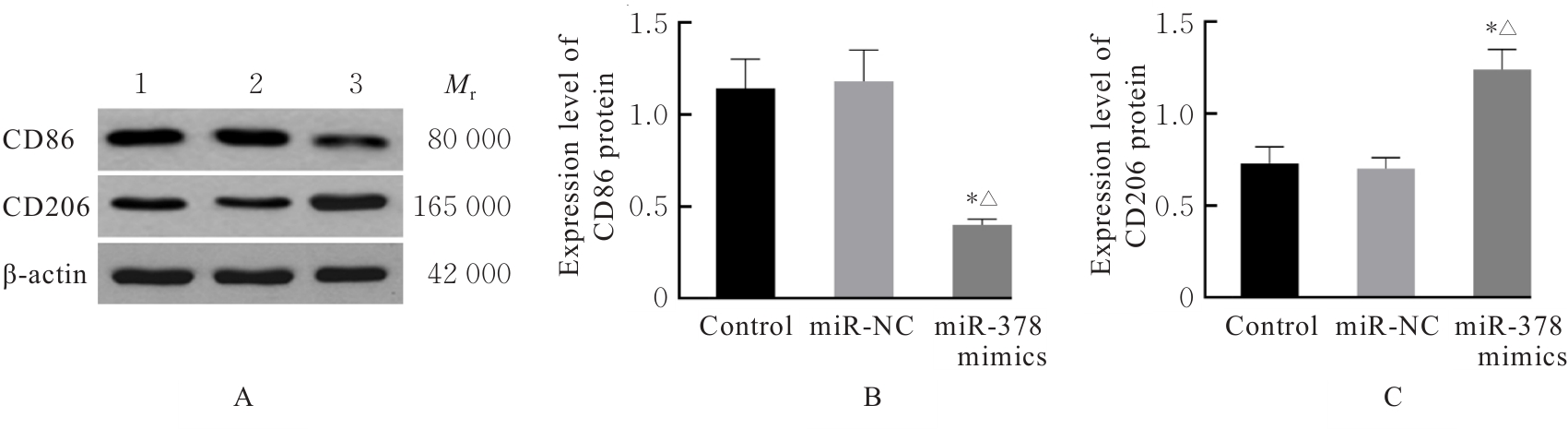
目的 探讨微小RNA(miR)-378在心肌缺血再灌注(I/R)引起的心肌细胞损伤中的作用,并阐明其作用机制。 方法 培养人心肌细胞AC16和人单核巨噬细胞THP-1,首先将miR-378模拟物(mimics)及其阴性对照(miR-NC)分别转染至THP-1细胞中,分为对照组、miR-NC组和miR-378 mimics组,对照组THP-1细胞正常培养,采用实时荧光定量PCR(RT-qPCR)法检测转染后各组THP-1细胞中miR-378表达水平以及M1型巨噬细胞分泌物[诱导型一氧化氮合酶(iNOS)、肿瘤坏死因子α(TNF-α)、白细胞介素1β(IL-)和白细胞介素6(IL-6)]和M2型巨噬细胞分泌物[精氨酸酶1(Arg-1)、 转化生长因子β1(TGF-β1)、 白细胞介素4(IL-4)和白细胞介素10(IL-10)]mRNA表达水平,Western blotting法检测各组THP-1细胞中M1型巨噬细胞表面标志蛋白分化簇86(CD86)和M2型巨噬细胞表面标志蛋白分化簇206(CD206)表达水平。AC16细胞进行缺氧/复氧(H/R)处理模拟I/R心肌细胞损伤,并与不同处理的THP-1细胞建立共培养体系,分为对照组(上室为AC16细胞,下室为THP-1细胞)、H/R组(上室为H/R诱导的AC16细胞,下室为THP-1细胞)、miR-NC+H/R组(上室为H/R诱导的AC16细胞,下室为转染miR-NC 的THP-1细胞)和miR-378 mimics+H/R组(上室为H/R诱导的AC16细胞,下室为转染miR-378 mimics的THP-1细胞)。采用细胞计数试剂盒8(CCK-8)法检测各组AC16细胞活性,试剂盒检测各组AC16细胞中丙二醛(MDA)和活性氧(ROS)水平及超氧化物歧化酶(SOD)活性以及细胞上清液中乳酸脱氢酶(LDH)活性。 结果 RT-qPCR法和Western blotting法,与对照组和miR-NC组比较,miR-378 mimics组THP-1细胞中miR-378表达水平明显升高(P<0.05),THP-1细胞中iNOSTNF-αIL-IL-6 mRNA表达水平和CD86蛋白表达水平明显降低(P<0.05),THP-1细胞中Arg-1TGF-β1IL-4IL-10 mRNA表达水平以及CD206蛋白表达水平明显升高(P<0.05);CCK-8法和试剂盒法,与对照组比较,H/R组AC16细胞活性明显降低(P<0.05),细胞中MDA和ROS水平明显升高(P<0.05),SOD活性明显降低(P<0.05),细胞上清液中LDH活性明显升高(P<0.05);与H/R组比较,miR-378 mimics+H/R组AC16细胞活性明显升高(P<0.05),细胞中MDA和ROS水平明显降低(P<0.05),SOD活性明显升高(P<0.05),细胞上清液中LDH活性明显降低(P<0.05)。 结论 miR-378可减轻H/R所致的心肌细胞损伤,其作用机制可能与调节巨噬细胞向M2型极化有关。

关键词: 心肌缺血再灌注, 微小RNA-378, 心肌细胞, 巨噬细胞, 缺氧/复氧

Abstract:

Objective To discuss the role of microRNA (miR)-378 in cardiomyocyte injury induced by myocardial ischemia reperfusion (I/R), and to clarify its mechanism. Methods The human cardiomyocytes AC16 and human monocyte macrophages THP-1 were cultured. Firstly, miR-378 mimics and its negative control (miR-NC) were transfected into the THP-1 cells respectively.The cells were divided into control group, miR-NC group and miR-378 mimics group, the THP-1 cells in control group were cultured normally. Real-time fluorescence quantitative PCR (RT-qPCR) method was used to detect the expression level of miR-378 and the expression levels of M1 macrophage secreted factors [inducible nitric oxide synthase (iNOS), tumor necrosis factor-α (TNF-α), interleukin-1β (IL-1β) and interleukin-6 (IL-6)] and M2 macrophage secreted factors [arginase-1 (Arg-1), transforming growth factor-β1 (TGF-β1), interleukin-4 (IL-4) and interleukin-10 (IL-10)] in the THP-1 cells after transfected; Western blotting method was used to detect the expression levels of M1 macrophage surface marker protein cluster of differentiation 86 (CD86) and M2 macrophage surface marker protein cluster of differentiation 206 (CD206). The AC16 cells underwent hypoxia/reoxygenation (H/R) treatment to simulate I/R cardiomyocyte injury, and were co-cultured with differently treated THP-1 cells. The cells were divided into control group (upper chamber containing AC16 cells, lower chamber containing THP-1 cells), H/R group (upper chamber containing H/R-induced AC16 cells, lower chamber containing THP-1 cells), miR-NC+H/R group (upper chamber containing H/R-induced AC16 cells, lower chamber containing THP-1 cells transfected with miR-NC) and miR-378 mimics+H/R group (upper chamber containing H/R-induced AC16 cells, lower chamber containing THP-1 cells transfected with miR-378 mimics). Cell counting kit-8 (CCK-8) method was used to detect the activities of the AC16 cells in various groups; kits were used to detect the levels of malondialdehyde (MDA) and reactive oxygen species (ROS) and the activity of superoxide dismutase (SOD) in the AC16 cells in various groups as well as the lactate dehydrogenase (LDH) activity in the cell supernatant. Results The RT-qPCR method and Western blotting method results showed that compared with control group and miR-NC group, the expression level of miR-378 in the THP-1 cells in miR-378 mimics group was significantly increased (P<0.05); the expression levels of iNOS, TNF-αIL-, and IL-6 mRNA and the expression level of CD86 protein in the THP-1 cells were significantly decreased (P<0.05); the expression levels of Arg-1TGF-β1IL-4, and IL-10 mRNA and the expression level of CD206 protein in the THP-1 cells were significantly increased (P<0.05). The CCK-8 method and kit method results showed that compared with control group, the activity of the AC16 cells in H/R group was significantly decreased (P<0.05), the levels of MDA and ROS in the cells were significantly increased (P<0.05), the activity of SOD was significantly decreased (P<0.05), and the LDH activity in the cell supernatant was significantly increased (P<0.05). Compared with H/R group, the activity of the AC16 cells in miR-378 mimics+H/R group was significantly increased (P<0.05), the levels of MDA and ROS in the cells were significantly decreased (P<0.05), the activity of SOD was significantly increased (P<0.05), and the LDH activity in the cell supernatant was significantly decreased (P<0.05). Conclusion miR-378 can alleviate H/R-induced cardiomyocyte injury, and its mechanism may be related to regulating macrophage polarization towards the M2 phenotype.

Key words: Myocardial ischemia-reperfusion, MicroRNA-378, Cardiomyocytes, Macrophages, Hypoxia/reoxygenation

中图分类号: 

  • R543