吉林大学学报(工学版) ›› 2025, Vol. 55 ›› Issue (12): 4010-4023.doi: 10.13229/j.cnki.jdxbgxb.20240538
• 计算机科学与技术 • 上一篇
多尺度细节增强与分层抑噪的图像去雾算法
杨燕( ),沈汪良
),沈汪良
- 兰州交通大学 电子与信息工程学院,兰州 730070
Multi⁃scale detail enhancement and layered noise suppression algorithm for image dehazing
Yan YANG(),Wang-liang SHEN
- School of Electronic and Information Engineering,Lanzhou Jiao Tong University,Lanzhou 730070,China
摘要:
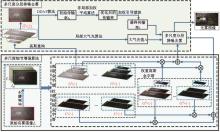
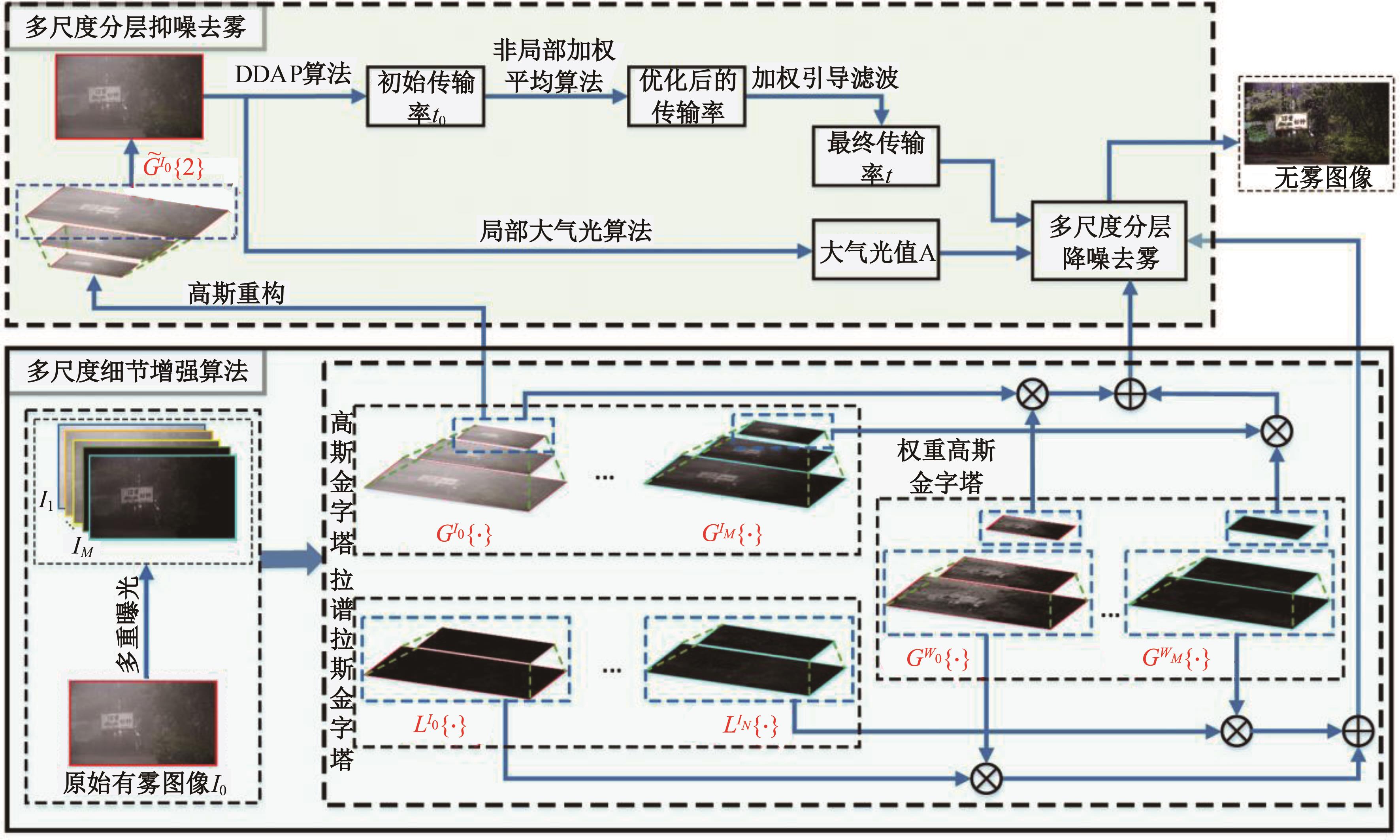
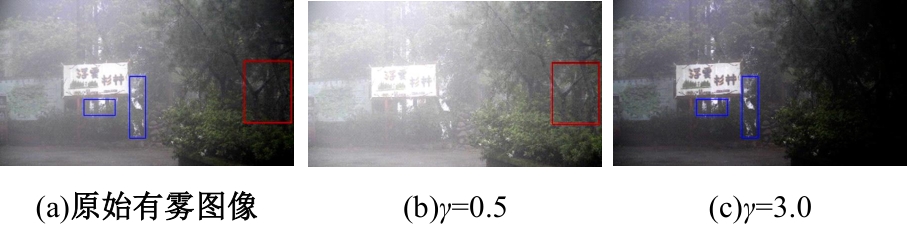
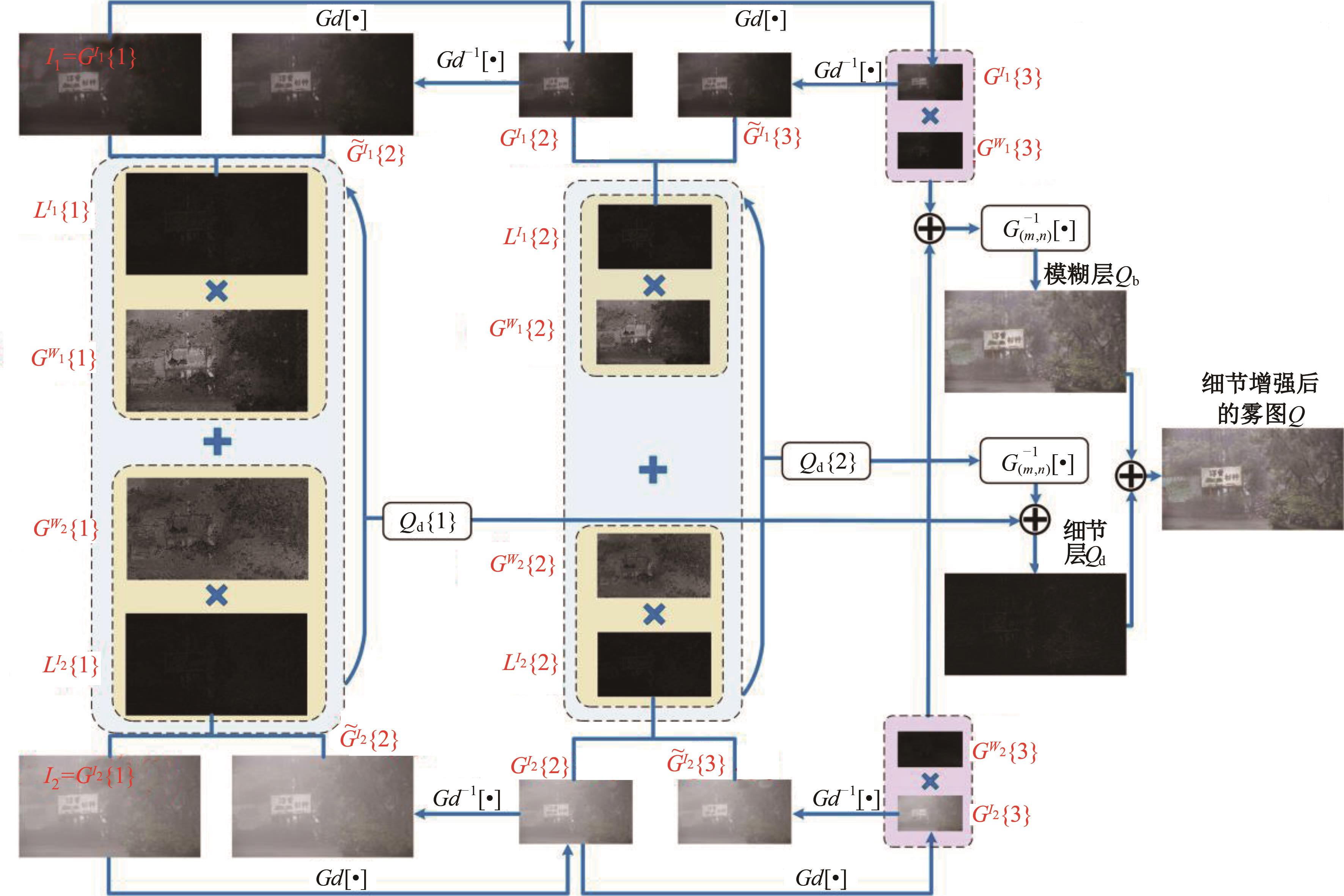
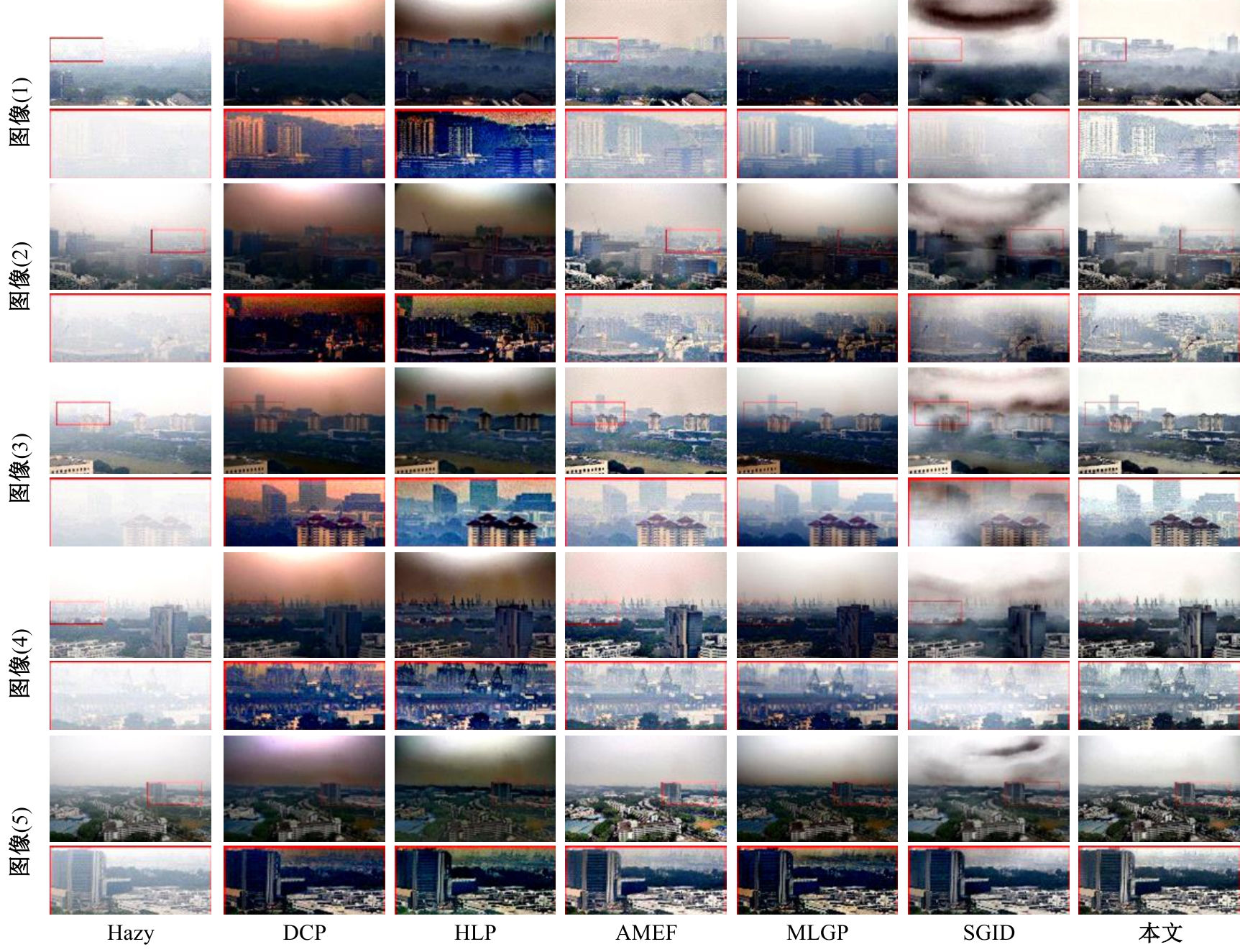
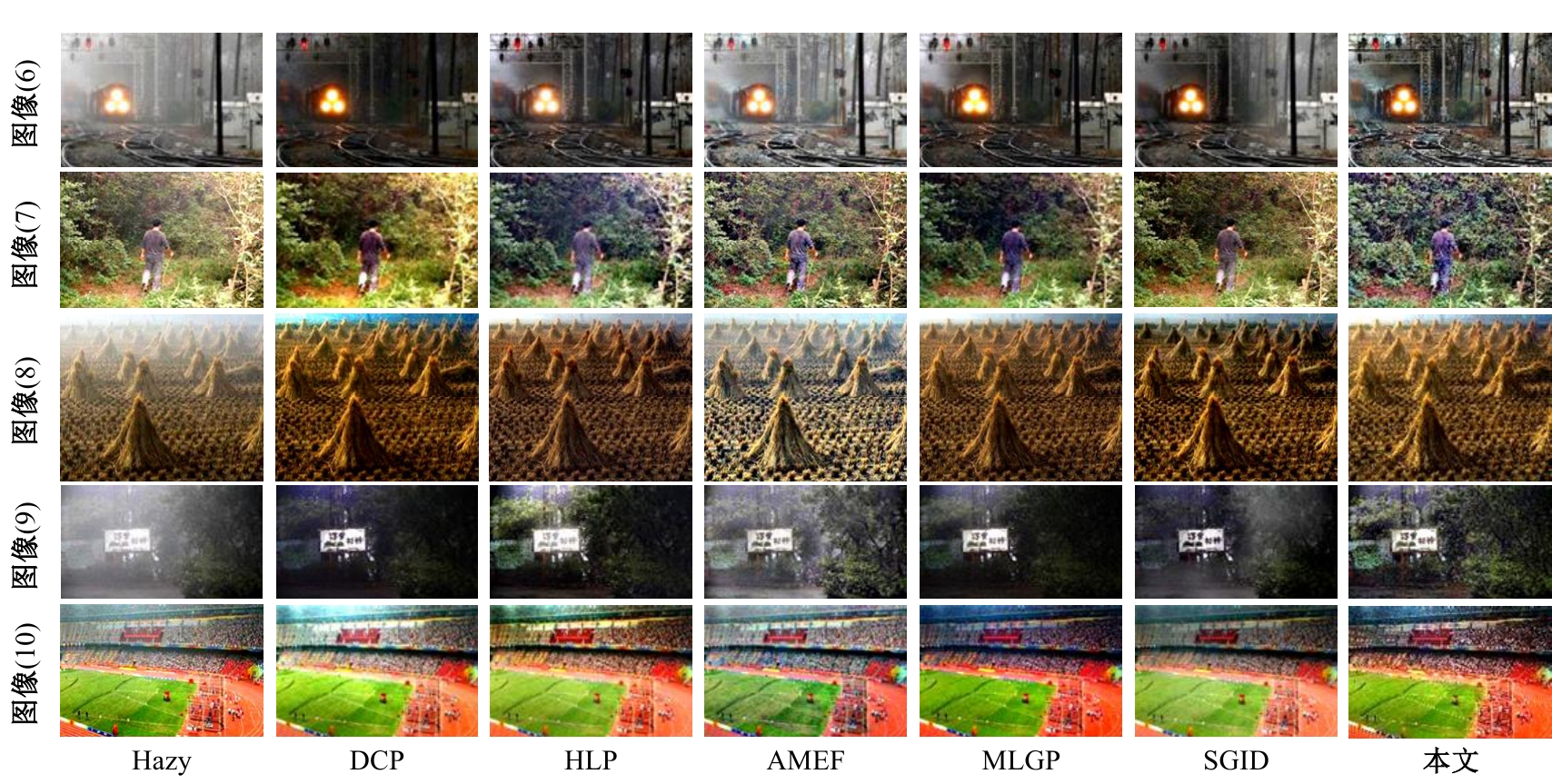
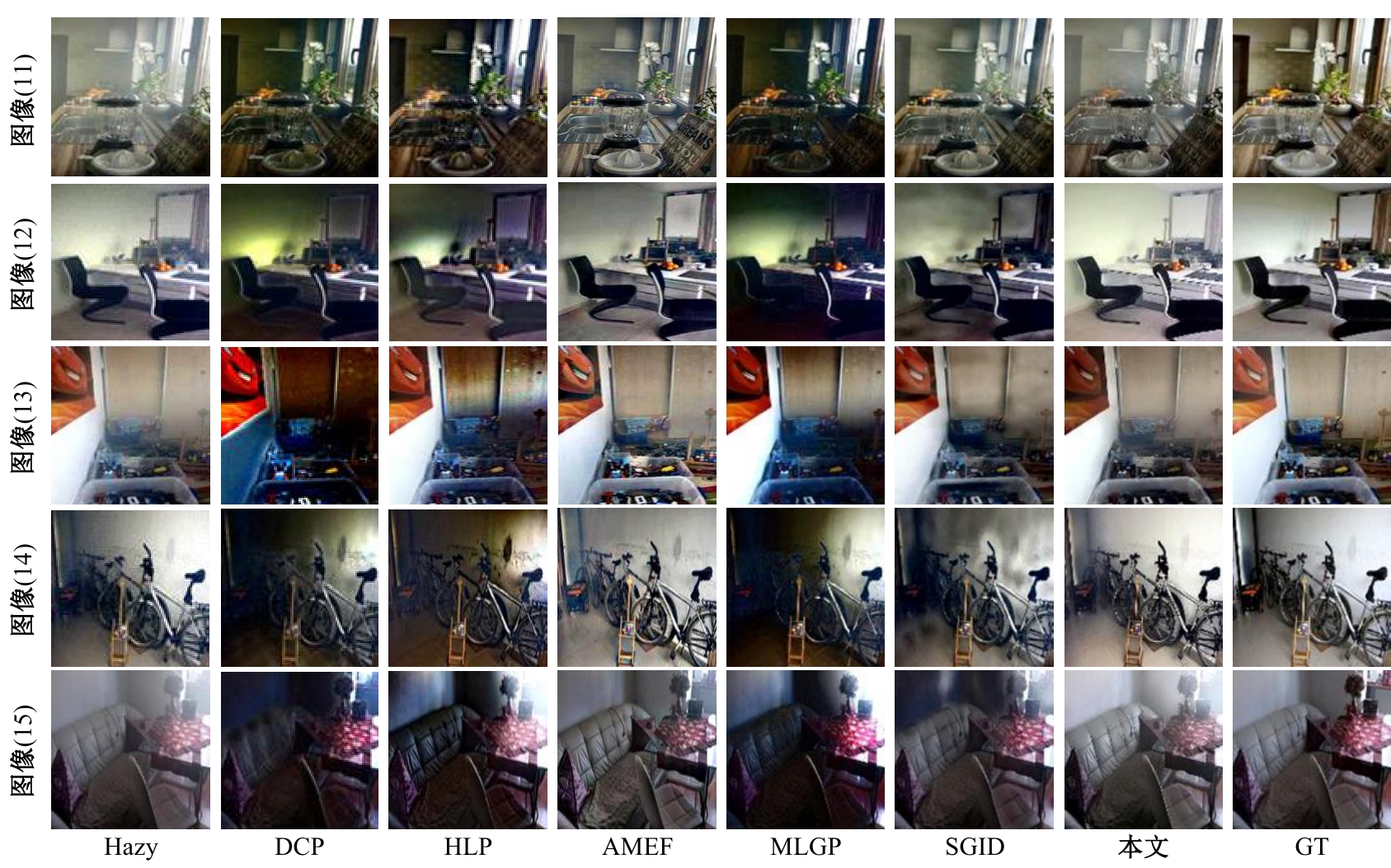
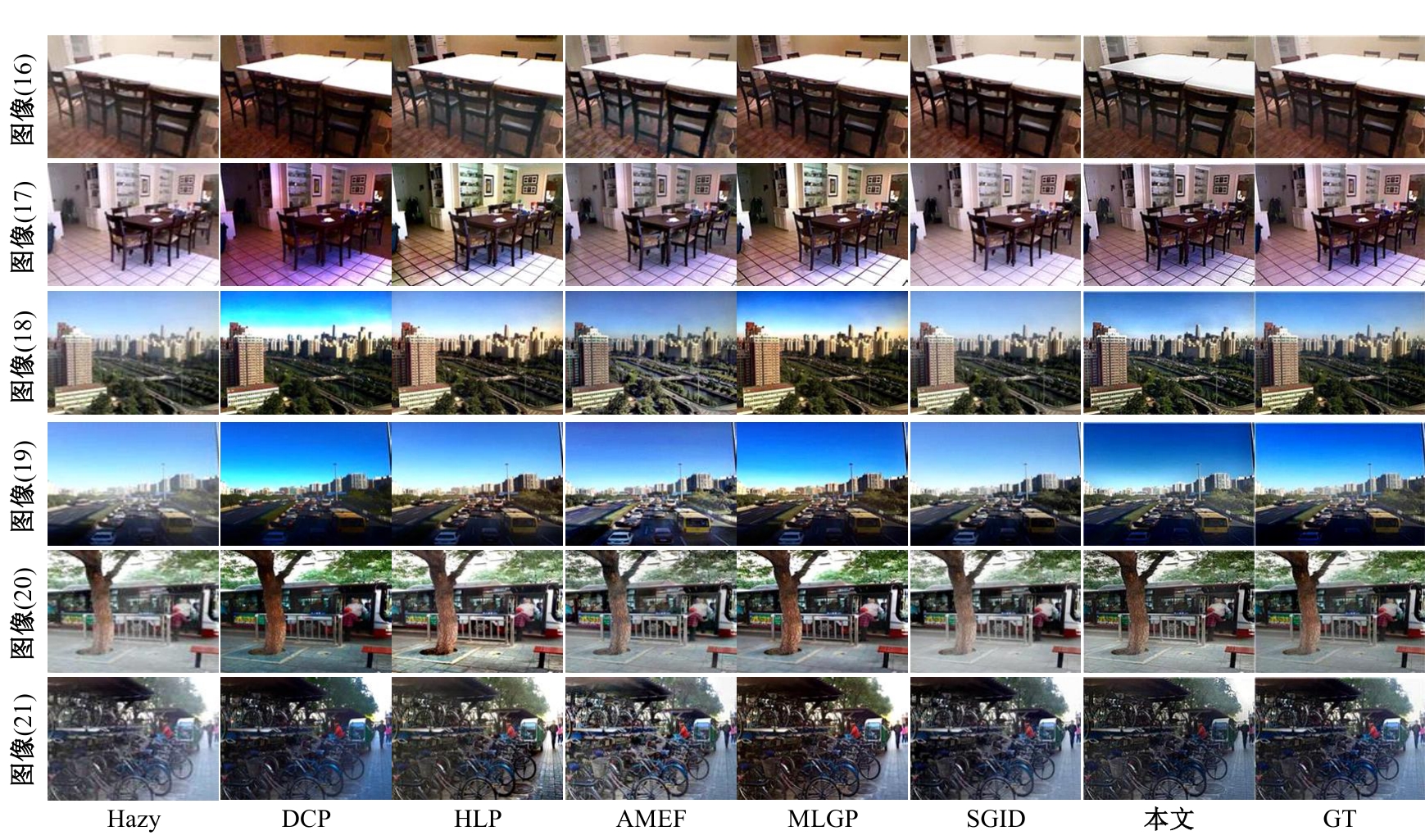
针对现有多数去雾算法存在复原图像细节模糊及噪声放大的问题,提出了一种基于金字塔结构的多尺度细节增强与分层抑噪的图像去雾算法。首先,设计了一种多尺度细节增强算法,将有雾图像通过伽马矫正生成的多幅不同曝光图像加权融合,得到一幅细节增强后的有雾图像以及对应的细节层与模糊层图像,以增强复原图像的细节。其次,构建了一种非局部加权平均算法优化暗直接衰减先验估计的初始透射率,以减少形态学伪影,并利用小半径加权引导滤波(WGIF)进一步细化,求得最终的透射率。最后,根据本文提出的多尺度分层抑噪去雾算法复原无雾图像并抑制噪声放大。实验结果表明,本文算法能更好地抑制噪声放大,得到的无雾图像细节清晰、色彩自然,天空区域复原质量更高,多项客观评价指标相较于当前主流算法显著提升。
中图分类号:
- TP391.4

| [1] | Thejas K, Chandra S. Autonomous bot using machine learning and computer vision[J].SN Computer Science, 2021, 2(4): 251. |
| [2] | Hassan N, Ullah S, Bhatti N, et al. A cascaded approach for image defogging based on physical and enhancement models[J]. Signal, Image and Video Processing, 2020, 14(5): 867-875. |
| [3] | Haller I, Nedevschi S. Design of interpolation functions for subpixel-accuracy stereo-vision systems[J]. IEEE Transactions on Image Processing, 2012, 21(2): 889-898. |
| [4] | Soni B, Mathur P. An improved image dehazing technique using CLAHE and guided filter[C]//2020 7th International Conference on Signal Processing and Integrated Networks (SPIN), Noida, India, 2020:902-907. |
| [5] | Sarkar M, Sarkar P R, Mondal U, et al. Empirical wavelet transform‐based fog removal via dark channel prior[J]. IET Image Processing, 2020, 14(6): 1170-1179. |
| [6] | Sankar M R, Krishna P R, Yamini A,et al. Optimization of single image dehazing based on stationary wavelet transform[C]∥Proceedings of the International Conference on Cognitive Computing and Cyber Physical Systems, Hainan, China, 2023: 414-421. |
| [7] | Su C, Li Z, Wei Z L, et al. Clarity method of low-illumination and dusty coal mine images based on improved Amef[J]. Informatica, 2023, 47: 101-114. |
| [8] | 张驰, 谭南林, 李响, 等. 基于改进型Retinex算法的雾天图像增强技术[J]. 北京航空航天大学学报,2019, 45(2): 309-316. |
| Zhang Chi, Tan Nan-lin, Li Xiang, et al. Foggy image enhancement technology based on improved Retinex algorithm[J]. Journal of Beijing University of Aeronautics and Astronsutics, 2019, 45(2): 309-316. | |
| [9] | Wang J B, Lu K, Xue J, et al. Single image dehazing based on the physical model and MSRCR algorithm[J]. IEEE Transactions on Circuits and Systems for Video Technology, 2018, 28(9): 2190-2199. |
| [10] | Cai B L, Xu X M, Jia K, et al.DehazeNet: an end-to-end system for single image haze removal[J]. IEEE Transactions on Image Processing, 2016, 25(11): 5187-5198. |
| [11] | Frants V, Agaian S, Panetta K. QCNN-H: Single-image dehazing using quaternion neural networks[J]. IEEE Transactions on Cybernetics, 2023, 53(9): 5448-5458. |
| [12] | 李硕士, 刘洪瑞, 甘永东, 等. 基于残差密集块与注意力机制的图像去雾网络[J]. 湖南大学学报: 自然科学版, 2021, 48(6): 112-118. |
| Li Shuo-shi, Liu Hong-rui, Gan Yong-dong, et al. Image dehazing network based on residual dense block and attention mechanism[J]. Journal of Hunan University (Natural Sciences), 2021, 48(6): 112-118. | |
| [13] | Lyu Z, Chen Y, Hou Y M. MCPNet: Multi-space color correction and features prior fusion for single-image dehazing in non-homogeneous haze scenarios[J]. Pattern Recognition, 2024, 150: No.110290. |
| [14] | Yi W C, Dong L Q, Liu M, et al. Priors-assisted dehazing network with attention supervision and detail preservation[J]. Neural Networks, 2024, 173: No.106165. |
| [15] | Wang S B, Mei X S, Kang P S, et al. DFC-dehaze: an improved cycle-consistent generative adversarial network for unpaired image dehazing[J]. The Visual Computer, 2024, 40(4): 2807-2818. |
| [16] | 肖进胜, 申梦瑶, 雷俊锋, 等. 基于生成对抗网络的雾霾场景图像转换算法[J]. 计算机学报, 2020, 43(1): 165-176. |
| Xiao Jin-sheng, Shen Meng-yao, Lei Jun-feng, et al. Haze scene image conversion algorithm based on generative adversarial network[J]. Chinese Journal of Computers, 2020, 43(1): 165-176. | |
| [17] | Wang P Y, Zhu H Q, Huang H, et al. TMS-GAN:a twofold multi-scale generative adversarial network for single image dehazing[J]. IEEE Transactions on Circuits and Systems for Video Technology, 2022, 32(5): 2760-2772. |
| [18] | Zhang J, Dong Q Q, Song W J. GGADN: guided generative adversarial dehazing network[J]. Soft Computing, 2021, 27(3): 1731-1741. |
| [19] | Wang Y Z, Yan X F, Wang F, et al. UCL-dehaze:toward real-world image dehazing via unsupervised contrastive learning[J]. IEEE Transactions on Image Processing, 2024, 33: 1361-1374. |
| [20] | Meng G F, Wang Y, Duan J Y, et al.Efficient image dehazing with boundary constraint and contextual regularization[C]∥2013 IEEE International Conference on Computer Vision, Sydney, Australia, 2013: 617-624. |
| [21] | 王柯俨, 胡妍, 王怀, 等. 结合天空分割和超像素级暗通道的图像去雾算法[J]. 吉林大学学报: 工学版, 2019, 49(4): 1377-1384. |
| Wang Ke-yan, Hu Yan, Wang Huai, et al. Sky segmentation and super dark channel at pixel level image to fog algorithm[J]. Journal of Jilin University (Engineering and Technology Edition, 2019, 49(4): 1377-1384. | |
| [22] | Kim S E, Park T H, Eom I K. Fast single image dehazing using saturation based transmission map estimation[J]. IEEE Transactions on Image Processing,2019, 29: 1985-1998. |
| [23] | Liu Y, Shang J X, Pan L, et al. A unified variational model for single image dehazing[J]. IEEE Access,2019, 7: 15722-15736. |
| [24] | 高原原, 胡海苗. 基于多子块协同单尺度Retinex的浓雾图像增强[J]. 北京航空航天大学学报, 2019, 45(5): 944-951. |
| Gao Yuan-yuan, Hu Hai-miao. Foggy image enhancement based on multi-block coordinated single-scale Retinex[J]. Journal of Beijing University of Aeronautics and Astronsutics, 2019, 45(5): 944-951. | |
| [25] | Galdran A. Image dehazing by artificial multiple-exposure image fusion[J]. Signal Processing, 2018, 149: 135-147. |
| [26] | Qu L H, Liu S L, Wang M N, et al. Rethinking multi-exposure image fusion with extreme and diverse exposure levels: A robust framework based on Fourier transform and contrastive learning[J]. Information Fusion, 2023, 92: 389-403. |
| [27] | Xu K, Wang Q, Xiao H Q, et al.Multi-exposure image fusion algorithm based on Improved weight function[J]. Frontiers in Neurorobotics, 2022, 16: No.846580. |
| [28] | Yang G, Li J, Gao X B. A dual domain multi-exposure image fusion network based on spatial-frequency integration[J]. Neurocomputing, 2024, 598: No.128146. |
| [29] | Zhu Q S, Mai J M, Shao L. A fast single image haze removal algorithm using color attenuation prior[J].IEEE Transactions on Image Processing, 2015, 24(11): 3522- 3533. |
| [30] | Mertens T, Kautz J, Van R F. Exposure fusion[C]∥15th Pacific Conference on Computer Graphics and Applications (PG'07), Tokyo, Japan, 2007: 382-390. |
| [31] | Hautière N, Tarel J P, Aubert D, et al. Blina contrast enhancement assessment by gradient ratioing at visible edges[J]. Image Analysis and Stereology, 2008, 27(2): 87. |
| [32] | Nayar S K, Narasimhan S G.Vision in bad weather [C]∥Proceedings of the Seventh IEEE International Conference on Computer Vision, Corinth, Greece, 1999: 820-827. |
| [33] | Cantor A. Optics of the atmosphere—scattering by molecules and particles[J]. IEEE Journal of Quantum Electronics, 1978, 14(9): 698-699. |
| [34] | He K M, Sun J, Tang X O. Single image haze removal using dark channel prior[C]∥2009 IEEE Conference on Computer Vision and Pattern Recognition, Miami, USA, 2009: 1956-1963. |
| [35] | Li Z G, Shu H Y, Zheng C B. Multi-scale single image dehazing using Laplacian and Gaussian Pyramids[J].IEEE Transactions on Image Processing, 2021, 30: 9270-9279. |
| [36] | Berman D, Treibitz T, Avidan S. Non-local Image dehazing[C]//2016 IEEE Conference on Computer Vision and Pattern Recognition (CVPR), Las Vegas, USA, 2016: 1674-1682. |
| [37] | Li Z G, Zheng J H, Zhu Z J, et al. Weighted guided image filtering[J]. IEEE Transactions on Image Processing, 2015, 24(1): 120-129. |
| [38] | Li Z G, Zheng J H. Single image de-hazing using globally guided image filtering[J]. IEEE Transactions on Image Processing, 2018, 27(1): 442-450. |
| [39] | 杨燕, 王志伟. 基于补偿透射率和自适应雾浓度系数的图像复原算法[J]. 通信学报, 2020, 41(1):66-75. |
| Yang Yan, Wang Zhi-wei. Image restoration algorithm based on compensated transmittance and adaptive haze concentration coefficient[J]. Journal of Communications, 2020, 41(1): 66-75. | |
| [40] | Bai H R, Pan J S, Xiang X G, et al. Self-guided image dehazing using progressive feature fusion[J].IEEE Transactions on Image Processing, 2022, 31: 1217-1229. |
| [41] | Ancuti C, Ancuti C O, Timofte R, et al. I-HAZE: A dehazing benchmark with real hazy and haze-free indoor images[C]∥Advanced Concepts for Intelligent Vision Systems:19th International Conference, ACIVS 2018, Poitiers, France, 2018: 620-631. |
| [42] | Li B, Ren W, Fu D, et al. Benchmarking single-image dehazing and beyond[J]. IEEE Transactions on Image Processing, 2018, 28(1): 492-505. |
| [43] | Huynh-Thu Q, Ghanbari M. Scope of validity of PSNR in image/video quality assessment[J]. Electronics Letters, 2008, 44(13): 800. |
| [44] | Wang Z, Bovik A C, Sheikh H R, et al. Image quality assessment: from error visibility to structural similarity[J]. IEEE Transactions on Image Processing, 2004, 13(4): 600-612. |
| [1] | 安金岚,王澜斌,周松,黄研清. 激光沉积修复钛合金热影响区异质结构及后续热处理的性能[J]. 吉林大学学报(工学版), 2025, 55(6): 1931-1939. |
| [2] | 文斌,彭顺,杨超,沈艳军,李辉. 多深度自适应融合去雾生成网络[J]. 吉林大学学报(工学版), 2025, 55(6): 2103-2113. |
| [3] | 程德强,王伟臣,韩成功,吕晨,寇旗旗. 基于改进密集网络和小波分解的自监督单目深度估计[J]. 吉林大学学报(工学版), 2025, 55(5): 1682-1691. |
| [4] | 聂为之,尹斐,苏毅珊. 任务驱动下成像声呐水下目标识别方法综述[J]. 吉林大学学报(工学版), 2025, 55(4): 1163-1175. |
| [5] | 方钰,梅德清,郑会龙,杨肖芳,武海龙,张晓武. 中国空间站燃烧科学柜火焰传播速度地面测量试验[J]. 吉林大学学报(工学版), 2024, 54(9): 2460-2468. |
| [6] | 王德兴,高凯,袁红春,杨钰锐,王越,孔令栋. 基于色彩校正和TransFormer细节锐化的水下图像增强[J]. 吉林大学学报(工学版), 2024, 54(3): 785-796. |
| [7] | 杨国俊,齐亚辉,石秀名. 基于数字图像技术的桥梁裂缝检测综述[J]. 吉林大学学报(工学版), 2024, 54(2): 313-332. |
| [8] | 王勇,边宇霄,李新潮,徐椿明,彭刚,王继奎. 基于多尺度编码-解码神经网络的图像去雾算法[J]. 吉林大学学报(工学版), 2024, 54(12): 3626-3636. |
| [9] | 肖明尧,李雄飞,朱芮. 基于NSST域像素相关分析的医学图像融合[J]. 吉林大学学报(工学版), 2023, 53(9): 2640-2648. |
| [10] | 金小俊,孙艳霞,于佳琳,陈勇. 基于深度学习与图像处理的蔬菜苗期杂草识别方法[J]. 吉林大学学报(工学版), 2023, 53(8): 2421-2429. |
| [11] | 张振海,季坤,党建武. 基于桥梁裂缝识别模型的桥梁裂缝病害识别方法[J]. 吉林大学学报(工学版), 2023, 53(5): 1418-1426. |
| [12] | 荣鑫,刘洪海,殷作耀,林海翔,边庆华. 基于图像处理的集料级配在线检测方法[J]. 吉林大学学报(工学版), 2023, 53(10): 2847-2855. |
| [13] | 杨怀江,王二帅,隋永新,闫丰,周跃. 简化型残差结构和快速深度残差网络[J]. 吉林大学学报(工学版), 2022, 52(6): 1413-1421. |
| [14] | 贾海洋,夏睿,吕安祺,管噌璇,陈娟,王雷. 基于模板融合的超声医学影像全景拼接方法[J]. 吉林大学学报(工学版), 2022, 52(4): 916-924. |
| [15] | 蒋华伟,杨震,张鑫,董前林. 图像去雾算法研究进展[J]. 吉林大学学报(工学版), 2021, 51(4): 1169-1181. |
|
||