吉林大学学报(工学版) ›› 2025, Vol. 55 ›› Issue (5): 1675-1681.doi: 10.13229/j.cnki.jdxbgxb.20230833
基于置信学习和协同训练的医学图像分割方法
赵宏伟1,2( ),周明珠1,刘萍萍1,2(),周求湛3
- 1.吉林大学 计算机科学与技术学院,长春 130012
2.吉林大学 符号计算与知识工程教育部重点实验室,长春 130012
3.吉林大学 通信工程学院,长春 130022
Medical image segmentation based on confident learning and collaborative training
Hong-wei ZHAO1,2(),Ming-zhu ZHOU1,Ping-ping LIU1,2(),Qiu-zhan ZHOU3
- 1.College of Computer Science and Technology,Jilin University,Changchun 130012,China
2.Key Laboratory of Symbolic Computation and Knowledge Engineering of Ministry of Education,Jilin University,Changchun 130012,China
3.College of Communication Engineering,Jilin University,Changchun 130022,China
摘要:
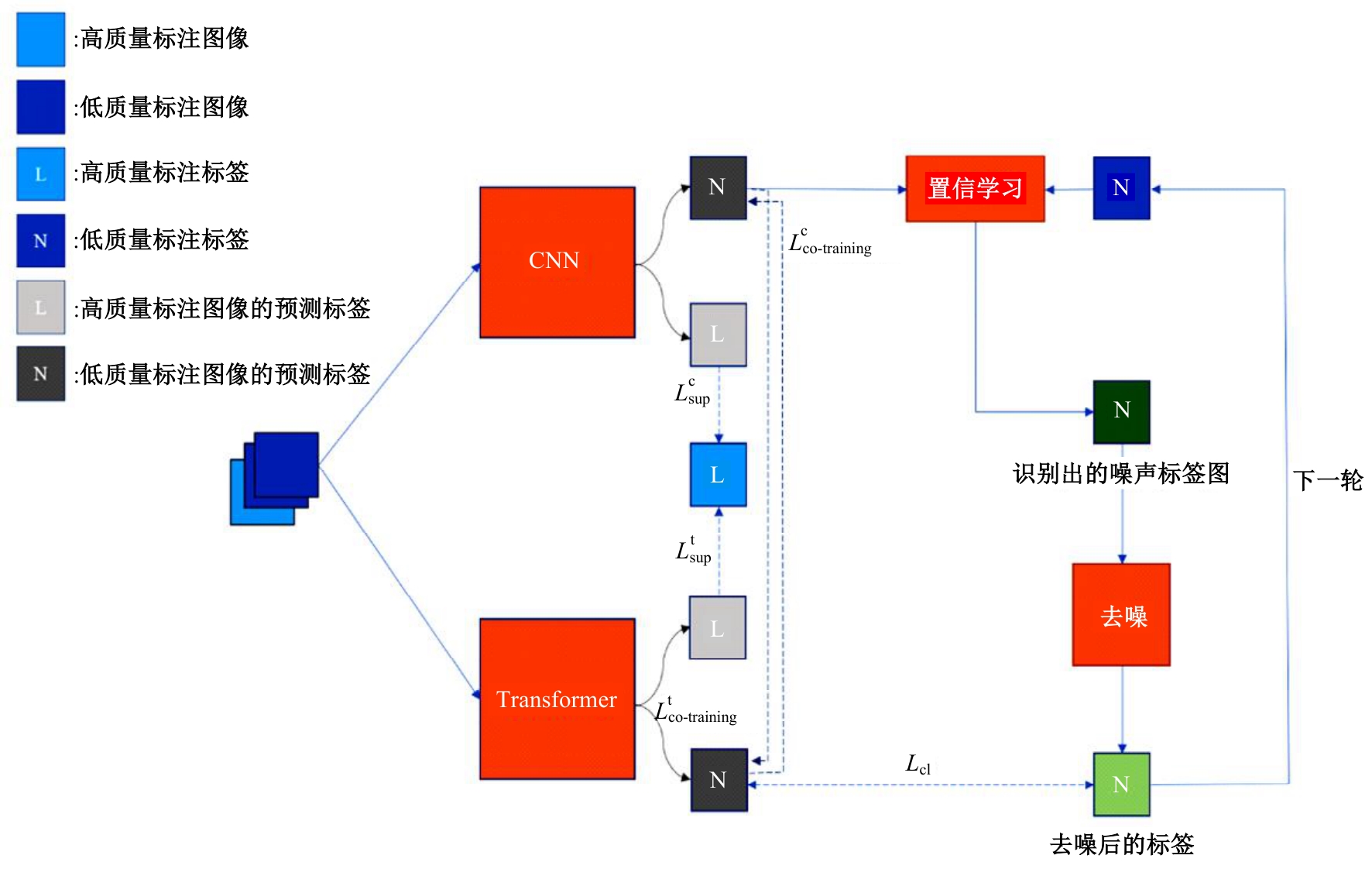
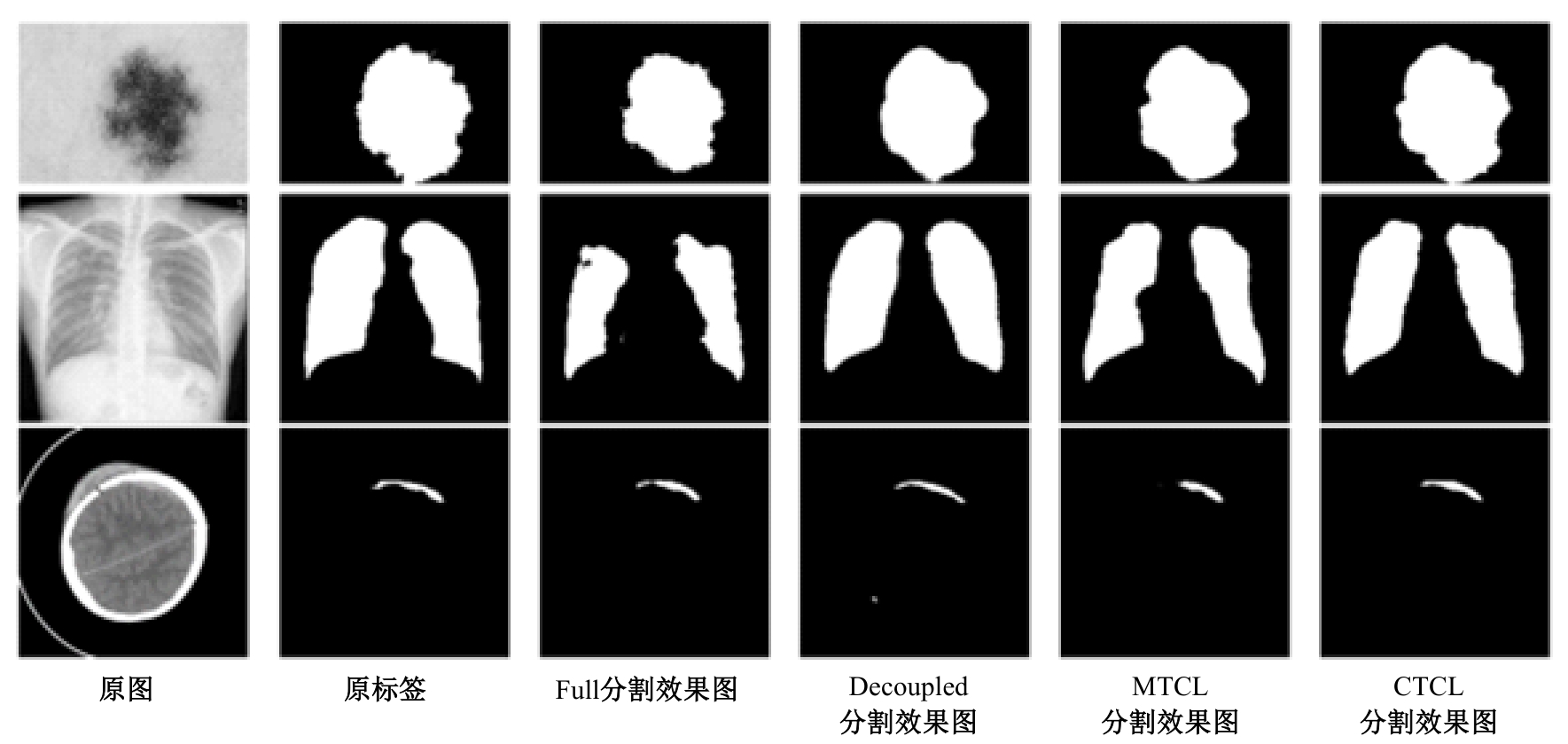
在医学图像低质量标注数据的训练中,置信学习发挥了重要的作用,但目前置信学习的应用均基于平均教师模型,并未探讨在其它网络上的可能性。针对该问题,提出了基于置信学习和协同训练的分割模型。该模型使用两个不同的网络,鼓励两网络的输出结果一致,接着将其中一网络的输出利用置信学习同原低质量标注进行对比,修正低质量标注数据从而使其提供有效训练参考。将提出模型在3个不同模态的医学图像数据集上进行对比,实验结果表明:提出模型的分割效果均优于已有的置信学习模型。
中图分类号:
- TP391

| [1] | Zhang Y, Lu Y, Chen W, et al. MSMANet: a multi-scale mesh aggregation network for brain tumor segmentation[J]. Applied Soft Computing, 2021, 110: 107733. |
| [2] | Zhou Y, Yu H, Shi H. Study group learning: improving retinal vessel segmentation trained with noisy labels[C]∥Medical Image Computing and Computer Assisted Intervention-MICCAI 2021: 24th International Conference, Strasbourg, France, 2021: 57-67. |
| [3] | 戴振晖, 简婉薇, 朱琳, 等. 基于3D UNet结合Transformer的肝脏及肝肿瘤自动分割[J]. 中国医疗设备, 2023, 38(1): 42-47. |
| Dai Zhen-hui, Jian Wan-wei, Zhu Lin, et al. Automatic segmentation of the liver and liver tumor based on 3D unet combined with transformer[J]. China Medical Devices, 2023,38(1): 42-47. | |
| [4] | Ren M, Zeng W, Yang B, et al. Learning to reweight examples for robust deep learning[C]∥International Conference on Machine Learning, Stockholm, Sweden, 2018: 4334-4343. |
| [5] | Goldberger J, Benreuven E. Training deep neural-networks using a noise adaptation layer[C]∥International Conference on Learning Representations, San Juan, Puerto Rico, 2016: 1-9. |
| [6] | Northcutt C, Jiang L, Chuang I. Confident learning: estimating uncertainty in dataset labels[J]. Journal of Artificial Intelligence Research, 2021, 70: 1373-1411. |
| [7] | Luo W, Yang M. Semi-supervised semantic segmentation via strong-weak dual-branch network[C]∥Computer Vision-ECCV 2020: 16th European Conference, Glasgow, UK, 2020: 784-800. |
| [8] | Xu Z, Lu D, Wang Y, et al. Noisy labels are treasure: mean-teacher-assisted confident learning for hepatic vessel segmentation[C]∥Medical Image Computing and Computer Assisted Intervention-MICCAI 2021: 24th International Conference, Strasbourg, France, 2021: 3-13. |
| [9] | Blum A, Mitchell T. Combining labeled and unlabeled data with co-training[C]∥Proceedings of the Eleventh Annual Conference on Computational Learning Theory, Madison, USA, 1998: 92-100. |
| [10] | Codella N, Rotemberg V, Tschandl P, et al. Skin lesion analysis toward melanoma detection 2018: a challenge hosted by the international skin imaging collaboration (isic)[J/OL]. [2023-07-23]. arXiv Preprint arXiv:. |
| [11] | Jaeger S, Karargyris A, Candemir S, et al. Automatic tuberculosis screening using chest radiographs[J]. IEEE Transactions on Medical Imaging, 2013, 33(2): 233-245. |
| [12] | Hssayeni M, Croock M, Salman A, et al. Intracranial Hemorrhage Segmentation Using a Deep Convolutional Model[J]. Data, 2020, 5(1): 1- 14. |
| [1] | 侯越,郭劲松,林伟,张迪,武月,张鑫. 分割可跨越车道分界线的多视角视频车速提取方法[J]. 吉林大学学报(工学版), 2025, 55(5): 1692-1704. |
| [2] | 申自浩,高永生,王辉,刘沛骞,刘琨. 面向车联网隐私保护的深度确定性策略梯度缓存方法[J]. 吉林大学学报(工学版), 2025, 55(5): 1638-1647. |
| [3] | 王友卫,刘奥,凤丽洲. 基于知识蒸馏和评论时间的文本情感分类新方法[J]. 吉林大学学报(工学版), 2025, 55(5): 1664-1674. |
| [4] | 王军,司昌馥,王凯鹏,付强. 融合集成学习技术和PSO-GA算法的特征提取技术的入侵检测方法[J]. 吉林大学学报(工学版), 2025, 55(4): 1396-1405. |
| [5] | 徐涛,孔帅迪,刘才华,李时. 异构机密计算综述[J]. 吉林大学学报(工学版), 2025, 55(3): 755-770. |
| [6] | 赵孟雪,车翔玖,徐欢,刘全乐. 基于先验知识优化的医学图像候选区域生成方法[J]. 吉林大学学报(工学版), 2025, 55(2): 722-730. |
| [7] | 车翔玖,武宇宁,刘全乐. 基于因果特征学习的有权同构图分类算法[J]. 吉林大学学报(工学版), 2025, 55(2): 681-686. |
| [8] | 蔡晓东,周青松,张言言,雪韵. 基于动静态和关系特征全局捕获的社交推荐模型[J]. 吉林大学学报(工学版), 2025, 55(2): 700-708. |
| [9] | 郭晓然,王铁君,闫悦. 基于局部注意力和本地远程监督的实体关系抽取方法[J]. 吉林大学学报(工学版), 2025, 55(1): 307-315. |
| [10] | 汪豪,赵彬,刘国华. 基于时间和运动增强的视频动作识别[J]. 吉林大学学报(工学版), 2025, 55(1): 339-346. |
| [11] | 刘元宁,臧子楠,张浩,刘震. 基于深度学习的核糖核酸二级结构预测方法[J]. 吉林大学学报(工学版), 2025, 55(1): 297-306. |
| [12] | 李路,宋均琦,朱明,谭鹤群,周玉凡,孙超奇,周铖钰. 基于RGHS图像增强和改进YOLOv5网络的黄颡鱼目标提取[J]. 吉林大学学报(工学版), 2024, 54(9): 2638-2645. |
| [13] | 赵宏伟,武鸿,马克,李海. 基于知识蒸馏的图像分类框架[J]. 吉林大学学报(工学版), 2024, 54(8): 2307-2312. |
| [14] | 张云佐,郑宇鑫,武存宇,张天. 基于双特征提取网络的复杂环境车道线精准检测[J]. 吉林大学学报(工学版), 2024, 54(7): 1894-1902. |
| [15] | 孙铭会,薛浩,金玉波,曲卫东,秦贵和. 联合时空注意力的视频显著性预测[J]. 吉林大学学报(工学版), 2024, 54(6): 1767-1776. |
|